
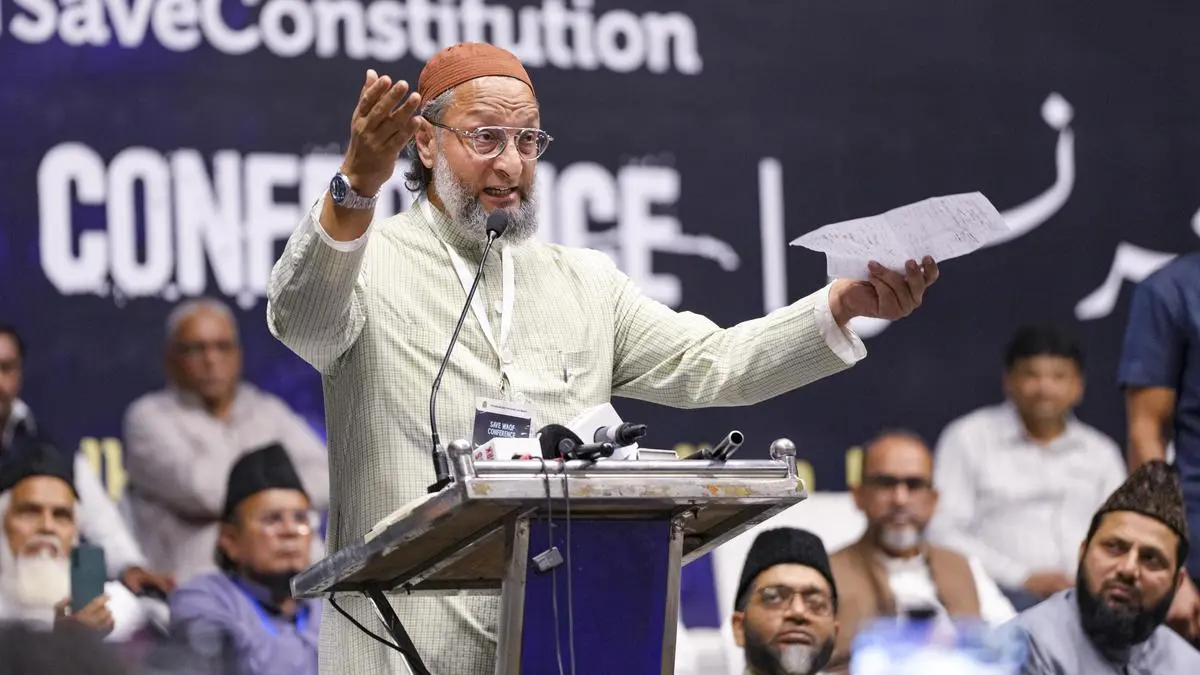

Since 2023, Asaduddin Owaisi’s party has been excluded by the opposition alliance. There is disagreement among Muslims on the ground over whether or not this exclusion is beneficial.
Representatives from 23 political parties attended a recent meeting of the INDIA bloc, which took place at Delhi’s Constitution Club. The purpose of the event was to draw attention to what opposition leaders see as the BJP’s methodical use of political tools and state institutions to limit the opposition’s influence in Indian politics. Projecting the coalition as a bulwark against communal polarization—which many believe has further split the nation along Hindu-Muslim lines—was another important goal.
The INDIA bloc portrays itself as a wide-ranging secular party alliance. However, the All India Majlis-e-Ittehadul Muslimeen (AIMIM), a party that likewise claims to support secular and constitutional ideals, has been conspicuously absent from this alliance since its creation on July 18, 2023. A crucial political question is raised by this absence: why has the AIMIM stayed outside the alliance in spite of its professed adherence to many of the ideals that the INDIA bloc promotes?
The INDIA bloc portrays itself as a wide-ranging secular party alliance. However, the All India Majlis-e-Ittehadul Muslimeen (AIMIM), a party that likewise claims to support secular and constitutional ideals, has been conspicuously absent from this alliance since its creation on July 18, 2023. A crucial political question is raised by this absence: why has the AIMIM stayed outside the alliance in spite of its professed adherence to many of the ideals that the INDIA bloc promotes?
The author visited various Islamic institutions and had in-person and telephone discussions with community members, Islamic scholars, and clerics in an attempt to comprehend Muslim sentiment regarding AIMIM’s ongoing exclusion and Asaduddin Owaisi’s changing political stance. The responses showed a wide variety of viewpoints, highlighting the lack of a single Muslim political voice and illuminating the discussions that influence Muslim political participation in India today.
The conflicting responses were scarcely unexpected. Approximately 60% of people surveyed still consider the AIMIM to be the BJP’s “B-team.” They contend that while being fully aware of the divisive political climate the BJP has created, where elections are increasingly framed along communal fault lines, the party has continuously refused to cooperate with national and regional opposition parties.
Owaisi and supporters of the AIMIM present an alternative interpretation. They contend that he is still one of the few political figures who openly discusses matters that impact Muslims both inside and outside of Parliament. For his followers, the more important question is not why the AIMIM wants to gain more seats, but rather why secular parties are unwilling to make room for it in seat-sharing talks. They question why the AIMIM alone should be seen as politically untouchable if coalition politics is based on inclusiveness and representation.
During these discussions, an equally clear comment surfaced. A number of respondents questioned whether secular parties’ reluctance is due to their concern about supporting the BJP’s claim that opposition politics is motivated by appeasing minorities. They contended that despite AIMIM’s stated dedication to constitutional and democratic principles, this has made their inclusion politically awkward.
One senior Islamic cleric offered a more considered assessment. While defending AIMIM’s right to expand its political footprint, he cautioned against the use of overtly religious symbolism and Islamic slogans as instruments of electoral mobilisation. Such an approach, he argued, risks blurring the distinction between faith and politics. Taken together, these perspectives reveal a deeper tension within contemporary Muslim politics: while there is no consensus on AIMIM’s role, there is broad recognition that the language of secular politics leaves limited room for overt religious mobilisation, regardless of which community employs it.
Owaisi at the crossroads
Today, Owaisi and the AIMIM stand at a political crossroads, watching the direction of India’s shifting electoral winds while waiting for the “B-team” label to finally fade. The debate gains further complexity when the credibility of the INDIA bloc itself comes under scrutiny. Critics often point to legislators from so-called secular parties who once accused the AIMIM of indirectly benefiting the BJP, only to later defect to the BJP themselves, abandoning both their parties and the positions they claimed to uphold. The contradiction becomes sharper in Telangana, where Owaisi shares a largely cordial relationship with the ruling Congress, yet is treated as a political outcast in the national arena. To his supporters, this reflects selective targeting; to his critics, it reinforces questions about his political strategy and broader electoral impact.
Many Muslims still find the matter extremely perplexing. The AIMIM portrays itself as a platform for autonomous Muslim political representation on the one hand. However, a sizable portion of the populace is still not persuaded that this approach successfully addresses the political difficulties and fears they have encountered throughout the BJP era. Therefore, the issue is not just about Owaisi but also about how Muslim politics in India will develop in the future.
The main question is whether Owaisi would eventually become more relevant outside of identity-based politics and adopt political pragmatism, similar to the Indian Union Muslim League in Kerala, which has sought accommodation within wider opposition coalitions. Alternatively, he might continue to follow an autonomous course focused on Muslim political assertion, even if it means staying cut off from more extensive secular partnerships.
In the end, electoral realities—rather than television debates or social media—will decide Owaisi’s strategy. It is up to the voters to decide whether AIMIM becomes a bridge to increased political representation or stays on the periphery.