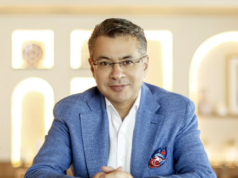



Kabir Mulchandani has never positioned FIVE as a conventional luxury hotel company. Its properties are designed as stages for a high-energy lifestyle, where rooms, restaurants, pools, clubs, branded residences and music reinforce one another. That clarity has made the business distinctive in a crowded hospitality market.
Born in Mumbai, Mulchandani began his career in his family’s consumer-electronics business before moving into entrepreneurship and real estate. He founded the company that became FIVE Holdings as SKAI in the early 2010s, initially focusing on Dubai property and hospitality development. In 2017, the group adopted the FIVE name and sharpened its identity around entertainment-led luxury.
FIVE Palm Jumeirah became the defining proof of concept. Instead of separating hotel operations from nightlife, the property used music, restaurants and social spaces to drive occupancy, food and beverage revenue and global visibility. FIVE Jumeirah Village and FIVE LUXE extended the model in Dubai, while FIVE Zurich and Ibiza assets demonstrated that it could travel beyond the UAE.
The transformative move came in 2023, when FIVE acquired The Pacha Group for about $333 million. The transaction brought one of nightlife’s most recognisable brands, along with Pacha Ibiza, Destino and related entertainment assets, into the portfolio. It gave Mulchandani an established cultural platform rather than requiring FIVE to build recognition market by market.
By 2025, Forbes estimated FIVE’s assets at about $3 billion and revenue at more than $600 million. The group has pursued expansion in the United States and Asia, supported by a $460 million revolving credit facility completed in 2025. Pacha New York, opened in 2026, represents an important test of whether the ecosystem can compete in one of the world’s most demanding entertainment markets.
Mulchandani’s business model has several reinforcing economics. Branded residences can help finance development. Entertainment and dining generate local demand beyond hotel guests. Music programming creates content and social reach. Direct relationships with a young, affluent customer base can lower reliance on traditional distribution. The result is closer to an integrated media and lifestyle company than a room-led hotel operator.
The progression from his family’s consumer-electronics business to SKAI and then FIVE also reveals a marketer’s instinct. Consumer technology taught him that aspiration, rapid product cycles and retail theatre can carry as much weight as specifications. FIVE applies the same lesson to hospitality. The room is only one component of a brand assembled through sound, social spaces, fashion cues and highly shareable moments. That makes the proposition commercially potent, but dependent on constant cultural relevance.
Sustainability is an unexpected but increasingly prominent part of the proposition. FIVE says its carbon footprint is materially below the average of comparable UAE luxury hotels and has used green finance to support its growth. The company has invested in renewable electricity, efficient buildings and detailed carbon reporting. The tension between high-consumption entertainment and environmental claims will invite scrutiny, but measurable performance gives the group a stronger basis than marketing language alone.
The brand’s intensity is also a risk. A concept built around nightlife can be polarising, vulnerable to shifts in taste and difficult to adapt to cities with different regulations or social norms. Mulchandani must preserve Pacha’s heritage while integrating it with FIVE, and expand without turning a distinctive experience into a formula.
That makes creative governance as important as financial control. Pacha must feel inherited, not merely acquired.
His leadership has been entrepreneurial rather than incremental. He identified a customer segment underserved by traditional luxury, created a product around its behaviour and then acquired an international brand capable of accelerating growth. In doing so, he has helped change how the region thinks about hotel demand. A guest may choose a property not as a place to sleep near the experience, but because the hotel is the experience.