
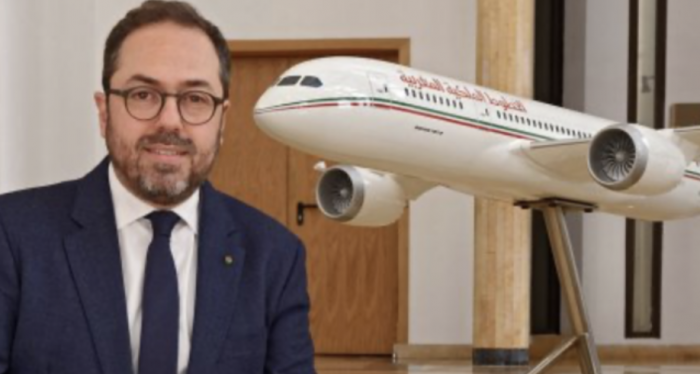


Royal Air Maroc occupies a strategic position that few airlines can replicate. From Casablanca, it can connect Europe, West and Central Africa, the Americas and the Middle East while carrying Morocco’s brand into international markets. Abdelhamid Addou has led the airline since his appointment as chairman and chief executive in February 2016.
Addou arrived with experience across tourism and business. He previously led the Moroccan National Tourism Office from 2008 to 2012, giving him direct knowledge of source markets, airline development and the connection between seat capacity and visitor demand. That background has informed his approach to Royal Air Maroc as an instrument of national tourism as well as a commercial airline.
At the tourism office, he worked on Morocco’s Vision 2010 programme and the international promotion required to support new hotel and resort investment. Moving to the airline placed him on the supply side of the same equation. Instead of requesting more seats from carriers, he became responsible for the economics of operating them, including aircraft utilisation, crew, fuel, bilateral rights and the commercial performance of individual routes.
His first decade at Royal Air Maroc included entry into oneworld, recovery from the pandemic and the negotiation of a new long-term programme contract with the Moroccan state. That agreement frames the airline as infrastructure for tourism and African connectivity, but it also raises expectations around fleet, service and financial performance. Addou must ensure that public strategic objectives do not weaken route discipline or leave the carrier carrying capacity that cannot earn an adequate return.
By July 2026, the carrier operated 67 aircraft and served 86 international destinations: 44 in Europe, 29 in Africa, seven in the Americas and six across Asia and the Middle East. The distribution shows the importance of Europe, but also the airline’s distinctive African reach.
Fleet renewal is central to the next stage. In January 2026, Royal Air Maroc agreed to lease 13 Boeing 737 MAX 8 aircraft from Dubai Aerospace Enterprise, with deliveries scheduled from 2027. New narrowbody capacity can increase frequency, improve efficiency and support expansion across Europe and Africa. It also requires careful planning around training, maintenance and route profitability.
Partnerships extend the network without requiring aircraft on every route. Royal Air Maroc joined oneworld in 2020, becoming the alliance’s first full African member. A 2025 codeshare agreement with Malaysia Airlines linked Casablanca and Kuala Lumpur through Doha, London and Paris, illustrating how alliances can open demand flows beyond the carrier’s own map.
Addou’s tourism experience will be especially valuable as Morocco prepares to co-host the 2030 FIFA World Cup. The tournament will generate a temporary surge, but the larger opportunity is lasting connectivity. Aircraft, airport capacity and international awareness can support tourism long after the final match if routes are commercially sustainable.
The airline must also maintain its role across Africa. Casablanca can be a gateway for travellers moving between African cities and long-haul destinations, but competition from European, Gulf and African hubs is intense. Schedule design and transfer quality are as important as route count.
Operational resilience remains a constant concern. Aircraft delivery delays, fuel prices, currency exposure and regional disruption can alter plans quickly. Expansion must therefore be supported by a stronger balance sheet and consistent service, particularly when passengers have multiple connecting options.
The 2030 tournament will make this balance more visible. Short-term capacity can be leased or added for peak demand, but aircraft and crews are long-duration commitments. Addou must separate temporary event traffic from routes capable of performing after the tournament. Done well, the World Cup becomes a catalyst for a stronger network. Done poorly, it can leave an airline with costs that outlast the demand surge.
Addou’s career connects destination marketing with airline execution. He understands that tourism campaigns are limited without seats, while airline capacity underperforms without compelling demand. His task is to keep Royal Air Maroc commercially disciplined while preserving its wider role as Morocco’s bridge to Africa and the world.