


AlUla cannot be marketed like an ordinary resort. Its value lies in a cultural landscape formed over millennia, including Hegra, Saudi Arabia’s first UNESCO World Heritage Site, an ancient oasis, dramatic geology and living communities. Rami Almoallim must convert that significance into visitation without allowing demand to overwhelm the place.
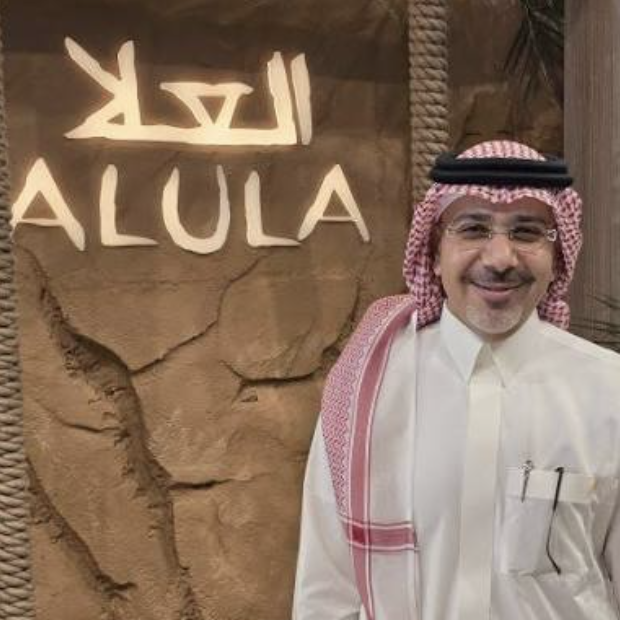
Almoallim became vice president of destination management and marketing at the Royal Commission for AlUla in March 2023. His career spans more than two decades and includes experience with Saudia in ground-handling agreements and communications work connected to Saudi ports, followed by senior roles across marketing and destination development.
Those early transport roles gave him a useful understanding of how destinations depend on systems beyond their own control. Ground-handling agreements determine whether an airline operation can function reliably, while ports must coordinate infrastructure, operators and government stakeholders. At AlUla, the equivalent challenge is to connect air access, accommodation, guiding, events and conservation into a visitor journey that feels simple even when the organisation behind it is complex.
His remit combines marketing with destination management, an important design choice. If the two functions were separated, campaigns could create demand that the destination was not ready to receive. Almoallim can use capacity, visitor-flow and satisfaction data to adjust promotion, while operating feedback can shape the markets and seasons the commission prioritises. That makes him accountable for conversion and experience, not only awareness.
By 2025, AlUla welcomed 318,917 domestic and international visitors. The figure is deliberately modest beside high-volume destinations. Capacity, heritage protection and the quality of experience matter more than rapid scale. Almoallim’s role is therefore as much about managing demand as creating it.
The destination has built a calendar around culture, music, wellness, sport and astronomy, giving visitors reasons to travel across different seasons. Luxury hotels and camps provide accommodation, but the broader journey includes heritage interpretation, guided nature experiences, restaurants, art and encounters with the oasis and old town.
Scientific research strengthens the proposition. In January 2026, the commission announced the documentation and international publication of a 465-million-year-old horseshoe crab fossil discovered in the Gharameel Nature Reserve. Work of this kind expands AlUla’s story beyond archaeology and creates a reason for universities, researchers and curious travellers to engage with its natural history.
Marketing must remain evidence-led. International awareness can be generated quickly through spectacular imagery and events, but access, room supply and guide capacity must keep pace. If campaigns create demand for dates when the destination is full or climatically challenging, the result can be frustration rather than value.
Community participation is essential. Local guides, farmers, artisans, hospitality workers and entrepreneurs need routes into the visitor economy. Without that connection, tourism risks presenting AlUla’s culture while excluding the people who sustain it. Destination management must therefore coordinate training, licensing, product development and visitor behaviour.
Almoallim also faces the task of converting first-time curiosity into advocacy. Many travellers arrive with high expectations shaped by dramatic images of Hegra and Maraya. The quality of booking, arrival, transport, interpretation and service determines whether the destination feels coherent beyond its landmarks.
Visitor yield is therefore a more useful measure than volume alone. Longer stays, guided experiences, local purchases and repeat seasonal travel create more value without placing the same pressure on sensitive sites as unrestricted day visitation. Almoallim can influence that equation through itinerary design, timed access, market selection and the balance between major events and smaller year-round experiences.
His work captures the central challenge of contemporary cultural tourism. Success is not the highest possible visitor number. It is the right number, distributed across suitable seasons and experiences, generating enough value to fund conservation and create opportunity. Almoallim’s career in transport, communications and destination strategy gives him a useful combination for managing that balance.