
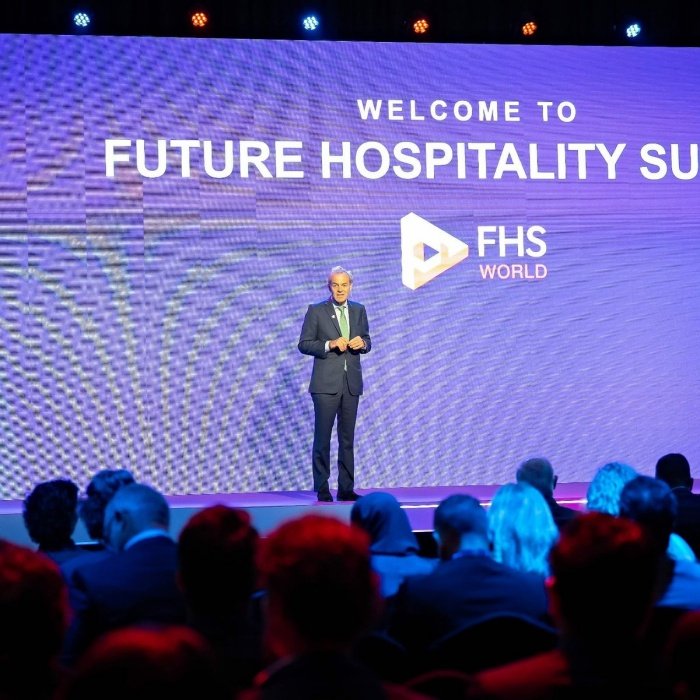


The second day of FHS World 2026 in Dubai brought together some of the hospitality sector’s most influential investors, operators, policymakers and innovators, with discussions ranging from longevity and wellness to artificial intelligence, investment strategy, food security and the changing relationship between hotel owners and operators.
Across 25 sessions, a consistent message emerged: hospitality is entering a period in which access to capital and technology alone will not determine success. The industry’s next phase will depend increasingly on disciplined investment, resilient destinations, stronger organisational cultures and the ability to use technology to enhance — rather than replace — the human experience.
UAE sets sights on 40 million tourists
One of the day’s major moments came as H.E. Abdulla bin Touq Al Marri, UAE Minister of Economy and Tourism, received the FHS Leadership Award.
Addressing delegates, Al Marri outlined the scale of the UAE’s tourism ambitions, including a tourism economy targeting AED450 billion and 40 million tourists by 2031.
He also highlighted longevity, medical tourism and the rapidly developing silver economy as areas offering significant potential for future investment.
“Longevity and medical tourism is really picking up, and that’s something that I would probably bet on,” Al Marri told the audience.
The discussion reflected a much broader theme running throughout FHS World: wellness is moving beyond the traditional hotel spa to influence the design of hotels, residences and entire destinations.
Longevity moves to the centre of luxury hospitality
Christopher Sanderson, Co-Founder and Chief Creative Officer of The Future Laboratory, described longevity as potentially transforming luxury hospitality from a provider of temporary escapes into a long-term partner in guests’ lives.
“Longevity is shifting luxury hospitality from a provider of escapes to be a partner in life. But the right to play that role needs to be earned,” he said.
Sonu Shivdasani, CEO and Founder of Sosei, brought a particularly personal perspective to the discussion, drawing on his experience of stage-four lymphoma and its recurrence to argue that hospitality has an opportunity to become more deeply involved in genuine health transformation.
Meanwhile, Amit Arora and Faik Al-Haddadin of Arada examined the practical challenges of incorporating precision wellness into real estate from the earliest stages of development.
The commercial case is also becoming increasingly compelling. Discussions during the day highlighted wellness-branded residences commanding premiums of around 30 per cent, while guests at wellness-led properties were reported to stay an average of five days longer.
The scale of the opportunity in emerging markets was also underlined by Varun Kapur of Kapur & Partners Family Holding, who noted that Africa represents only around $500 million of an estimated $860 billion global wellness real estate market.
Hotel owners demand greater investment discipline
Investment strategy formed another major pillar of the programme.
Alain Debare of HVS Middle East and Africa and Vijay Raghavan of Golden Sands Hotel Co. LLC examined the true cost of hotel management agreements, arguing that owners need to look well beyond headline management fees.
Reservations, loyalty programmes, sales and marketing, technology and central services can all add substantially to an operator’s overall cost. The message for owners was therefore to measure the complete operator cost against the total return being delivered by the property.
The operating model itself is also changing.
Bruno Trenchard of Accor said 60 per cent of regional openings during the previous year had been conversions, while discussions around franchise and third-party operating models suggested the GCC could move further towards structures already commonplace in more mature hotel markets.
Franchise and third-party operator penetration was put at only 10–20 per cent of regional branded supply, compared with approximately 80 per cent in the United States.
Neil George of Aleph Hospitality said more than half of his company’s lead pipeline now comes from brands, illustrating how relationships between international brands and third-party operators are evolving.
AI changes how travellers discover hotels
Artificial intelligence inevitably featured prominently, but some of the most important conversations moved beyond the question of whether hospitality should adopt AI towards how the technology should actually be deployed.
Terry Kane, Managing Director of The Trade Desk, argued that traditional search is losing its position as the starting point of the traveller journey.
“Search is no longer my start point. Search is no longer your start point,” Kane said.
The discussion introduced Generative Engine Optimisation (GEO) as an emerging successor to conventional SEO, as consumers increasingly use generative AI platforms to research destinations, hotels and travel experiences.
For hospitality brands, this could have significant implications. Visibility will increasingly depend not simply on ranking highly for keywords but on whether AI systems understand a brand, regard its information as authoritative and surface it when travellers ask questions.
Fasie Malherbe, CEO of Smart Operator, approached AI from the operational side, demonstrating technology designed to give frontline employees hands-free access to live information in 89 languages.
His argument was that AI should strengthen the role of hospitality employees rather than eliminate it.
“Artificial intelligence plus human intelligence equals operational super intelligence,” Malherbe said.
Tourism growth meets a more challenging investment environment
UN Tourism brought a global perspective to the programme.
The organisation reported global tourism receipts of $1.9 trillion in 2025, although the outlook for arrivals has become more cautious. Its 2026 global arrivals forecast has been revised from 3–4 per cent growth to 1–3 per cent, while the Middle East recorded a 14 per cent decline in the first quarter amid regional conflict.
At the same time, governments across the GCC continue to deploy enormous amounts of capital into tourism and related infrastructure.
Figures presented during FHS World put commitments at $120 billion for Saudi Arabia, $31 billion for Oman, $27 billion for the UAE and $22.5 billion for Qatar.
Samer Alkharashi, Director of the UN Tourism Regional Office for the Middle East, nevertheless warned that infrastructure investment on its own would not be sufficient.
“Will we invest only for the next project, or will we invest for the next generation?” he asked.
That question is becoming particularly relevant as destinations compete for a smaller pool of international investment. The report highlighted that global greenfield foreign direct investment in tourism fell from $217 billion during 2014–2019 to $81 billion during 2020–2025.
Food security becomes part of tourism resilience
FHS World also widened the conversation around what constitutes a resilient tourism economy.
Atul Chopra of FreshOnTable and Hassan Halawy, Group CEO of Elite Agro Holding, examined food security and the importance of building domestic and regional supply capacity rather than assuming financial wealth can guarantee access to food.
Halawy pointed to successful trials of Arabica coffee, vanilla, cocoa and tea as evidence of the UAE’s growing agricultural capabilities.
“There’s nothing that we cannot produce locally,” he said.
For hotels and destinations, the debate increasingly connects food production with sustainability, supply-chain resilience and the development of stronger local supplier ecosystems.
Culture could become hospitality’s ultimate differentiator
For all the discussion around AI, investment and technology, the closing sessions repeatedly returned to people.
Carlos Diez de la Lastra, CEO of Les Roches Global Hospitality Education, argued that technology will eventually become accessible to virtually every operator, making it increasingly difficult to use technology alone as a competitive advantage.
“The big difference between the brands that they want to charge €1,500 per room night and the other brands that they want to charge 300 — the big difference will not be the technology,” he said.
“Technology is a commodity. It will be in the people, the culture that you are creating around your asset or your brand.”
The human element extended to leadership itself.
David Singleton of Oraculi and executive performance coach David Labouchere OBE explored sustainable high performance, including the consequences of executives making major decisions while severely sleep deprived.
Renata Liuzzi of Accenture Middle East and Agnès Roquefort, Chief Development Officer Luxury & Lifestyle at Accor, meanwhile focused on female leadership and the importance of actively seeking opportunities, promotions, salary discussions and representation within the industry.
Hospitality enters its next investment cycle
If the first decades of the Gulf’s hospitality expansion were characterised by rapid development, landmark properties and the arrival of the world’s largest hotel brands, FHS World 2026 suggests the next stage will be more complex.
Investors are scrutinising returns more closely. Owners are questioning traditional management structures. Wellness is becoming embedded in real estate rather than added after construction. AI is changing both hotel operations and the way travellers discover brands. And destinations are being challenged to demonstrate resilience, sustainability and a compelling investment case before development begins.
Yet the strongest message emerging from the second day of FHS World was also one of the simplest.
Technology may become ubiquitous and capital can build extraordinary assets, but hospitality ultimately remains a people business.
For the industry gathering in Dubai, the opportunity now lies in combining all three — capital, technology and human leadership — to create a more resilient and valuable hospitality sector for the next generation.