
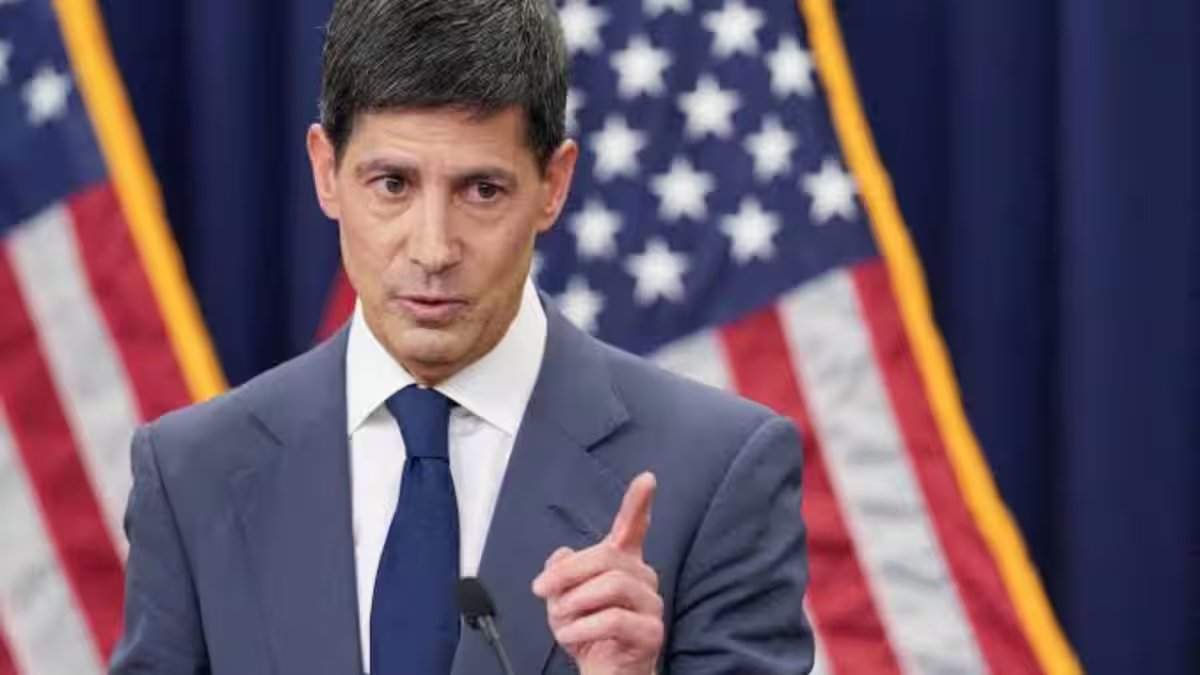

Federal Reserve Chair Kevin Warsh defended the central bank’s rate decision, saying inflation has remained above target for too long and recent data have not shown enough improvement to shift the Fed’s focus away from price stability.
The Federal Reserve raised interest rates by 25 basis points on Wednesday, with Chair Kevin Warsh signalling that persistent inflation will remain at the heart of monetary policy even as the US economy shows signs of renewed strength.
“The plain fact is that inflation is too high and has been for too long,” Federal Reserve Chair Kevin Warsh said after the US central bank raised interest rates by 25 basis points, making clear that persistent price pressures remain at the centre of the Fed’s policy debate.
Warsh said the decision came as the US economy appeared to be strengthening, with hiring, private-sector earnings and business capital investment all improving in recent months. But he argued that the progress on the economy and labour market had not been matched by sufficient improvement in underlying inflation.
“For more than five years, inflation has been running above target. So our predominant focus is on the price stability side of our mandate,” Warsh said.
No signal on what comes next
Warsh also declined to offer guidance on the Fed’s next move, repeatedly stressing that policymakers would assess incoming data rather than commit to a predetermined path.
“My business is not to give any forward guidance,” he said, adding that he was “not going to prejudge” future decisions.
The Fed chair said the latest inflation readings did not provide enough evidence that underlying price pressures were moving decisively towards the central bank’s objective.
 More from Business
“This summer’s inflation readings do not tell me that underlying trends have meaningfully improved,” Warsh said, pointing to the number of categories in recent CPI and PPI data that continued to record increases above 3 per cent over six- and 12-month periods.
“We must be confident that underlying inflation is moving to our objective, clearly and at sufficient speed,” he said.
Oil prices and second-round effects
Warsh acknowledged that the Fed cannot directly control individual prices, including oil and food prices, but said its responsibility was to prevent temporary or relative price shocks from spreading through the wider economy.
“We cannot affect any individual price, whether it be oil prices, whether it be foodstuffs at the grocery store,” he said.
“What we can do and will do is ensure that any change in relative prices don’t broaden out, don’t have second and third order effects in the economy.”
‘We stay in our lane’
Asked about pressure from President Donald Trump, Warsh declined to discuss any conversation with the president.
“I’ve got nothing for you on a discussion with the president,” he said.
Warsh also defended the Fed’s independence, saying policymakers should remain focused on the mandate given to them by Congress.
“Part of the independence of the Federal Reserve is we stay in our lane,” he said. “Independence is a two-way street.”
Focus on lower-income Americans
Warsh said stable prices were particularly important for Americans who do not own significant financial assets and depend primarily on wages.
“Those who are least well off have the most to gain from a durable expansion, a solid labor market, and stable prices,” he said.
He said the Fed’s objective was to determine whether the economy was around full employment while ensuring price stability, ultimately protecting people’s real take-home pay.
The rate decision, Warsh said, was therefore a “sober”, “serious” and “responsible” step aimed at fulfilling the Fed’s price-stability mandate, while leaving future policy decisions open to incoming economic data.