

Nothing gives a better idea of what Madras was like 80 years ago than scenes from the film En Manaivi, released in 1942. Indian medicine specialist Vembu Iyer, played by the late T.R. Sarangapani, tells his friend and patient that he moved from Pattanam (Mylapore) to the village of Kodambakkam to prevent his wife from visiting her relatives regularly.
The film begins with the arrival of a train at Kodambakkam railway station, surrounded by trees, waterbodies, and houses set amid paddy fields. In 84 years, Kodambakkam — or Kollywood, the heart of Tamil cinema — has changed beyond recognition. So has the Tamil film world.
The film was produced by A.V. Meiyappan, who established the AVM studio in Vadapalani on 10 acres of land that once housed a tannery. He bought the land for ₹37,500, a princely sum in those days.
He constantly experimented with filmmaking and was among the first to achieve post-synchronisation when the required technology was not available. In the film Sri Valli, when the heroine, Kumari Rukmini, could not match the pitch of the hero, T.R. Mahalingam, Meiyappan recorded the songs in the voice of playback singer Periyanayaki.
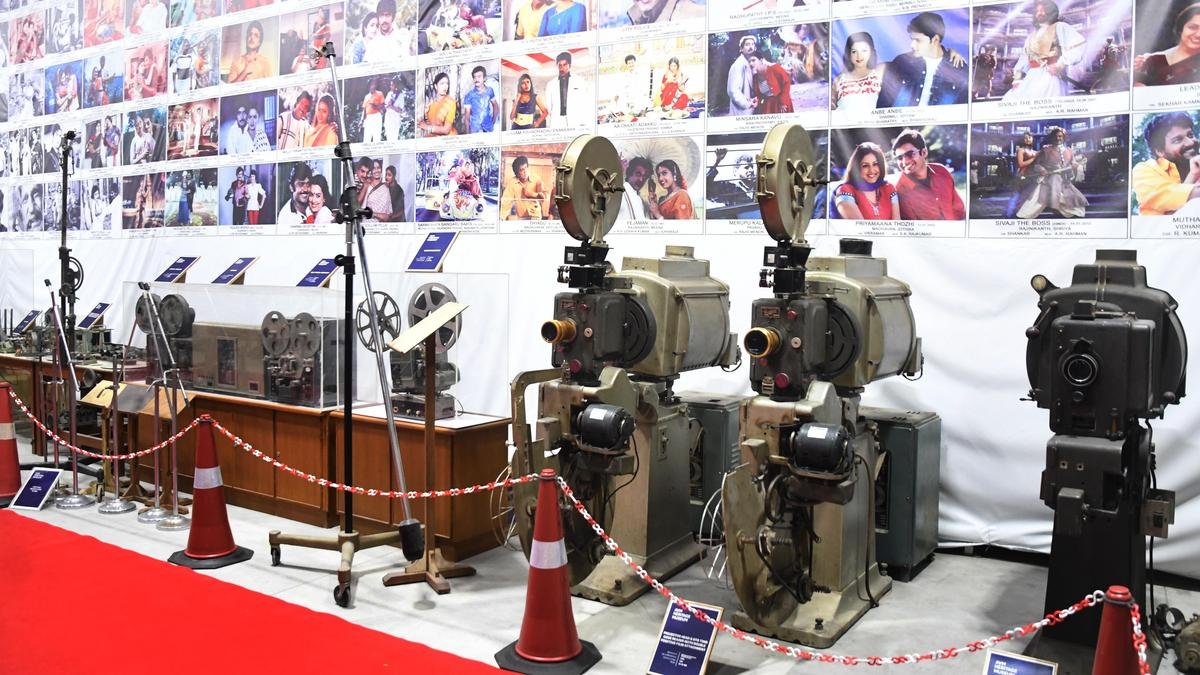
In his memoir, Enadhu Vaazhkai Anubhavangal, he writes that his experiment was a phenomenal success, and that the film — produced on a budget of ₹2 lakh in 1945 — earned a tenfold profit. He introduced the latest technology and imported the U.S.-made Mitchell 35 mm camera, which is preserved at the AVM Heritage Museum, offering a glimpse into the sweeping changes embraced by the film world.
Who would have thought that cinemas that once ran with a single projector — with four breaks as there was no second projector to keep the entire film ready for screening — would adapt to IMAX, even though they have fallen on hard times with the advent of exclusive film channels and OTT platforms?
Even filmmaking has undergone great changes — from shooting thousands of feet of film to embracing digital technology. Writer Ashokamitran, in My Years with Boss at Gemini Studios, recalls how thousands of feet of film shot for Avvaiyar were trimmed to create the final product. “Vasan (the boss) sat down to select from the miles of footage — only in films can the footage be in miles. He sat for hours viewing the projection of all that had already been shot, while his editors stood by with scissors and splicers. Every time he closed his eyes, a thousand feet were cut. He streamlined the multi-styled rendering, freshly shot, and inserted connecting links from scene to scene, gave a truly poetic beginning to the film, and ended it with a spectacular ‘ascent to the heavens’ finale,” he writes.
But Meiyappan dispensed with the practice of shooting 20,000 feet of film and inserting over 50 songs, and began making shorter films. When he released Naam Iruvar, S.S. Vasan congratulated him on making a good film in a small town without sophisticated equipment.
Cinematographer-turned-actor M. Ilavarasu said the primitive Mitchell camera, due to its pull-down claw and pin registration, could shoot only up to 24 frames per second (fps), both forward and reverse. It gave way to the German Arriflex 2C and 2BV, which, designed with pressure pad registration, could shoot up to 48 fps. But this was not suitable for masking double action shots. Later came Mitchell high-speed cameras with 144 fps, but they were not popular in India, he said.
“In the early days, the Mitchell camera was the non-reflex type, with a rack-over viewfinder; camerapersons could start shooting only after plenty of rehearsals as they could not see through the viewfinder while filming. The Arriflex 2C and 2C BV are high-speed cameras capable of shooting 48 fps, but with a fixed viewfinder,” he, who worked with Stills Ravi and cinematographer Kannan, the cinematographer of Bharathiraja, before working as a cinematographer for 11 films between 1991 and 2005, said. Subsequently, filmmakers imported Arriflex 3C and Arri 3 with rotating viewfinders, and much later, the Arri 435, whose viewfinder could be shifted to the other side for left-eyed camerapersons, he added.
The film reels, stored in boxes (petti), were transported across the State to cinema halls for release/screening in the past. “Potti vanthuruchu, potti vanthuruchu,” the chorus in the film Aan Paavam after the arrival of the reels in a box, recalls the years when films were made on the expensive celluloid.
Writer Perumal Murugan, in his memoir Nizhal Mutrathu Ninaivugal, recorded how multiple theatres would screen the same film by quickly dispatching the reels to another after a screening. Any delay would anger the audience, who would be eagerly waiting to watch the next part of the film.
“My Vaathiyar (mentor) Balu Mahendra used to tell me how careful he had to be while using film for shooting. He recalled the days when he worked as a cinematographer on the film Chattakari (1974), directed by K.S. Sethumadhavan, who would touch his shoulder while saying ‘cut’,” recalled writer and director Suka.
But today, digital technology has revolutionised filmmaking, and cinematographers and directors can experiment with any number of takes until they are completely satisfied.
“Digital cameras allow 120 fps and come with an additional monitor that lets a third person supervise the production while the cameraperson focuses on the viewfinder,” Mr. Ilavarasu said. Nowadays, films are sent in the file format for screening, with amazing sound effects.
Theatres have survived all odds to become one-stop destinations — they sell everything and allow online ticket booking, making the rush to buy tickets and the beeline to the canteen for a cup of tea, goli soda, a thattu murukku or a bun, things of the past.
Published – August 25, 2026 12:40 am IST