
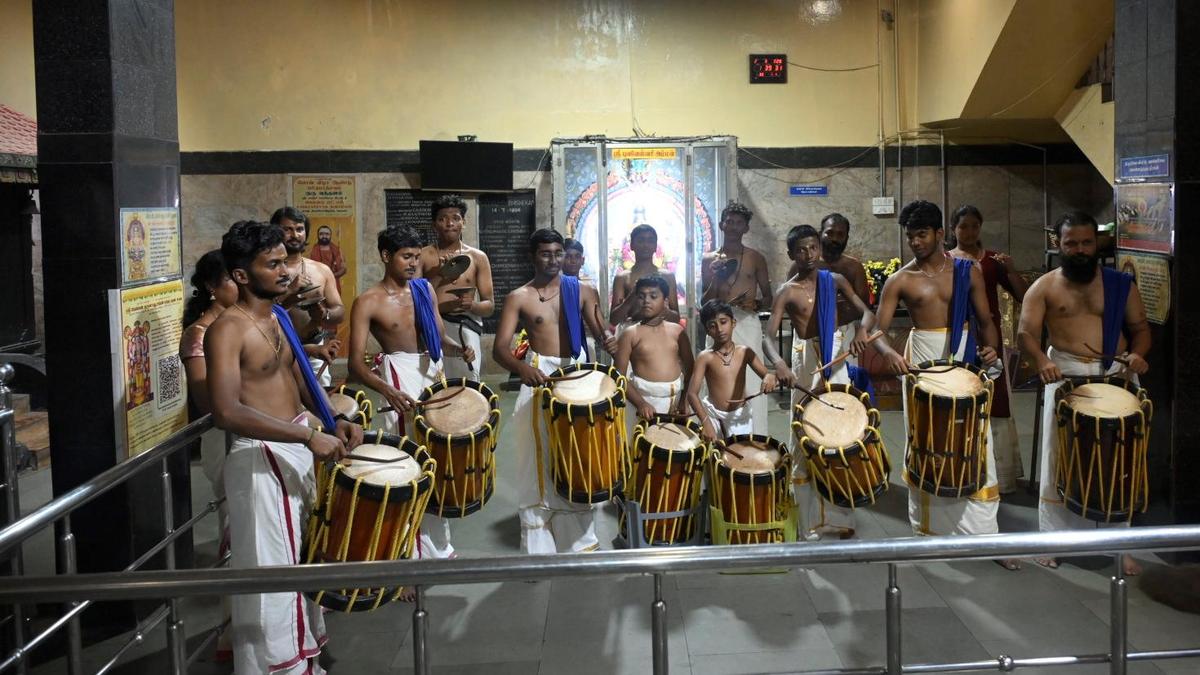

As Onam approaches, the thunderous rhythms of Chenda Melam evoke the sounds of Kerala’s temple festivals. In Chennai’s Villivakkam, Sri Sastha Kshetra Vadya Sangam at Ayyappan Kovil, has been keeping the tradition alive and accessible through free Chenda classes that attract learners across generations.
The institution was founded by Rajeev Kumar, whose association with the temple began in his childhood. His father, C.N. Sukumaran Guruswamy, founded the Villivakkam Ayyappan Temple. The idea for the institution emerged during preparations for the temple’s second Kumbhabhishekam in 2013, when Rajeev’s father expressed a desire to have an in-house Chenda troupe, as bringing teams from Kerala was expensive. Inspired by the idea, Rajeev decided to learn the Chenda. He trained under guru Devaraj Marar for two years.
Though Rajeev was fortunate to have found a guru in the city, the experience made him realise how difficult it was for aspiring Chenda players in Chennai to receive a formal training. “Not everyone can afford to travel to Kerala and stay there to . “That bothered me, and I decided to start an institution,” says Rajeev.
Rajeev, under the guidance of his father, established Sri Sastha Kshetra Vadya Sangam as a charitable trust with a simple objective: make Chenda Melam accessible to anyone interested in learning it, regardless of gender or language. Rajeev teaches in Tamil, English and Malayalam, and says offering free classes remains integral to the institution’s purpose. “We don’t run this organisation for money. We run it as a service,” he says.
New students begin with Chembada Thalam, which Rajeev describes as a basic form. Then, they progress to Panchaari Melam and Adantha Melam. Rajeev says learning the basics takes around four to five months. An arangetram is held for the students every December. The institution is preparing for its 10th batch in 2026 and has so far had nearly 150 students.

Rajeev Kumar and his team during a training session.
| Photo Credit:
Johan Sathyadas J
The learners include young boys and girls, and even middle-aged men and women. Shankar A. and R. Karthick conduct the Chenda classes, while S. Surendar organises events, teams and manages various activities.
For Shankar, teaching involves breaking the course into smaller sections so students can understand and practise each part before putting them together. Regular practice, he adds, helps improve concentration and makes lessons easier to learn.
Rhythm is central to Chenda Melam. Rajeev explains that the tala used is similar to what is used in Carnatic percussion. Rhythm lies at the heart of Chenda Melam. Rajeev explains that its rhythmic structure is similar to that of Carnatic percussion, though the presentation differs. The performance incorporates a range of talas, including Chembada, Adantha and Panchaari, each contributing to its distinctive sound
Chenda Melam brings together a range of instruments, including the chenda, ezhathalam, kombu, idakka and kuzhal, with diverse talas and rhythmic patterns forming its musical framework. The institution’s efforts, says Rajeev, have been sustained by the positive response from both students and parents. “Once the training is completed, we take our students to perform at festivals and events across Chennai,” he adds.
Younger learners say they were first drawn to the instrument’s powerful sound. Ten-year-old T. Nikhil, who has already completed his arangetram, recalls being fascinated with the chenda when he saw it being played at the temple. “I now enjoy playing it,” he says. Eight-year-old Jeevitesh shares a similar story.
The institution has also given women an opportunity to learn an art form that was not always accessible to them. Says 49-year-old Sini Sreekrishnan, “I wanted to learn it since childhood. Whenever I pick up the instrument and play, I am transported to Kerala.” She also appreciates the inclusive environment at the Sangam. “There is no discrimination on the basis of gender or age here.”
As Onam approaches, the work at Sri Sastha Kshetra Vadya Sangam in Villivakkam offers a reminder that Kerala’s musical traditions can thrive well beyond the State’s borders. By creating opportunities for people of all ages and backgrounds to learn and perform, it is ensuring that the resonant rhythms of Chenda Melam continue to find new audiences and practitioners.
Published – August 24, 2026 04:14 pm IST