

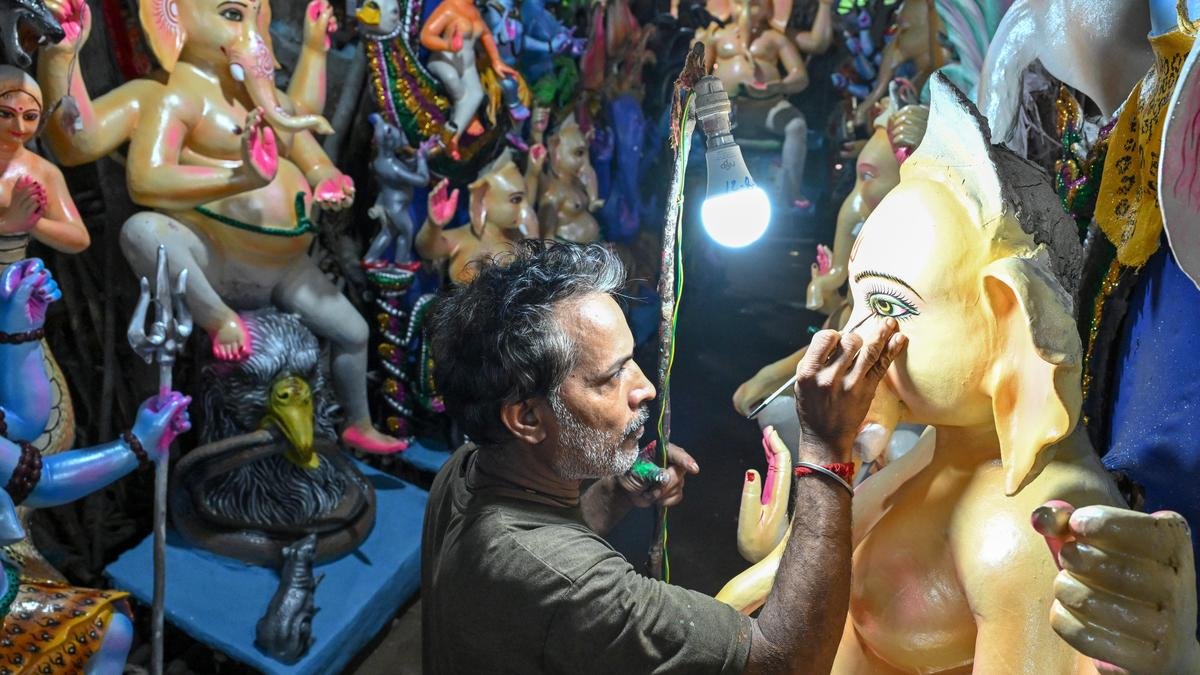

A Bengali song drifts through a makeshift workshop at One Town Area as Visakhapatnam stirs outside. In the soft, early light, the first hands reach for clay. Someone begins kneading a fresh mound; another bends over an unfinished Ganesha, working a thumb gently around the eyes. In a corner, a coal fire is already glowing, sending up the first promise of breakfast. The day has begun at the makeshift workhouse that belongs to Binay Pal’s, an idol-maker from West Bengal, as it has every year for over two decades.
The festive season is approaching, and there is little time to pause.

Ganesha idols in different foams made by the artisans from West Bengal with clay brought from the banks of the Ganga ahead of Ganesh Chaturthi in the One Town area of Visakhapatnam. The traditional clay idols are increasingly preferred by devotees as an environmentally friendly alternative to plaster-of-Paris idols.
| Photo Credit:
KR Deepak
This year, the team has made 250 Ganesha idols, each different from the other. There is a Ganesha gleefully sliding down a slide, another perched on a cycle and one whose form resembles a leaf. Some carry playful, contemporary touches, including hints of cartoon characters. Beneath the variety is an old craft that Binay and his team have carried from Bengal to the coastal city for the past 26 years.
The artisans arrive in Visakhapatnam every May and stay until after Dasami. For years now, the festive calendar has meant leaving Kolkata behind just when Durga Puja preparations begin there.
“For us, making idols is as good as Durga Puja. If we don’t come here, we won’t be making money,” says Binay.
Luchi, aloo dum and a Bengali menu
While the artisans work, another familiar rhythm unfolds in a corner of the workhouse.
Cook Arjun Maji heads towards the kitchen, where heaps of onions and potatoes sit alongside vegetables, carefully stacked and ready for the day’s meals. A large cauldron rests over a coal fire. Breakfast is on its way — luchi and aloo dum.

A cook prepares traditional Bengali fare for the artisans at their makeshift idol-making workshop in Visakhapatnam’s One Town area.
| Photo Credit:
KR Deepak
Arjun has been accompanying the team for the past couple of years, ensuring that artisans get home food despite living thousands of kilometres from home.
For him, the day’s work involves more than preparing breakfast. He already has lunch planned: boal macher jhol (freshwater catfish curry), masoor dal and aloo fry.
The kitchen, much like the workshop, becomes a little piece of Bengal transplanted into Visakhapatnam. The smell of frying potatoes and the sound of Bengali conversation mingle with the scrape and slap of hands working clay.
Hands that remember
Back in the workshop, the real transformation is underway. The artisans knead, press, smooth and mould the clay with an ease that comes from years of repetition. Fingers work around the eyes, ears and trunks, adding the finer details that turn an anonymous lump of earth into a recognisable deity.

An artisan from West Bengal making eco-friendly Durga idols made of clay brought from the banks of the Ganga ahead of Ganesh Chaturthi and Durga puja in the One Town area of Visakhapatnam. The traditional clay idols are increasingly preferred by devotees as an environmentally friendly alternative to plaster-of-Paris idols.
| Photo Credit:
KR Deepak
For Binay, the skill was inherited early. “I learnt this craft when I was 13 years old from my father. Now both my sons have learnt this from me and assist me,” he says. Binay’s sons now work alongside him, learning the same movements that he once learnt from his father.
For these artisans, it all starts with clay. Nearly half the clay used by the team is brought from the banks of the Ganga in Bengal. The remaining is sourced locally in Visakhapatnam. The two are brought together in a process that connects the artisans’ homeland with the city where their idols eventually find homes.
The clay is only the beginning. The artisans work through several stages to create the structure, volume and intricate features of each idol. The final product reflects a distinctly Bengal-influenced style while also responding to the tastes and imagination of their Visakhapatnam customers.
And there is plenty of room for experimentation. The Ganeshas emerging from the workshop are not confined to one traditional pose. Some are whimsical, some contemporary and some almost childlike in their expressions.
This year, alongside the 250 Ganesha idols, the team has also made 200 Durga idols, including special ones commissioned by Bengali Durga Puja associations.
Rising costs
For all its colour and creativity, the business is facing a less cheerful reality: rising raw-material costs.
The price of materials has steadily increased, putting pressure on the artisans who work on tight seasonal margins. Even the cotton thread used for the lion’s mane has become significantly more expensive. “It costs about ₹250 a kilogram today, compared with ₹80 just two years ago,” says Binay.
For artisans who spend months away from home and depend heavily on the festive season for their earnings, every increase matters.
For 26 years, Visakhapatnam has been Binay and his team’s seasonal home, where they return each year to make idols. The cycle has repeated for 26 years, long enough for an entire generation to grow up knowing that the festive season begins with a journey away from home.
Published – September 04, 2026 09:03 am IST