

Conversations drifted through the space, mingling with the aroma of coffee and the hum of people moving between sessions. Inside the auditorium, attendees listened and debated, while outside, discussions spilled into the cafeteria and corridors. This was CultureCon 2026 at the National Centre for the Performing Arts (NCPA). The networking mixer brought together artistes and cultural practitioners. We caught up with Sanjoy Roy, Roshan Abbas, Karsh Kale and Jishnu Dasgupta to ask: what happens to creativity when technology changes the very act of creating?
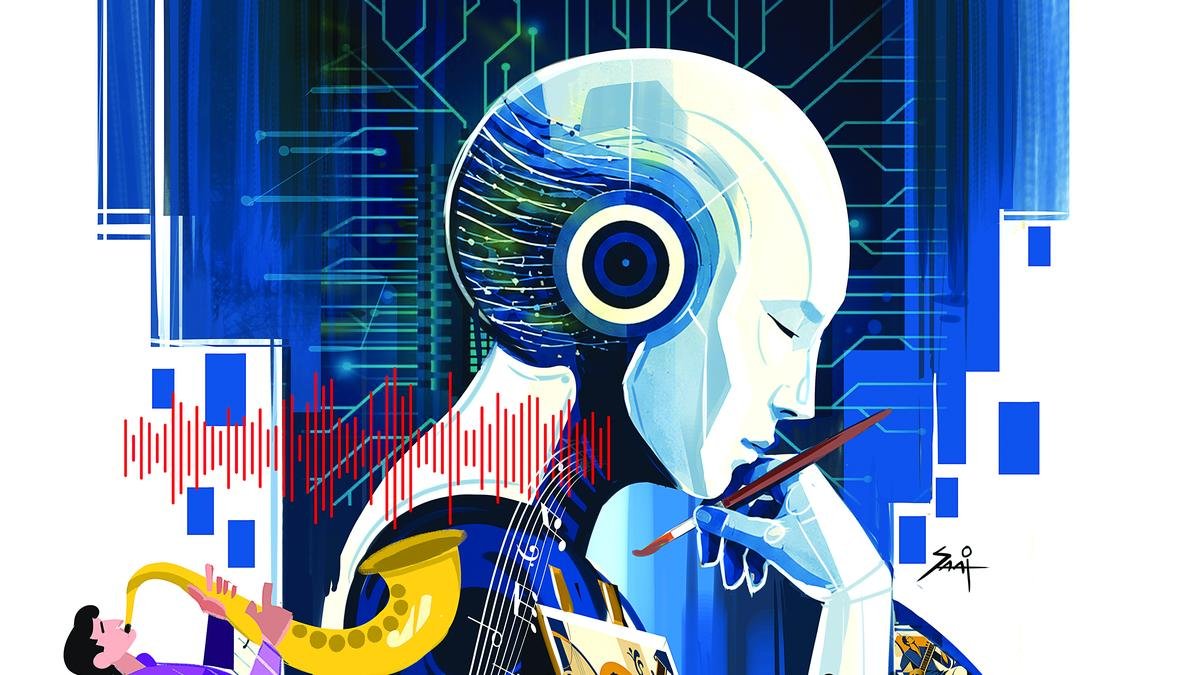
Ironically, patchy network connectivity offered an unexpected break from phones, drawing attention back to the stage. And the conversation there centred on a question that is becoming increasingly difficult for the creative world to ignore: when AI can generate images, music, text and video with increasing ease, what happens to originality, artistic labour and the human impulse to create?

Sanjoy Roy of Teamwork Arts
| Photo Credit:
Courtesy: CultureCon
For Sanjoy Roy of Teamwork Arts, this democratisation is not entirely new. According to him, technology has long lowered the barriers to creative participation. “The minute these phones came about, everything got democratised because you were taking photographs. This has made everybody a filmmaker. This has made everybody a creative artiste. This has made everybody a meme. This has made everybody an influencer.”
But if technology can draw from everything that already exists, what happens to the artiste whose value lies in imagining something that does not? Roshan Abbas, a storyteller, media entrepreneur and creative industry leader, sees that distinction in originality. “I keep saying that art is created in the extraordinary, art is created in the flaw, art is created in the anomaly. So, AI, unfortunately, is aggregating what is already available. Art is about that which has never been seen,” he says.

Media entrepreneur Roshan Abbas
| Photo Credit:
Courtesy: CultureCon
For Abbas, the imaginative leap remains uniquely human. He explains, “If you had aggregated a tape recorder and, you know, a phone, you would not have got an iPhone. So, it requires somebody who’s a bit of a creative thinker. And I think that’s what is important to celebrate, really, people who can think out of the box.”
Musician and producer Karsh Kale sees a similar limitation in AI: its inability to anticipate an artiste’s next move. Kale says, “But the one thing AI can’t do is predict what the next thing an artiste is going to do. It can study a particular artiste — Mozart, Bach, Ustad Zakir Hussain or Nusrat Fateh Ali Khan — and recreate everything that they have done. What it can’t do is predict what the next thing they were going to do, and that’s where that human element is still important.”

Musician and producer Karsh Kale
| Photo Credit:
Courtesy: CultureCon
The human element becomes sharper when creativity is viewed not just as an idea, but as labour. Musician Jishnu Dasgupta, bassist and manager of folk-rock band Swarathma, takes a more uncompromising position. Dasgupta says, “I have a sharp stance on AI in the creative field. I believe it has no place in creativity at all. Creative expression is inherently a human condition. It makes the unbearable weight of human existence more bearable. That is the point of art — it is something that is as critical to life as breathing or as eating.”
For Dasgupta, efficiency can come at the cost of meaning. He says, “As we infuse more of the so-called artificial intelligence to take the humanness out of art, we are doing a disservice to it even though it appears that we are doing things more efficiently. So, even though we can probably make a large number of songs quickly with AI, you are stripping them of the very soul that creative expression is all about.”

Jishnu Dasgupta, bassist and manager of folk-rock band Swarathma
| Photo Credit:
Courtesy: CultureCon
Dasgupta also questions AI’s role in making live events more sustainable. He says, “I do not think AI is helping make live events and concert tours more sustainable in any way.”
On creative decisions, Dasgupta believes the boundary must be drawn. He says, “AI should not become integral to planning and producing events. AI cannot replace human judgment in doing something that has never been done before.”
Yet the debate at CultureCon was not about rejecting technology in favour of artistic purity. Roy cautions against defining creativity through tradition alone. He says, “This is not about the pure Carnatic tradition or North Indian classical. Learning from tradition does not mean reproducing it mechanically. “By producing exactly what your guruji has taught is not creativity. It is when you make it your own, interpret it and then create a new form within the meter. And, that is creativity.”
For Kale, the question extends beyond originality to the physical labour involved in mastering an art form. He believes that such labour could become more valuable in an age of abundant machine-made output. “I think we’re eventually going to come to a point where that’s valued more, because there’s going to be so much output of different types. So actually even seeing somebody weave a chair is going to be fascinating, because the human element is what’s going to be worth more than anything else.”
That value, however, lies not only in creating art but also in communicating it. Abbas believes storytelling will become increasingly important in the AI era, particularly for artistes who struggle to articulate their work. “I find many people who are great practitioners of their art, but are not able to actually put things out. Many people I find are diffident; they don’t know how to tell their story. So that’s where I feel it is important to actually enhance your skills of storytelling.”
If technology can increasingly produce the form, perhaps what becomes more valuable is not simply the finished work, but the human impulse, labour, imagination and experience behind it.
Published – September 05, 2026 02:57 pm IST