



Breaking Travel News spends a few days exploring the coast, mountains and historical sites Ajman, known as the hidden gem of the UAE.
It is my eighth time in the United Arab Emirates, a country where it is remarkably easy to spend a week seeing little beyond air-conditioned megamalls, mirror-glass skyscrapers, and tourist enclaves. For many visitors, the UAE exists as a futuristic spectacle rising from the sand. Yet barely an hour’s drive from the mega-towers of Dubai lies Ajman, the smallest of the seven emirates, and perhaps the most surprisingly grounded. Here, the pace slows, and a different narrative unfolds: one defined by organic growth, ancient trade routes, and a deep, continuous connection to the landscape.
Deep Roots in the Dust
To understand Ajman is to look past the modern infrastructure and trace a line backward through millennia. Long before oil and concrete, life here was shaped by the sea and the soil. At the Ajman Museum, housed in an 18th-century fort that once served as the ruler’s residence and police station, Iron Age settlements and ancient burial sites reveal that people have called this coastline home for thousands of years.
This was a world powered by pearl diving, subsistence farming, and the falaj, an ingenious underground channel irrigation system designed to carry water from mountain aquifers to arid plains without losing a drop to evaporation.
Into the Hajar Peaks: Masfout
Leaving the coast behind, the landscape shifts dramatically as you head inland toward the enclave of Masfout. Tucked into the foothills of the rugged Hajar Mountains, Masfout feels a world away from the coast. The air here is cooler, the soil fertile enough to support small agricultural plots, and the pace of life measured by the sun and seasons.
Sitting inside the museum’s built from the old fort, the continuity of local life comes alive in simple, generous ways. Our guide Layla treats us to her fresh baked bread drizzled with mountain honey and infused with aromatic saffron, the warm bread tastes of a hospitality that has remained largely unchanged across generations.
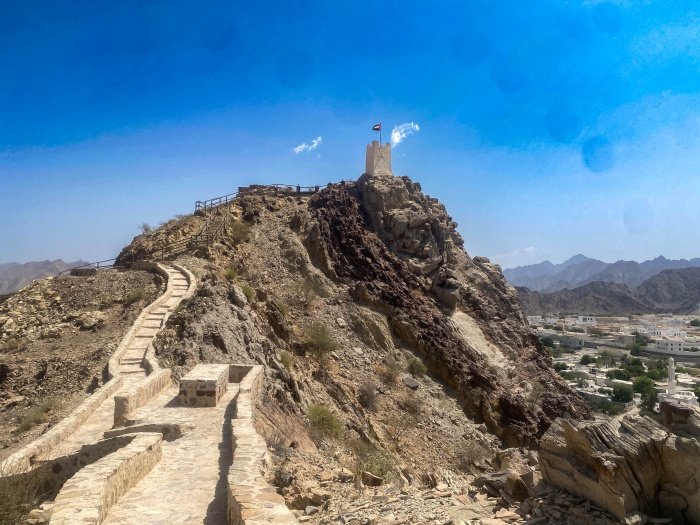
At the edge of the town, an ancient watchtower sits perched atop a rocky crag: the Owl Lookout. Historically, guards posted high on these slopes watched for approaching tribes or travelers moving through the mountain passes. To alert the village below without raising alarm to intruders, lookouts would call out into the valley using convincing owl hoots, an acoustic early-warning system echoed by the geography itself.
Nearby, active farms still raise racing camels and mountain goats alongside crops of dates, dappled light giving the oasis a serene charm. The hospitality in these inland pockets is unstudied and genuine; visitors are welcomed as curious guests.
Everyday Rhythms
Back along the coast, Ajman’s charm lies in its unpretentious, organic flow. Unlike the highly master-planned developments found elsewhere, Ajman’s streets feel naturally evolved. Neon-lit neighbourhood storefronts, local tailors, and traditional eateries sit side by side.
In Souq Saleh and the surrounding gold and wedding dress markets, life happens at its own cadence. Families stroll along the waterfront boardwalk as the sun sets, local vendors chat across narrow alleys, and small, atmospheric restaurants serve regional comfort foods like maleh, a rich, sun-dried fish curry deeply tied to the region’s maritime preservation techniques.
Coastal Sanctuary: Mangroves, Flamingos, and Tidal Fairways
Even as Ajman remains grounded in its local heritage, it offers pockets of eco-minded luxury along its northern coastline. At the heart of this coastal fringe lies the Al Zorah Reserve, a sprawling natural sanctuary of million-square-meter mangrove forests, tidal creeks, and vibrant birdlife including resident flocks of pink flamingos that wade through the shallow wetlands.
Framing this ecosystem is the Al Zorah Golf Club, an 18-hole championship course designed by Nicklaus Design that has racked up accolades at the World Golf Awards. Even for a non-golfer, the landscape design is striking: the course actively incorporates the natural ebb and flow of the Gulf tides.
Adjacent to the course sits the Al Zorah Beach Resort, providing a high-end, peaceful base where the air feels noticeably crisper and fresher than the dense smog of neighboring metropolis hubs. It stands as a compelling model for how modern coastal developments in the UAE can coexist with delicate coastal ecosystems, offering front-row seats to native birdlife alongside world-class design. The tastleful modernist buildings are tranquil, framed by lush vegetation, soundtracked by exotic birds and mirrored in water features.
A Destination in Balance
Ajman is not frozen in the past. Cranes dot the horizon, and new coastal developments, such as the quiet resort sanctuaries around the Al Zorah nature reserve, are steadily taking shape. Yet unlike the rapid transformations seen in neighboring emirates, development here feels more integrated into the existing fabric of the community.
For travelers who have seen the gleaming facade of the UAE, Ajman offers something far more rewarding: context, quiet, and a reminder that beneath the polished glass lies a land with ancient roots and an enduring soul.
Words and images by Sapphire Goss