
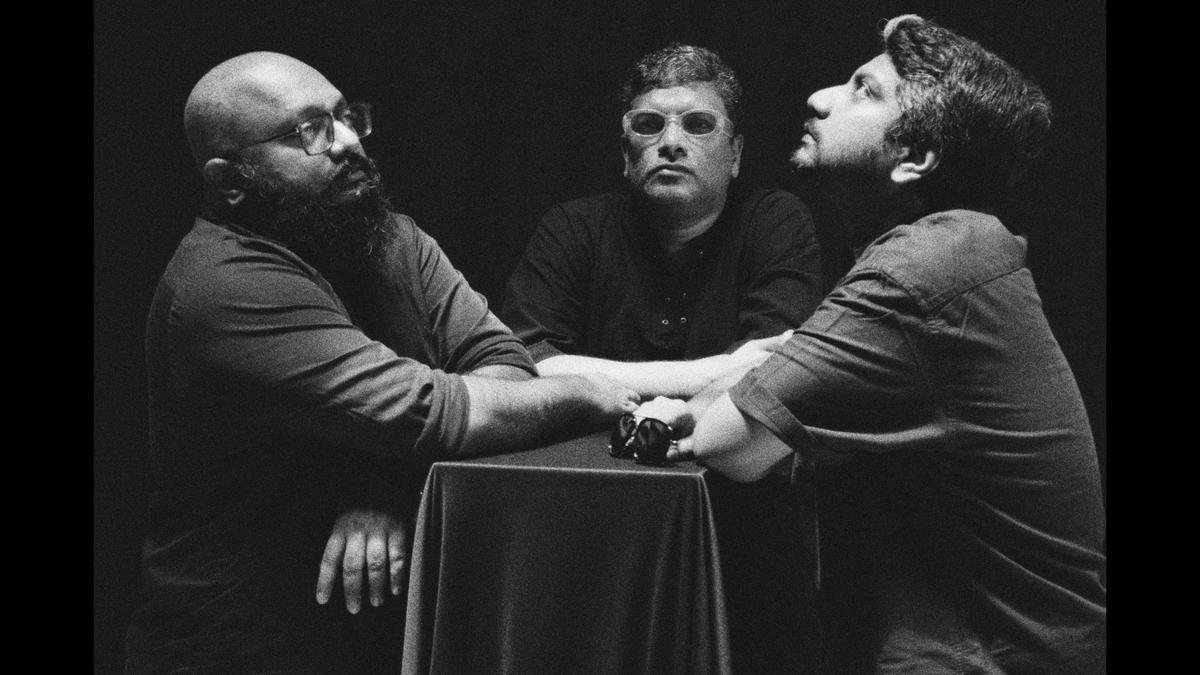

My journey with Siennor’s music started by singing Innum Enna (single released in 2021) to a date. The song still flashes memories of a good night, a promise of a beautiful future. Like this romance that once was, Siennor Trio’s latest album Ninaivu Maaligai (Castle of Memories) looks to respect the past and explores the idea of moving on.
The album, a collection of songs written over the years, besides some new ones, has Siennor on vocals, guitar and keys, Aravind Murali on bass, and Vinay Ramakrishnan on drums. It moves across love, politics, and madness, and blends several genres in one record.
“When I look back at the theme and the time during which these songs were born, then it seems obvious to me that Ninaivu Maaligai is l a tribute to the things from the past. It wasn’t planned really though,” says Siennor.

Siennor Trio’s performance in Chennai.
As a producer of the album, Aravind says that he found it interesting musically as it had a lot of different types of movements. “It is fascinating lyrically too. Because it’s not like your regular average thoughts that have been expressed in Top 40 pop, it ends up having more depth,” he adds.
Siennor’s early writing was “very simple, and very structured,” he says, “like absolute poetry with all the writing scheme.” Then he began breaking the structure. Subsequently, the subject matter changed too. His last album was six songs of introspection: “how I feel on the inside.” Ninaivu Maaligai turns outwards: “how I feel with somebody else or how I feel on the outside as a part of society,” says Siennor.

Siennor Trio’s performance in Chennai.
Where the earlier work dealt with internal conflict, this one is “like a madman exploring,” he adds.
This album stands out with a blend of rock, sufi, pop, jazz and much more. Unlike other albums that Siennor has written, this one does not really follow a structure either.
“Some songs have an extended outro, some songs have an extended interlude and some songs have no chorus, it’s just verse one, interlude, and then verse two,” quips Siennor. He gives an example using his new song Sambalam Mattum. “It’s completely folk with Sufi touch to it, like a qawwali where at the end of every verse we come back to the same line, where we can sing together like a chorus.”
Aravind’s favourite tracks from the album are Vaa and Iru Vizhigalile. Originally written for seven minutes, Iru Vizhigalile comes up to 10 long minutes now.

“I just refused to stop playing. That’s all,” Vinay shares, laughing. “We thought the song was done. I just refused to stop playing. Both Arvind and Siennor said ‘you know what? Let’s keep going.’ And then, thankfully, it went on to be even better than what we thought.”
Holding tight
In the age of Instagram reels and short attention span, Aravind says bringing out this album is a “leap of faith”. He continues, “[This is] kind of rare these days. Hopefully it will stand out in some way. And it’s also the way we grew up and listening to our music. This is the way we want to present stuff.”
Siennor believes that releasing an album has a lot of space to explore the soundscape of the band. “We have experimented with something. For the next album or next single, we don’t have to try the same thing really. A large pressure is off. Now, we can start again.” He adds, “Just like the name Ninaivu Maaligai goes. Let’s pay our tribute to the past. Like a snake shedding its skin. Let’s start anew.”
Feel of the music
The artistes say that they chose to record the album live with all three playing together in a room, rather than building it on a computer with a metronome. “When we record with a metronome, all of us tend to stay at the same pace throughout the song. That is a very modern recording technique,” he says. But after writing, arranging and rehearsing, the songs, even the choice of words, sounded old-school to the band.
Playing together meant the tempo would drift. “We don’t stay stiff like a computer. Since even the way we breathe changes, the rhythm takes a similiar journey. We let it flow. Most of the industry just corrects the mistakes. We just wear them on our sleeves. We want people to feel things,” he says.

Siennor Trio’s new album Ninaivu Maaligai.
Siennor does not soften it when the talk turns to money. “Live musicians’ pay has not been increased in a really long time,” he says.
His biggest complaint is about the word indie. Big labels entering the Tamil market is ‘fine’, he says, but a production with a producer, dancers, and lakhs spent on the video and promotion “doesn’t really sound like indie.” Once everything sits under one umbrella, he argues, “the weight is going to fall on our shoulders” in terms of the market and business. In his view, much of what is released as indie is just low-budget cinema, he says. While his band has been financially independent, putting in their own money, time, effort, and life experiences,” seems essential.
There is some good news. “We’re still able to thrive. A little bit,” he says. People now buy tickets and turn up for independent music. Yet, the battle persists as mainstream music tends to rule over people’s playlists.
I turn to the trio’s art to understand these issues better.
A line from Sambalam Mattum says, “En sambalam mattum yeralaye, yenna nyayam ma?” (Why has only my salary not gone up? What kind of justice is this?).
As the cruel fates continue to rule the world, I realise that I could not agree more.
What really is this kind of justice?
Siennor Trio will be playing live at Museum Theatre on October 17. Tickets are available at outworld.fanpit.live
Published – October 07, 2026 06:00 pm IST