

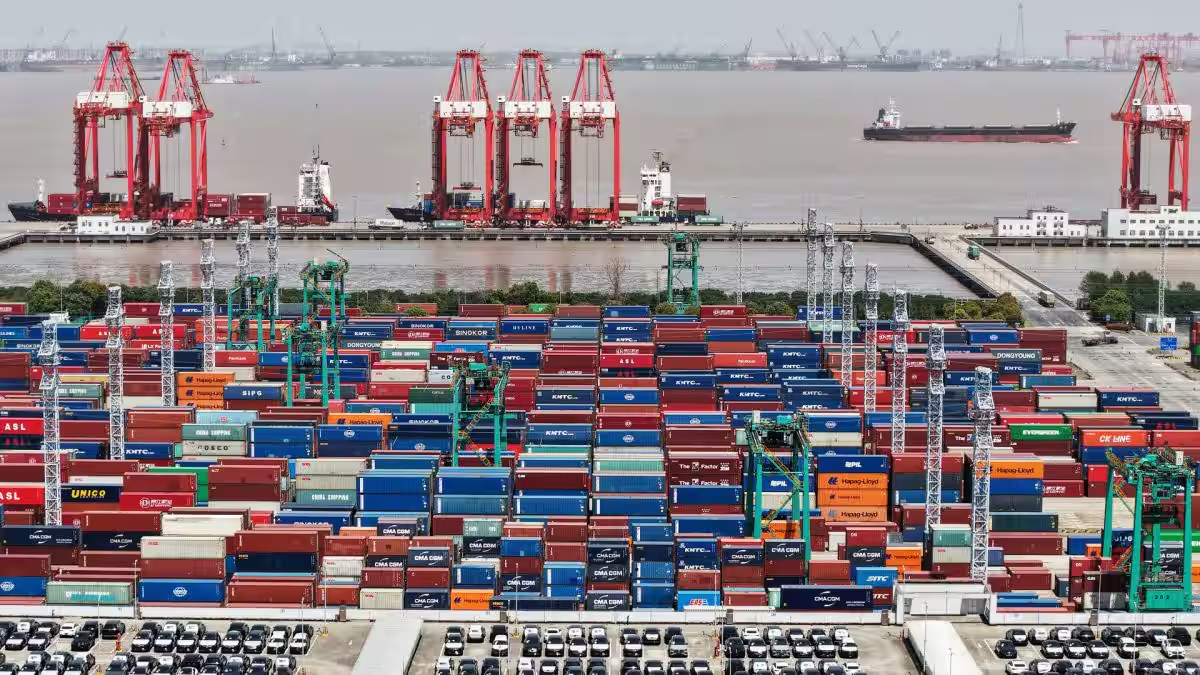

Higher oil and commodity prices lift factory-gate inflation, but weak domestic demand continues to weigh on China’s economic recovery
China’s factory-gate inflation accelerated in August as higher energy and raw material costs, linked to the ongoing Iran war and supply disruptions in the Middle East, pushed up prices across several industrial sectors.
The producer price index (PPI), which measures the prices manufacturers charge at the factory gate, rose 3.8 per cent from a year earlier in August, according to data released by China’s National Bureau of Statistics on Wednesday. The increase was faster than the 3.5 per cent rise recorded in July and above the 3.6 per cent increase economists had expected.
Consumer inflation also strengthened. China’s consumer price index (CPI) rose 0.8 per cent year-on-year in August, up from 0.5 per cent in July and in line with the Reuters poll.
The figures point to a complicated picture for the world’s second-largest economy. Higher energy and commodity prices are pushing inflation higher, but this does not necessarily mean that domestic demand has recovered.
Energy costs drive inflation
The main source of pressure came from energy and industrial commodities.
Dong Lijuan, a statistician at China’s National Bureau of Statistics, said higher international crude oil and non-ferrous metal prices had pushed up prices across related industries.
Energy price inflation alone added about 0.28 percentage points to China’s annual consumer inflation rate in August, according to the statistics bureau.
 More from Business
The increase came as the Iran war continued to disrupt energy markets and raised concerns about supplies from the Middle East. Oil prices have moved sharply higher as attacks and disruptions around key energy infrastructure have increased the risk of a prolonged supply squeeze.
Brent crude was approaching $100 a barrel on Wednesday after Iran-backed Houthi forces attacked targets in Saudi Arabia, adding to concerns over energy supplies from the region.
For Chinese manufacturers, higher oil and raw material prices can raise production and transportation costs even when demand for their products remains weak.
Domestic demand remains the weak spot
Despite the increase in headline inflation, China’s domestic economy continues to face significant pressure.
Core inflation, which excludes volatile food and energy prices, rose 1 per cent in August from a year earlier, compared with 0.9 per cent in July. That improvement remains modest and suggests that underlying price pressures are still relatively weak.
On a monthly basis, consumer prices rose 0.4 per cent in August, reversing July’s 0.1 per cent decline and beating expectations for a 0.3 per cent increase.
The problem for Beijing is that higher prices are not being driven primarily by a broad-based increase in household spending. Instead, external factors such as energy and commodity prices are doing much of the work.
That makes the latest inflation figures different from a conventional demand-led recovery.
China has been relying heavily on exports to support growth as households remain cautious and the property market continues to weigh on confidence and spending.
Exports provide a cushion
China’s strong export performance has provided an important counterweight to weak domestic demand.
Exports surged 25 per cent year-on-year in August, helped by strong global demand for high-tech and artificial intelligence-related products. High-tech exports rose 42.9 per cent, while the country recorded a trade surplus of $119.09 billion.
The export boom has helped factories maintain production even as domestic consumption remains subdued.
But dependence on overseas demand also leaves China exposed to trade tensions and changes in global demand. The country is already dealing with tariff disputes and a difficult property market, while policymakers are trying to encourage households and private businesses to spend more.
Weather adds to pressure
China also faced disruptions from typhoons and heavy rainfall in August.
The bad weather affected transport, production and construction activity in several parts of the country, adding another layer of pressure to an economy already dealing with uneven demand.
The combination of higher input costs and weak demand creates a difficult environment for businesses.
Manufacturers may face rising costs without being able to fully pass them on to consumers, particularly in sectors where competition is intense and demand remains soft.