

India wants to connect UPI with more foreign payment systems, potentially making cross-border transfers faster, cheaper and easier for its diaspora and businesses
India is seeking to take its Unified Payments Interface (UPI) beyond its domestic success and turn it into a wider cross-border payments network, with Prime Minister Narendra Modi calling for greater integration with payment systems in other countries.
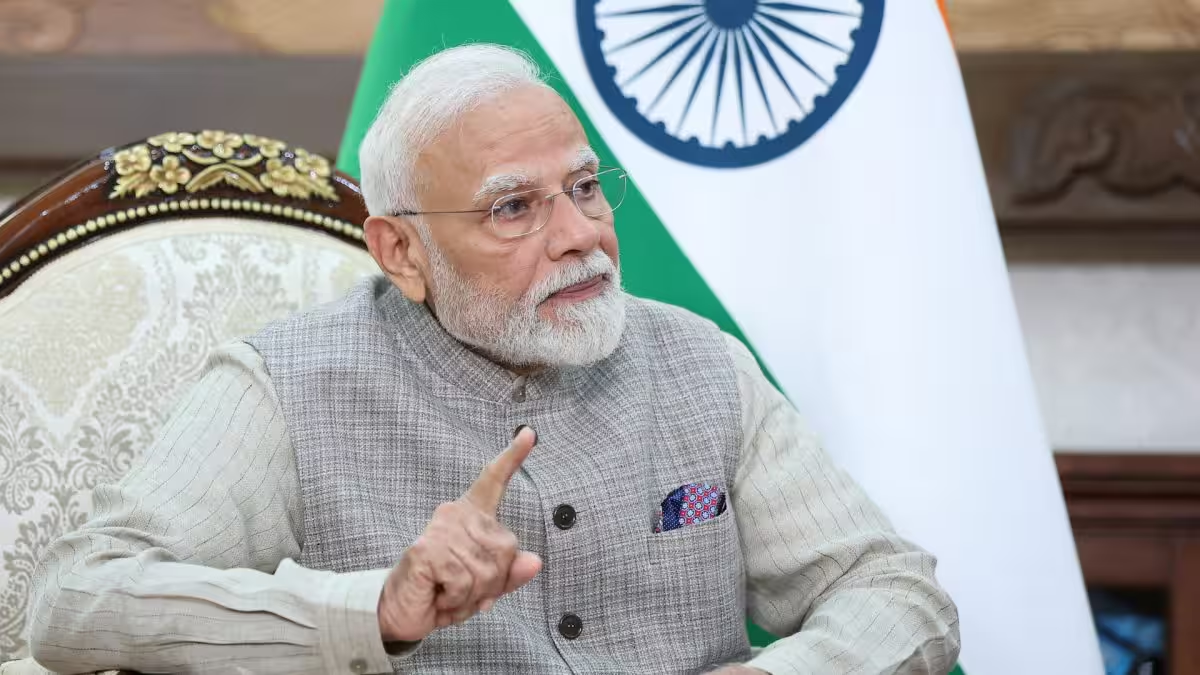
Speaking at the Global Fintech Fest 2026 in Mumbai, PM Modi said UPI should be linked with the domestic payment rails of more countries, particularly those with large Indian populations and strong trade ties with India.
“Now to connect with other payment rails is the next step,” Modi said.
The push comes days before India hosts the Brics summit in New Delhi on September 12-13, where discussions on trade, payments and greater economic connectivity are expected to be important areas of focus.
From domestic success to global ambition
UPI, operated by the National Payments Corporation of India (NPCI), has become one of the world’s largest instant payment systems by transaction volume.
It processed 24.51 billion transactions worth Rs 29.82 trillion in August, according to the latest data.
The network is already live in 11 countries, including Singapore, the UAE, France and Nepal. But Modi’s latest remarks point to a broader ambition than simply allowing Indian users to make UPI payments overseas.
The goal is to connect UPI with foreign domestic payment systems so that users in different countries can transfer money more directly and quickly.
 More from Business
India already has such a model with Singapore. UPI and Singapore’s PayNow were linked in 2023, allowing users to transfer funds instantly using a mobile number or Virtual Payment Address.
Modi said similar links should be pursued with countries where India has significant trade and diaspora ties.
Why cross-border links matter
Cross-border payments can be slower and more expensive than domestic digital transactions because they often involve multiple intermediaries, currency conversion and different banking systems.
Greater interoperability between instant payment networks could reduce some of that friction.
For India, remittances are a particularly important part of this push. Indians working overseas send billions of dollars home every year. Lower transaction costs could mean more money reaches recipients in India.
A wider UPI network could also make payments easier for Indian travellers and businesses dealing with overseas partners.
But turning UPI into a global payments rail will require countries to align their technical systems, regulations and safeguards on data, cybersecurity and financial crime.
A Brics opportunity
The timing of Modi’s comments is significant as India prepares to host the Brics summit.
India has been pushing for greater cooperation among Brics countries in areas such as trade, cross-border payments, technology and economic connectivity. Linking domestic payment systems could support that agenda by making transactions between participating economies faster and potentially cheaper.
This does not mean UPI would replace existing international payment systems or become a common Brics currency. The more immediate proposition is to create links between national payment networks.
For India, that would also strengthen the international reach of its digital public infrastructure model.
The challenge ahead
UPI’s enormous scale in India gives it a strong base, but domestic dominance does not automatically translate into global adoption.
Countries have different rules governing payments, data, foreign exchange and consumer protection. Building links therefore requires agreements between regulators, banks and payment operators.
The expansion will also have to address cybersecurity and data-privacy concerns, areas that have become increasingly important as digital payment networks grow.
The bigger test for India is whether UPI can evolve from being an Indian payment system accepted abroad into a network that connects different national payment rails.
If it succeeds, UPI could become more than a domestic fintech success story. It could emerge as an important piece of the global push to make cross-border payments faster, cheaper and more seamless.
(With inputs from agencies.)