
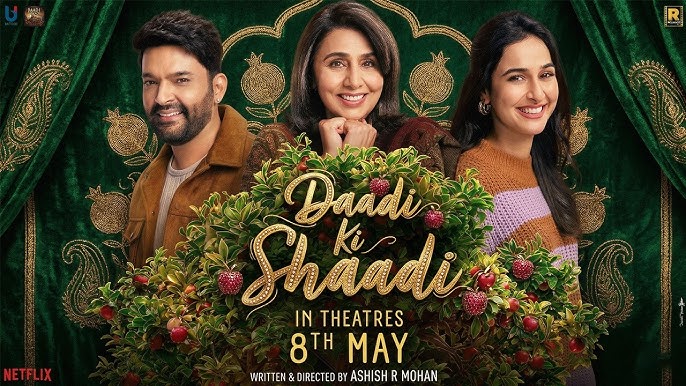

It never occurred to me that I would begin a movie review in 2026 with the query, “What if Baghban and Kal Ho Naa Ho hooked up, had an unwed child, tried to make it work, lived separate lives in one home, but traumatised the child because of their dysfunctional relationship?” Naturally, that child would grow up to be Daadi Ki Shaadi (“Grandmother’s Wedding”), an antiquated, lengthy, cloying, and unfunny family drama that once more chastises busy Indians for not spending enough time with their elderly and lonely parents. How many times have we witnessed adult children of widows or widowers being humiliated for neglecting their elderly parents?
I swear I won’t be too grumpy here. Thus, the title gag appears at the beginning of Daadi Ki Shaadi. Tony (Kapil Sharma) and Kanika (Sadia Khateeb) are engaged and headed for a lavishly planned wedding when they receive a bit of news: Vimla (Neetu Singh), Kanika’s grandmother from Shimla, posts on Facebook that she is getting married. The fact that she wasn’t invited to the ceremony is a complaint that will last for ten more years. The engagement is called off because Shah Rukh Khan’s Aman from Kal Ho Naa Ho is a nosy outsider who wants to mend a broken household. This includes other relatives who weren’t invited to Shimla. even if it’s out of self-interest.
We soon find out that poor Vimla made a typo on social media, but she chooses to keep it a secret because she loves spending time with her family after all these years. The lie must be maintained because she has missed them so much. In order for Vimla to maintain this façade and create a future husband out of thin air, the remainder of the movie twists and turns like an inebriated serpent. Eventually, her three children discover how callous and transactional they have been all along. Tony is first a self-centred idiot who wants to save his own engagement, but because he’s cool like that, he changes sides to support Vimla.
In addition, the movie is unsure of how to handle him in any other way. One of the humiliated characters even queries, “Why couldn’t you tell us directly instead of doing all this?” toward the end.The ” This was also the sentiment of the crowd in the hall, as evidenced by the passionate groans and chuckles I heard around me.
In the charming Shimla cottage, Daadi Ki Shaadi (not to be mispronounced as Daddy Ki Shaadi; I learned this the hard way) somehow spends almost 150 minutes creating scenarios. Vimla’s two boys, one of whom is Kanika’s ultra-Delhi father, receive instruction in every manner imaginable. Even by the standards of a weak Bollywood performer, she goes a little too far to capture their interest and empathy after receiving criticism for her significant choice. Vimla pretends to have a fake gambling habit and debt, pretends to love a man, pretends to sell their childhood mementos, pretends to be betrayed twice by her pretend suitor, pretends to be humiliated by him to get her sons to defend her, and even threatens to live in an assisted living facility to make her lose all hope. Vimla, a desperate parent who needs a trash-talking angel like Tony to save her family, is another example of emotional blackmail. It doesn’t concern him, but has a man ever been deterred by that?
Oddly, while the others devolve into clichés and mayhem, Kapil Sharma and Neetu Singh are reduced to a string of reaction shots. In a perfect world, Singh could have portrayed Vimla as her character from Jugjugg Jeeyo (2022)’s spiritual sibling, but Daadi Ki Shaadi views the most of its female characters as concepts that merely talk a bit. The passages when the female protagonists are continually shut down (what is comedian Aditi Mittal doing here?) until they receive the most implausible payout are only one example of the strong written-by-men vibe. Among the others, Deepak Dutta’s portrayal of Jeevan, the older son, has his moments, especially when he’s still whiny enough to be funny.
However, a movie that ignores the complexity of Vimla, its purported protagonist, in favour of a tone that is neither absurd nor serious enough loses its irony. At best, Daadi Ki Shaadi is “joint-family propaganda,” but it’s not as good as Badhaai Ho as a social message film. It’s kind of cute because, as long as the children are the erratic villains, it insists on being both traditional (honour your parents) and modern (allow them to remarry).
I’m not sure how every second Hindi comedy plays out as the cinematic counterpart of that condescending uncle at weddings who nods regretfully and chastises younger generations (“kids today..”) for having the audacity to be unique and independent. But here we are, back at the beginning, using regressive ideas disguised as bleeding-heart dramas to guilt viewers into being Good Sons and Daughters. Uncle is unsure of what a situationship is and is just on his third peg.