

MUMBAI, May 4 (Reuters) – India’s central bank is studying ways to mobilise dollar inflows to bolster its foreign exchange buffers and cushion rising pressure on the rupee from a spike in oil prices driven by the Iran war, three sources familiar with the discussions told Reuters.
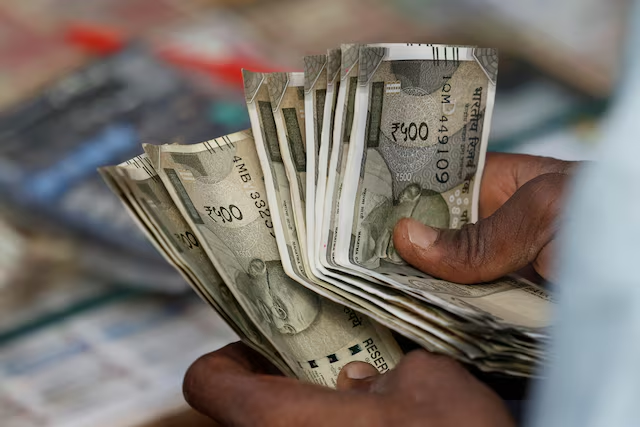
The rupee has slumped 5.5% this year, sliding to an all-time low of 95.33 per dollar last Thursday, while foreign exchange reserves have fallen from a peak of $728.5 billion and equity outflows have hit $19 billion over March and April alone.
Although the Reserve Bank of India (RBI) has insisted that its reserves are sufficient to meet 11 months’ worth of imports, the most recent policy talks highlight the increased need to strengthen defences in the face of capital outflows.
Although experts have conjectured about how authorities might revive parts of its crisis-era playbook, the central bank’s deliberations have not been previously revealed.
Reviving a system that was last utilised in 2013 to collect dollar contributions from non-resident Indians is one of the actions being discussed, according to two of these sources. Eliminating withholding tax on foreign investors in government bonds is a second alternative under discussion to promote inflows, they said.
The third source stated that no final decision has been made and that the government will be consulted before any action is taken. Reuters was unable to determine when a decision will be made.Both are being carefully considered,” the source continued, adding that India’s federal finance ministry has the final say over taxation.
Since they are not permitted to speak to the media, the sources declined to be named. The federal finance ministry and the RBI did not immediately respond to an email requesting comment.
The third month of the conflict between the United States, Israel, and Iran has devalued the Indian rupee, contributing to an almost 5% decline in 2025.
According to the sources, the second option under consideration is to eliminate the 5% withholding tax that is imposed on international investors purchasing Indian government bonds. This might promote inflows.
In 2025, foreign investors were net buyers of Indian government bonds, investing over $6.5 billion. However, this pace has slowed in 2026, with inflows of only approximately $1.1 billion so far this year as mood became more cautious following the Iranian crisis.
The total amount of equity withdrawals in 2026 has increased to almost $20.6 billion, surpassing the outflows for the entire year 2025.
According to one of the sources, the actions will mainly support foreign exchange reserves and stabilise the rupee.
FOREX RESERVE PRESSURE
Since 2013, when the U.S. Federal Reserve revealed intentions to taper its quantitative easing program, which put pressure on its currency and other emerging markets, India’s foreign exchange reserves have more than doubled.
In a speech over the weekend, RBI Governor Sanjay Malhotra referred to India’s existing reserves of $698 billion as “adequate”.
However, reserves have dropped from a peak of $728.5 billion, and given its $104 billion in short dollar forward commitments, economists warn that the headline amount overstates the RBI’s immediate capacity.
To stem the rupee’s depreciation, the RBI has made significant interventions in the spot and forward foreign exchange market.
According to Vivek Kumar, an economist with QuantEco Research in Mumbai, the proportion of gold in foreign exchange reserves has also increased, decreasing the available foreign currency assets.In March 2026, the effective holding of foreign currency assets was $449 billion, according to Kumar.The import cover may be further damaged if the Middle East crisis continues, Kumar warned, adding that this would call for legislative actions to lower the trade gap and promote capital inflows.