

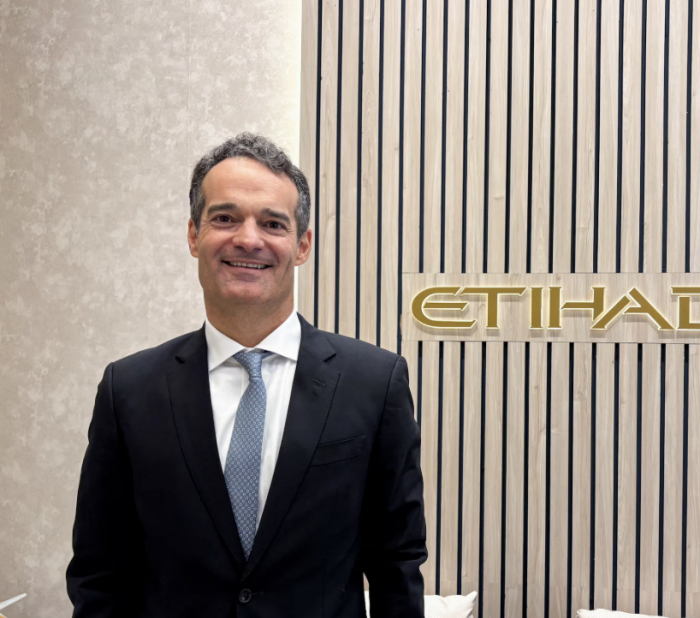


Antonoaldo Neves inherited an airline that had already endured one of the most difficult restructurings in global aviation. His task at Etihad Airways was not to repeat the retrenchment, but to prove that the carrier could grow again without returning to the excesses of its earlier expansion.
Neves became group chief executive in 2022. His career had prepared him for the assignment through strategy consulting, finance and airline leadership. A former McKinsey partner, he went on to senior roles at Azul in Brazil, where he helped lead the airline through its New York Stock Exchange listing, and later became chief executive of TAP Air Portugal, overseeing a major turnaround.
His 14 years at McKinsey included work on the long-term plan for Brazilian aviation and the privatisation of the country’s airports. At Azul, he moved from adviser to operator and led the carrier to its 2017 New York Stock Exchange flotation. He then took charge of TAP, improving passenger numbers, customer service and enterprise value before the pandemic forced the Portuguese government to intervene. Between TAP and Etihad, he founded the technology-led travel company Oner Travel, adding a digital retail perspective to his airline experience.
That history explains his insistence on governance and transparency at Etihad. Under Neves, the airline began publishing fuller financial information and prepared its systems and balance sheet to be capable of supporting a future listing, should its shareholder decide to proceed. The discipline is strategically important after an earlier era in which equity investments in overseas airlines generated heavy losses. The new model places capital allocation, route contribution and the productivity of Etihad’s own assets at the centre of growth.
His academic background reinforces the analytical character of his leadership. Neves trained in civil engineering in Sao Paulo, completed an MBA at the University of Virginia’s Darden School of Business and earned a master’s degree in corporate finance. At Etihad, that combination has translated into close attention to network economics, fleet productivity and return on capital.
The numbers show the direction. Etihad carried 22.4 million passengers in 2025 and generated revenue of approximately $8.3 billion. Net profit reached $698 million, an increase of 50 per cent, while the fleet grew rapidly. By early 2026, the airline operated 128 aircraft and served 110 destinations.
This is growth with a different profile from Etihad’s earlier era. The airline is adding destinations that can support Abu Dhabi tourism as well as connecting traffic, while deploying a broader mix of aircraft to match capacity with demand. Rather than pursue global influence through equity stakes in other carriers, it is concentrating on the performance of its own network and customer proposition.
The change matters to Abu Dhabi. Etihad is both an airline and a destination-development instrument. Every new route expands the pool of potential visitors for the emirate’s museums, events, cruise business, beaches and entertainment districts. Neves has increasingly framed the company as a contributor to Abu Dhabi’s economic strategy, not simply a connecting carrier based there.
Product investment remains essential. Etihad competes in a region with some of the world’s strongest airline brands. New aircraft, premium cabins, lounges and digital tools must therefore arrive alongside network growth. The airline also needs enough pilots, engineers and cabin crew to absorb a fleet that expanded by 29 aircraft in 2025 and was expected to grow further in 2026.
External shocks are unavoidable. Airspace closures, aircraft delivery delays and fuel-price volatility can quickly alter the economics of a route plan. Neves’ response has been to emphasise flexibility and a simpler balance sheet. That financial resilience is what allows an airline to keep investing when conditions change.
His achievement is not that Etihad has rediscovered ambition. The airline never lacked that. It is that ambition is now tied more visibly to profitability, aircraft utilisation and destination value. The next test will be whether Etihad can sustain this pace while protecting service and margins. Neves has built his career around turning complicated transport businesses into investable growth stories. Abu Dhabi is now the largest expression of that work.