

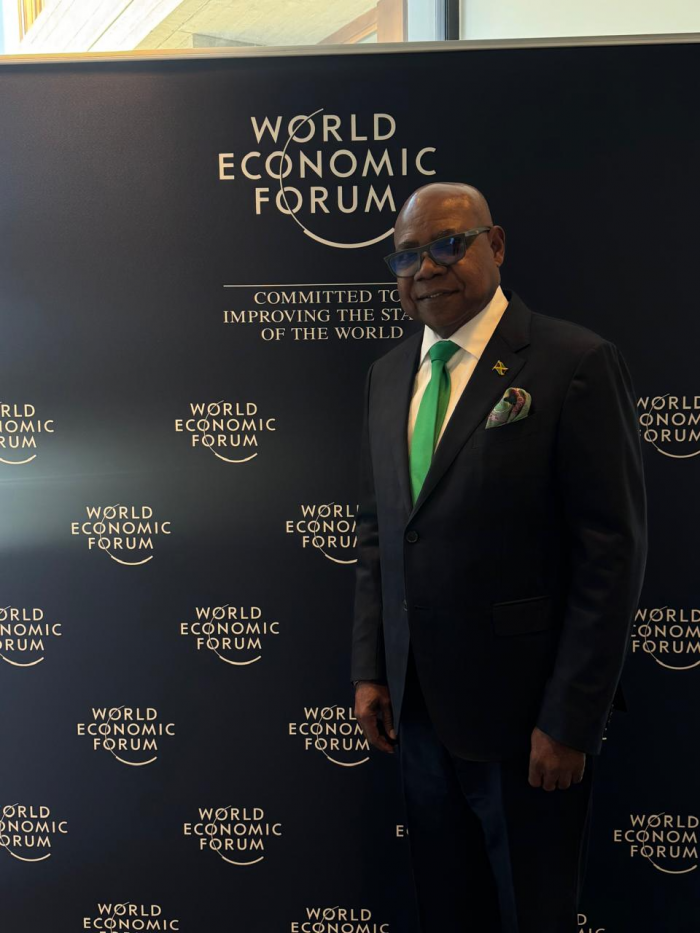


Jamaica’s Minister of Tourism, Hon. Edmund Bartlett, has called for tourism to be placed “at the nucleus of global development”, using Jamaica’s emerging Tourism 3.0 model to make the case for an industry measured not simply by visitor arrivals and earnings, but by the prosperity, security and resilience it creates for local people.
Addressing the World Economic Forum in Geneva, Bartlett set out an ambitious vision for a new era of tourism development, while renewing his call for the creation of a Global Tourism Resilience Fund, with a proposed mobilisation ambition of US$10 billion and dedicated support for Small Island Developing States and other highly tourism-dependent economies.
“I come before you with a conviction born of Jamaica’s experience: tourism belongs at the nucleus of global development,” Bartlett said.
“Consider what stands behind a visitor’s journey. A farmer has planted. A builder has worked. A young person has learned a language. A musician has kept a tradition alive. A family has invested its savings in a business. The visitor encounters a destination. Behind that encounter stands an economy, and behind that economy stand people with hopes for a better life.”
Bartlett argued that the responsibility of tourism policymakers is to make that connection work for those people.
“When tourism succeeds in the fullest sense, the farmer gains a dependable buyer, the worker gains a future, and the community gains the means to improve its own life. This is why tourism must occupy a central place wherever the world discusses sustainable development.”
He added that the ultimate test of tourism’s success must extend “beyond the visitor’s departure” to the life that continues within a destination after the visitor has gone.
Tourism as a global development system
The scale of tourism, Bartlett argued, means it can no longer be treated as a peripheral part of the global development conversation.
Citing World Travel & Tourism Council estimates, he noted that travel and tourism contributed US$11.6 trillion to the world economy in 2025 and supported 366 million jobs when its wider supply chains and spending supported by tourism incomes are included – equivalent to almost one-tenth of global output and approximately one in nine jobs.
“An activity of this scale belongs in our discussions of economic security, food systems, infrastructure and the future of work,” Bartlett said.
But scale also brings responsibility.
Tourism, he said, must protect the landscapes and cultures on which it depends, reduce emissions, use water responsibly, protect coastlines and ensure residents can continue to afford to live in destinations sought out by visitors.
“Sustainability becomes real when investment improves the destination for the people who call it home.”
Small islands face global risks with local resources
For Small Island Developing States, Bartlett said the challenge is particularly acute.
An island may depend on only a small number of airports and ports to connect it to international markets, while its hotels, homes and businesses often share the same vulnerable coastline. At the same time, destinations depend on international connections they cannot control and can be forced to borrow heavily to rebuild following disasters they did little to cause.
“When a hurricane closes a hotel, its consequences travel inland. A farmer loses an order. A driver loses a day’s earnings. A household postpones a school expense. Public revenue falls just as the need for public assistance rises.”
The pandemic demonstrated that vulnerability on an unprecedented scale, with international tourist arrivals falling by 74 per cent in 2020.
For Jamaica, more recent disruption has provided another reminder of the human consequences behind tourism recovery. Bartlett pointed to the reopening of Royalton Negril in August following Hurricane Melissa, which brought hundreds of employees back to work.
“Each returning worker represented a household regaining income. That is the human meaning of resilience,” he said.
“Small islands should never have to face risks of global origin with resources of local scale.”
Tourism 3.0: changing the measure of success
Bartlett said the answer is to make tourism a stronger instrument of development.
Small islands may not be able to manufacture every product at the scale of continental economies, but they can connect their culture, food, services and talent to international demand through tourism.
The challenge is to build those connections deliberately.
Farmers require information about demand, reliable transport and the ability to meet purchasing standards. Small businesses need working capital and fair access to contracts, while communities need a voice in investment decisions affecting their surroundings.
Used in this way, Bartlett argued, tourism can help diversify an island economy by turning the destination into a market for a much wider domestic productive base.
That philosophy lies at the heart of Jamaica’s Tourism 3.0 strategy.
“The prevailing model has too often measured success through more arrivals, more rooms and higher gross earnings,” Bartlett said.
“Arrivals matter. Investment matters. Earnings matter. But those measures leave fundamental questions unanswered. Who supplies the industry? Who owns the businesses? What security does the worker gain? What burden falls on the community? How much progress survives the next crisis?”
Jamaica’s answer is Tourism 3.0 – an attempt to make tourism an integrated national economy in which success is judged by the value created for Jamaicans.
Agriculture, manufacturing, culture, technology and other domestic capabilities are being brought into a closer relationship with the visitor economy, with the ambition of increasing local ownership and strengthening national prosperity.
“The central question has changed,” Bartlett said. “We must ask how much development each visitor helps us achieve.”
Jamaica builds its Tourism 3.0 model
Tourism 3.0 brings together what Bartlett described as a decade of experimentation, institution building and adaptation since 2016.
Rather than being centred around a single programme, the Jamaican model combines worker security, professional development, domestic supply chains, entrepreneurship, technology and resilience.
Among its foundations is the Tourism Workers Pension Scheme, supported by legislation in 2019 and launched in 2022. The scheme extends across occupational categories and includes eligible self-employed workers.
“The person who spends a working life caring for visitors deserves to approach later life with security,” Bartlett said. “A successful destination must make room in its definition of prosperity for that person’s future.”
The Jamaica Centre of Tourism Innovation provides another component, linking professional development with opportunities for career progression. According to the Ministry, more than 25,000 workers have been trained and certified.
“Professional dignity requires recognised competence, fair opportunities and a credible path of advancement. Changing a job title alone cannot deliver it.”
Connecting farmers with tourism
Tourism 3.0 also seeks to strengthen the connection between Jamaica’s tourism industry and its domestic suppliers.
The Tourism Linkages Network provides local businesses and producers with routes into the tourism economy, while its Agri-Linkages Exchange – ALEX – connects farmers directly with hotels and other buyers.
In 2024, ALEX facilitated more than J$450 million in produce sales.
“A hotel purchase can support a farmer’s next planting, a rural household and the businesses serving that community,” Bartlett said.
“This is how tourism’s reach extends beyond the resort gate.”
The next stage is Jamaica’s Local First initiative. A task force was established in 2025, with the policy being advanced to enable more Jamaicans to supply, own and earn within tourism.
Jamaica is also developing arrangements for a Tourism Supply Logistics Centre designed to address some of the practical barriers separating domestic producers from large tourism buyers.
Alongside this, the Tourism Innovation Incubator is creating opportunities for Jamaican entrepreneurs to develop new tourism products and technology.
Under Tourism 3.0, Bartlett said the ambition is for Jamaicans to own more of the solutions used by the industry.
“Artificial intelligence and digital platforms should help our people become more capable and productive. Their value should be visible in better opportunities for the worker and the entrepreneur.”
Making resilience an institution
Resilience forms another major pillar of Jamaica’s approach.
The Global Tourism Resilience and Crisis Management Centre, headquartered at The University of the West Indies in Jamaica and established in 2019, provides a permanent institutional base for research, training and practical crisis knowledge.
Jamaica’s COVID-19 Resilient Corridors also provided operational lessons in destination assurance, coordination and reopening during the pandemic.
The country subsequently helped take the resilience agenda to the international stage through its leadership in establishing the United Nations observance of Global Tourism Resilience Day.
“These efforts express a duty we all share: to prepare while there is time, and to make knowledge available wherever livelihoods are at risk,” Bartlett said.
Taken together, he described the initiatives as making Jamaica a “working proof of concept” for Tourism 3.0.
“We can point to a functioning pension scheme, certified workers, farmers selling through a digital exchange and an institution dedicated to resilience. These are tangible foundations on which the next phase can build.”
Bartlett also acknowledged that the model remains a work in progress.
“Local First must deliver on its promise. Benefits must reach more communities. We must continue to measure who gains, who remains excluded and how well our institutions perform when tested.”
He invited other countries and international institutions to examine Jamaica’s approach, test its results and learn from both its achievements and difficulties.
“Our proposition is that a small island can contribute a model of development with global relevance.”
Five foundations for Tourism 3.0
Jamaica’s official Tourism 3.0 framework rests on five long-term policy priorities: human capital; sustained reinvestment in destinations, products and communities; modern infrastructure and visitor experience; air connectivity and travel facilitation; and destination assurance and resilience.
Bartlett argued that these priorities could provide a framework for other destinations to examine and adapt.
Human capital should mean investing in recognised skills and worker security and assessing whether people genuinely advance.
Reinvestment should connect tourism income with stronger local businesses, communities and better places to live.
Modern infrastructure should provide services residents can depend upon while improving the visitor experience and strengthening the ability of destinations to withstand disruption.
Connectivity should strengthen access while pursuing cleaner transportation and greater cooperation between destinations.
And resilience should move from being treated as a response to individual crises to becoming part of everyday destination management.
Bartlett proposed that destinations complement conventional arrival and earnings statistics with public reporting on local value retained, worker security, community benefit, environmental performance and recovery capability.
“What we measure should reveal whether prosperity reaches people and whether it can endure.”
Call for a US$10 billion Global Tourism Resilience Fund
Despite the importance of national policies, Bartlett warned that even well-designed tourism strategies encounter a fundamental problem when major shocks strike: finance.
“Knowledge cannot repair a bridge without financing. A trained worker cannot wait indefinitely for an employer to reopen. A small enterprise cannot survive on a promise of assistance after its cash has run out.”
“The world’s tourism economy needs a financial instrument equal to its exposure.”
Bartlett therefore renewed his call for a Global Tourism Resilience Fund, including a dedicated window for Small Island Developing States and other highly tourism-dependent economies.
He proposed an initial mobilisation ambition of US$10 billion, built in stages, while stressing that its eventual scale should follow a transparent assessment of need and the commitments that can be secured from partners.
“Resilience must become an investment we make before the loss.”
The proposed US$10 billion figure is a mobilisation ambition rather than an existing capital commitment, with institutional hosting, eligibility, governance and contributions still requiring agreement between potential partners.
Three financing windows
Bartlett proposed that the fund operate through three financing windows.
The first would focus on prevention, supporting resilient infrastructure, early-warning systems, business preparedness and protection of natural assets including reefs and mangroves.
A second would provide rapid assistance following a shock, helping eligible workers and smaller enterprises bridge interruptions in income while keeping essential services operating.
A third would finance recovery designed to reduce future exposure, ensuring that reconstruction leaves communities better protected against the next crisis.
The fund could draw on public contributions, development finance, philanthropy and willing private-sector partners across the travel economy.
Grants and carefully designed concessional financing, Bartlett argued, could help vulnerable states avoid repeated cycles of unaffordable disaster debt.
Governance would also be critical. Bartlett said countries and communities benefiting from the fund should have a role in its governance, while eligibility should reflect both tourism dependence and vulnerability.
Published criteria, independent audits and clear measurements of results would be required to provide confidence for both contributors and citizens.
He invited multilateral development banks to help design an appropriate financial home for the initiative, while organisations such as the Global Tourism Resilience and Crisis Management Centre could contribute technical expertise, subject to agreement among partners.
“Every protected livelihood would be part of the return on this investment.”
Bartlett challenges WEF to put tourism at the centre
Bartlett used his address to issue a direct invitation to the World Economic Forum to build upon its existing work on tourism and use its convening power to give the sector a more central position within the global development agenda.
He called for tourism’s links with climate resilience, food security, decent work and investment to receive a sustained place in the core conversations at Davos.
He also proposed a rigorous international examination of Jamaica’s Tourism 3.0 experience, bringing together international partners and independent expertise to establish what works, under what circumstances and how the model could be adapted by governments and investors elsewhere.
Most significantly, Bartlett called on the WEF to help convene a founding coalition for the Global Tourism Resilience Fund.
“Bring destinations together with those who invest in tourism, benefit from its trade and finance its future,” he said, calling for a design mandate and initial expressions of support at Davos 2027.
Alongside the financial initiative, Bartlett proposed advancing a compact for tourism workers based around recognised skills, retirement security and fair opportunity.
“Let our ambitions for the industry’s future be matched by our ambitions for the people who sustain it.”
Putting human dignity at the heart of tourism
Bartlett concluded by returning to the people whose livelihoods ultimately depend upon the decisions taken by governments, investors and the global tourism industry.
“The ultimate measure of this work will be found far from this room,” he said.
“It will be found in the farmer who plants with confidence because a market is within reach. In the young professional who can build a career at home. In the worker who can face retirement with dignity. In the island community that can withstand a storm without surrendering its future.
“These are the lives our decisions must serve.”
For Bartlett, Jamaica’s experience provides a potential model, Tourism 3.0 provides the framework, and a Global Tourism Resilience Fund could provide the financial protection necessary to ensure that development gains are not erased by the next global crisis.
“Let us place tourism at the nucleus of development, and let us place human dignity at the heart of tourism,” Bartlett said.
“Let the prosperity we create reach further than the visitor travels. Let it remain in the community. Let it endure through the crisis. Let it open a future for the child who will inherit the destination.
“That is the promise before us. Let us give it the institutions, the investment and the resolve it deserves.”