

India wants Brics to become more useful to businesses, particularly by improving trade flows within the grouping and making global supply chains less vulnerable to shocks
India is heading into the 18th Brics summit with an agenda that is broader than the blocs long-running debate over the dollar.
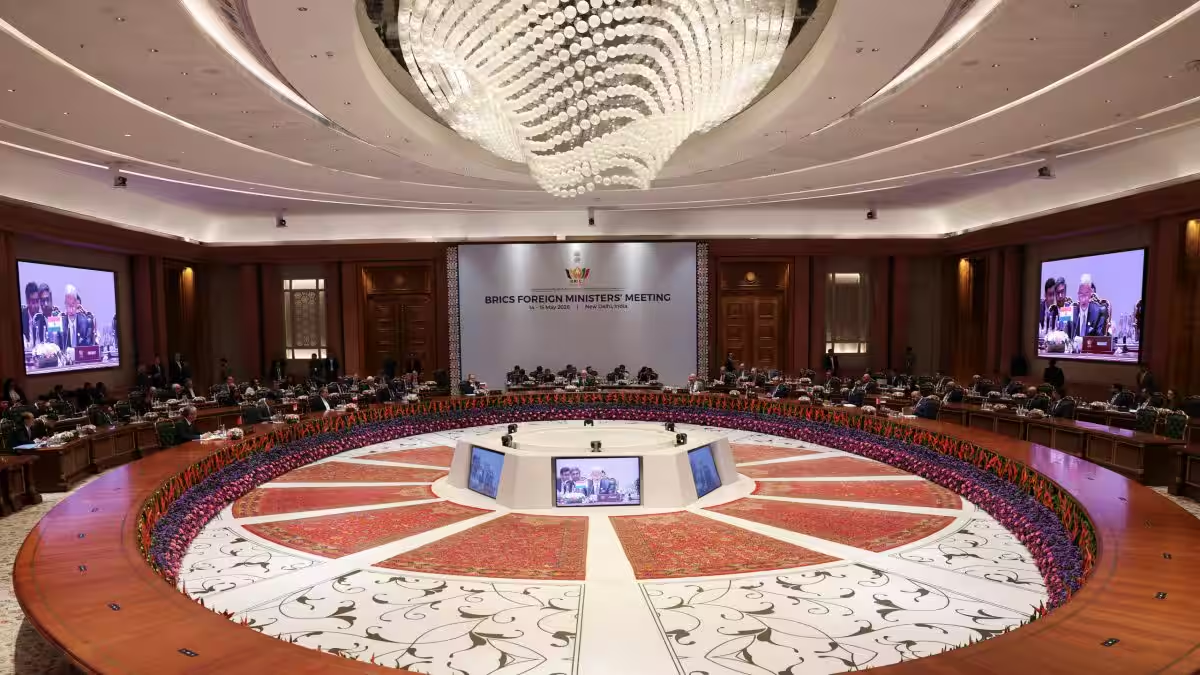
The September 12-13 summit in New Delhi will bring together the expanded Brics grouping at a time when trade tensions, supply-chain disruptions, geopolitical conflicts and rapid technological change are reshaping the global economy. India, which assumed the Brics chairship on January 1, is seeking concrete cooperation in trade, cross-border payments, supply chains, technology and artificial intelligence, energy, development finance and global governance reform.
After months of ministerial meetings, working groups and negotiations, the New Delhi summit will be the point at which India tries to convert that agenda into political commitments and deliverables.
Trade is the immediate economic priority
India wants Brics to become more useful to businesses, particularly by improving trade flows within the grouping and making global supply chains less vulnerable to shocks.
At the Brics Trade Ministers Meeting in Jaipur in August, members advanced work on the Brics Strategy for Economic Partnership 2030. The proposed strategy covers trade in goods and services, investment, the digital economy, industry, innovation and financial cooperation. Ministers also backed measures aimed at expanding the participation of MSMEs in global trade.
 More from Business
India has also been pushing for more balanced intra-Brics trade and more diversified global value chains.
That matters because the expanded group brings together major manufacturing economies, energy producers, commodity exporters and some of the worlds largest consumer markets.
A supply-chain framework is expected to be among the important outcomes India will seek at the summit. The objective is not to create a closed trading bloc, but to improve resilience against disruptions caused by wars, shipping problems, export restrictions and overdependence on particular suppliers.
India is also making clear that Brics cooperation should complement, rather than replace, the multilateral trading system. At the Jaipur meeting, New Delhi backed the WTO as the core of global trade governance while defending special and differential treatment for developing economies.
Payments and the practical version of de-dollarisation
Cross-border payments are likely to attract major attention in New Delhi. India is promoting greater use of national currencies in trade and is exploring ways for Brics payment systems to work more closely with one another.
Recent discussions have included the possible linking of fast payment systems and central bank digital currencies. India is also expected to push Brics partners towards more seamless cross-border digital payment arrangements.
This is important because the most realistic Brics financial project is not a common currency. The members have widely different monetary systems, financial markets and policy priorities. Building payment connectivity and enabling local-currency settlement is far more achievable than creating a single currency.
For India, it also fits with the broader push to increase the international use of the rupee.
The NDB is the blocs financial tool already in place
Brics does not need to start from zero on development finance. The New Development Bank, created by the founding Brics members in 2015, already finances infrastructure and sustainable development projects in emerging markets. The bank has been working to expand local-currency financing and broaden its use of instruments such as guarantees and trade finance.
For India and other developing economies, the NDB provides something that political declarations cannot, a mechanism capable of putting capital behind infrastructure and development projects.
That makes strengthening the bank and expanding its role one of the more practical elements of the Brics economic agenda.
AI and technology are moving to the centre
Artificial intelligence is becoming one of the fastest-growing areas of Brics cooperation. During India’s chairship, the grouping has discussed AI, high-performance computing, quantum technologies, advanced materials, biotechnology and digital infrastructure.
The Brics science and technology ministers adopted the Chennai Declaration in August, stressing collaborative research, innovation capacity, young innovators and technology cooperation among developing countries.
At the Brics communications track in Pune, members focused on four areas, resilient digital infrastructure, cybersecurity and trustworthy ICT, digital skills and capacity building, and innovation, startups and entrepreneurship.
The significance goes beyond technology policy. For emerging economies, access to computing capacity, digital infrastructure, skills and AI systems is increasingly linked to productivity, competitiveness and economic sovereignty. India wants Brics to become a platform for cooperation in these areas rather than simply a market for technologies developed elsewhere.
Energy security remains a strategic concern
Energy is another area where Brics has considerable collective weight.
The grouping includes some of the worlds biggest energy producers and consumers. Under India’s chairship, discussions have covered energy security, sustainability and innovation, including cooperation on smart grids and energy storage.
The challenge is that Brics members do not have the same energy mix or the same development needs.
India has therefore argued for a transition that recognises different national circumstances while promoting cleaner technologies and greater energy security.
The issue has become more urgent as geopolitical conflicts, disruptions to energy supplies and rising electricity demand create new risks for both producers and consumers.
Food security and climate are part of the same resilience agenda
India has also brought agriculture and climate into the economic discussion.
At the Brics Agriculture Ministers Meeting in June, members focused on food security and nutrition, agricultural trade, climate-resilient farming, and innovation and investment in future-ready food systems.
The logic is increasingly straightforward, climate shocks, supply disruptions and restrictions on food exports can quickly become inflation and economic stability problems.
Climate cooperation under Brics is similarly being framed around the needs of developing economies, with greater attention to technology, investment and the cost of transition.
Global governance reform remains the political core
Behind the economic agenda lies a bigger ambition. India wants Brics to strengthen the voice of emerging and developing economies in institutions that still reflect an older global balance of power.
That means pushing for reform of the United Nations and UN Security Council, IMF, World Bank and WTO, among other international institutions.
External Affairs Minister S Jaishankar has repeatedly linked the Brics agenda to what India describes as the need for a more representative and effective multilateral system.
This is also where Brics faces its biggest internal challenge.
The 11 members do not share identical geopolitical interests. India and China have their own strategic competition. Russia has a very different relationship with the West from countries such as India, Brazil or the UAE. Questions involving conflicts and security can therefore be much harder to negotiate than economic issues.
The real test for the New Delhi summit
Brics has grown dramatically since the original grouping of Brazil, Russia, India and China was established in 2009 and South Africa joined in 2011.
The expanded grouping now includes Brazil, Russia, India, China, South Africa, Egypt, Ethiopia, Iran, the UAE, Indonesia and Saudi Arabia, although Saudi Arabias status has been described differently by some official sources. The expansion has increased the blocs economic weight, but also made consensus more difficult.
That is why the September summit is less about announcing another grand vision and more about showing whether Brics can deliver practical cooperation.
India wants progress on trade and supply chains. It wants payment systems that can actually connect markets. It wants the NDB and local-currency finance to play a larger role. It wants Brics countries to cooperate on AI, digital infrastructure and critical technologies.
And it wants a stronger collective voice for the Global South in global institutions.
The broad objective is therefore not simply to build an anti-Western bloc or replace the dollar.
It is to create a larger economic and diplomatic platform where emerging economies can cooperate on the systems that increasingly determine their growth and strategic autonomy.
The September 12-13 summit in New Delhi will show how much of that ambition can be converted into concrete outcomes.