


A local-currency settlement system would simply allow two countries to trade using their existing currencies, such as the rupee, yuan, rouble or dirham
The question of whether Brics will create a common currency is likely to return to the spotlight as the grouping prepares for its summit in New Delhi this month. But India has already made its position clear: it does not support the creation of a separate Brics currency.
Instead, Brics finance ministers and central bank officials are discussing measures that could allow member countries to conduct more trade in their own currencies and make cross-border payments without relying as heavily on existing dollar-based channels.
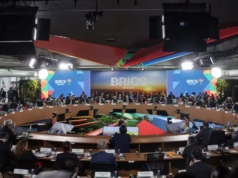
Finance Minister Nirmala Sitharaman is chairing a meeting of Brics finance ministers on September 1-2 in New Delhi, ahead of the leaders summit on September 12-13. The discussions include financial mechanisms, digital currencies and ways to increase intra-Brics trade using national currencies, according to officials.
A common currency would mean Brics countries creating a new currency shared by the bloc. A local-currency settlement system would simply allow two countries to trade using their existing currencies, such as the rupee, yuan, rouble or dirham.
The second option is what Brics is actively working on.
India rejects a common Brics currency
Commerce and Industry Minister Piyush Goyal said in August that India is not in favour of a Brics currency and does not support any proposal to introduce one.
 More from Business
His comments came after a two-day meeting of Brics trade and industry ministers in Jaipur. “India is not in favour of a Brics currency,” Goyal said, making clear that New Delhi opposes a separate currency for the grouping.
India’s position also fits with the approach it has taken in earlier Brics discussions: increasing the use of national currencies in trade rather than creating a new common monetary unit.
Brazil has also played down the prospect of a common Brics currency. During his February visit to India, Brazilian President Luiz Inacio Lula da Silva supported greater use of local currencies in bilateral trade but rejected the idea that Brics was working towards a common currency.
Russia too said in February that a single Brics currency was not on the agenda, while describing increased use of national currencies for settlements, investment and infrastructure financing as a priority.
What Brics is actually discussing
The current discussions are centred on making cross-border payments easier and expanding the use of national currencies.
The 2025 Brics leaders declaration called on finance ministers and central bank governors to continue work on the Brics Cross-Border Payments Initiative. It also backed efforts to make payment systems across member countries more interoperable and to support faster, cheaper and more accessible cross-border transactions.
Brics finance ministers had already endorsed the use of local currencies in international trade and financial transactions in earlier discussions. They also supported stronger correspondent banking links between member countries to facilitate local-currency settlements.
For businesses, the concept is relatively simple. Suppose an Indian company imports goods from another Brics country. Instead of converting the rupee into dollars and then using dollars to settle the transaction, the two sides could increasingly arrange payment directly between their national currencies. That does not eliminate the dollar from global trade. It simply reduces the number of transactions in which the dollar has to be used as an intermediary currency.
India has proposed linking digital currencies
New Delhi has also backed a digital route. The Reserve Bank of India has proposed exploring links between the official digital currencies of Brics central banks to facilitate cross-border trade and tourism, according to Reuters sources familiar with the proposal.
The idea is to improve the ability of national digital currencies to work across borders rather than create a new Brics currency.
The proposal is significant because central bank digital currencies, or CBDCs, are issued by central banks in the same way as conventional national currencies. In India, the digital rupee is the RBI’s CBDC.
The finance ministers’ discussions in New Delhi are therefore expected to examine digital currencies alongside broader payment mechanisms.
Why the dollar remains central
Even as Brics pushes for greater use of national currencies, the US dollar continues to dominate the international financial system.
The latest IMF data show that the dollar accounted for 57.13 per cent of global official foreign-exchange reserves in the first quarter of 2026, up from 56.42 per cent in the previous quarter. Total official foreign-exchange reserves stood at about $13.1 trillion.
That makes a rapid shift away from the dollar difficult.
A currency used widely for international trade and reserves needs deep financial markets, broad convertibility, liquidity and confidence among governments, banks and investors. Creating a new common currency would therefore require much more than an agreement between Brics governments.
This is one reason current Brics initiatives have focused on payments and settlement mechanisms rather than a single currency.
Brics has already moved towards local-currency trade
The shift is not entirely theoretical. China and Russia have sharply increased the use of their own currencies in bilateral trade. Carnegie India noted that 99 per cent of China-Russia bilateral trade was being conducted in the yuan and rouble as of November 2025. It also pointed to payment infrastructure such as China’s Cross-Border Interbank Payment System, or CIPS, and Russia’s System for Transfer of Financial Messages, or SPFS, as part of the wider effort to build alternatives to traditional Western financial channels.
But these systems remain far smaller than the established global financial infrastructure centred on the dollar and SWIFT.
That means Brics is not currently replacing the dollar-based financial system. It is developing additional channels alongside it.
What could come out of the September summit?
The clearest developments to watch are therefore likely to be agreements on local-currency settlements, payment-system interoperability and digital-currency cooperation, rather than the launch of a new Brics currency.
The 2025 Brics declaration already set out work on a cross-border payments initiative, while India’s 2026 presidency has placed financial connectivity and trade facilitation among its priorities.
For India, the approach also has a domestic dimension. Greater use of the rupee in international transactions could support its broader push to expand the currency’s role in cross-border trade.
For other Brics members, particularly those seeking to reduce exposure to Western financial restrictions, local-currency settlements can provide another payment option.
But none of this amounts to a common currency.
As Brics meets in New Delhi, the immediate financial question is therefore less about creating a new currency and more about building a system in which member countries can trade, invest and settle payments using their own currencies more easily.