

As Washington and Beijing push for separate AI supply chains, Wall Street banks continue to fund Chinese tech while Chinese investors increase their exposure to US AI and semiconductor companies
The United States and China are trying to build separate artificial intelligence ecosystems. Their investors, however, are still putting money into both sides.
While Washington restricts China’s access to advanced chips and AI technology, US banks are helping Chinese technology companies raise money. At the same time, Chinese capital continues to flow into US technology and semiconductor stocks.
Wall Street banks have acted as bookrunners on 19 Chinese high-tech equity deals worth $17.2 billion so far this year, according to LSEG data cited by Reuters. That is nearly 30 per cent of total issuance in the sector.
Chinese money is also heavily exposed to US technology. US equities account for nearly half of the roughly 1 trillion yuan, or about $150 billion, managed by China’s outbound mutual funds. The value of US equities held by mainland Chinese and Hong Kong investors has risen 23 per cent over the past year to more than $750 billion, according to US data.
Why the money keeps crossing the AI divide
The reason is partly simple. Investors are looking for returns even as governments focus on strategic competition.
China is pushing to become more self-reliant in chips and AI. That has created demand for domestic companies developing alternatives to US technology. The US, meanwhile, is trying to secure its own AI supply chain and limit China’s access to advanced technology.
This has created investment opportunities on both sides.
US investment restrictions on sensitive Chinese technology do not cover every form of investment in publicly traded securities. That has allowed Wall Street banks to remain involved in Chinese technology listings despite the broader restrictions.
 More from Business
Wall Street banks have worked on more than a dozen Chinese AI and chip listings and follow-on share sales this year.
For example, Goldman Sachs, Morgan Stanley and Citigroup were among the global coordinators for optical components maker Zhongji Innolight’s $6.8 billion Hong Kong listing. Goldman Sachs and Morgan Stanley also worked on Hong Kong listings involving AI developer MiniMax and Chinese chipmakers.
JPMorgan underwrote a roughly $2.6 billion Hong Kong share sale by Victory Giant Technology, which supplies printed circuit boards for AI servers.
Chinese investors are also buying US AI exposure
The flow of capital is not one-way. Chinese holdings have risen this year in US semiconductor companies including Micron Technology, AMD, Sandisk, Lam Research and Applied Materials, according to data compiled by Sinolink Securities.
Investment in US AI funding rounds involving investors based in China or Hong Kong has also increased sharply. S&P Global Market Intelligence data shows such funding rose from about $436 million in 2023 to roughly $8.9 billion through mid-September this year.
The calculation is particularly relevant because neither the US nor China currently controls every part of the AI supply chain. The US has strengths in advanced chips, chip design and AI software, while China has built significant capabilities across manufacturing, hardware and a large domestic technology market.
What could change the investment equation
The biggest risk is that financial links eventually become subject to the same strategic restrictions now affecting technology.
Washington has already tightened controls on advanced chips, semiconductor manufacturing technology and some US investments linked to sensitive Chinese sectors. The US is also adding Chinese technology companies to lists tied to national security and military concerns.
Chinese investors face their own constraints when accessing US technology.
The lack of transparency around some offshore investment structures also makes it difficult to measure the full scale of Chinese exposure to US technology, according to Thilo Hanemann of Rhodium Group.
That means investors face a different kind of AI risk. It is no longer only about which company develops the better model or chip. Government decisions on exports, investment and national security can directly affect the value and accessibility of those assets.
AI could become a new area of US-China engagement
The financial links come just as Washington and Beijing are discussing whether they can establish a limited framework for managing AI-related risks.
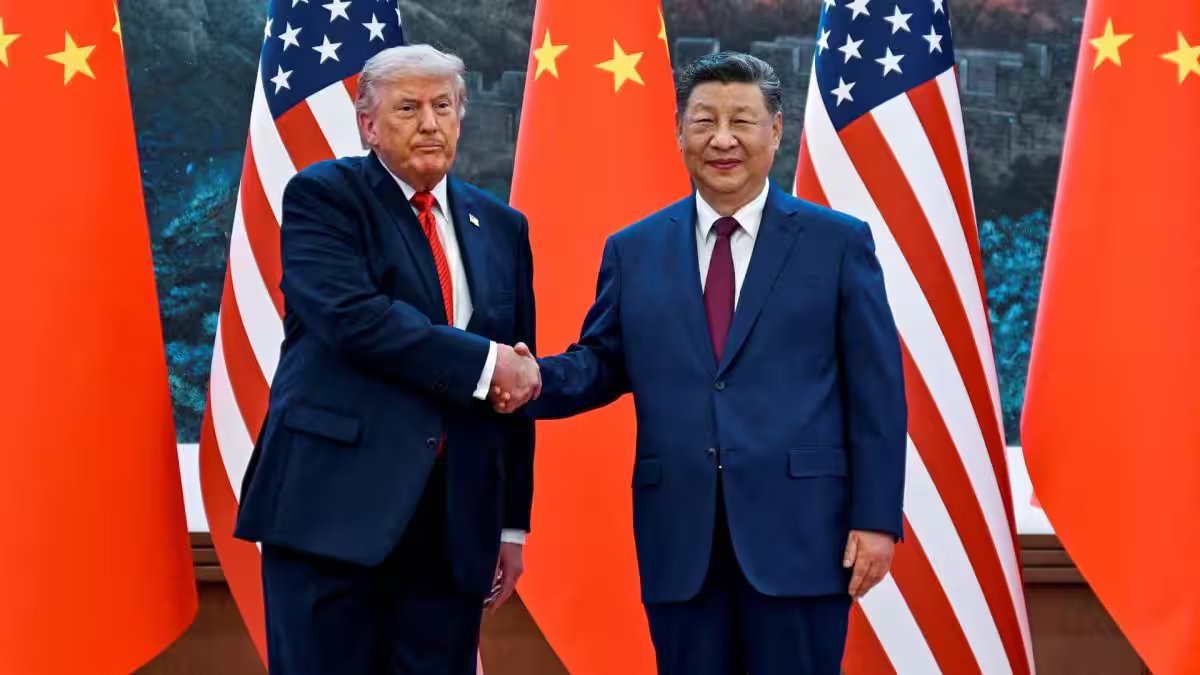
US Treasury Secretary Scott Bessent said Washington had proposed a US-China AI dialogue and a notification mechanism for serious AI incidents involving national security. The proposal is expected to be considered around President Donald Trump’s meeting with Chinese President Xi Jinping in Washington this week.
That does not mean the two countries are moving towards a common AI strategy. Their competition over chips, supply chains and technology standards remains.
But the proposed dialogue shows that competition and cooperation can exist at the same time.
For markets, the more immediate lesson is that the AI economy cannot yet be divided neatly into an American camp and a Chinese camp.
Capital continues to cross the divide because investors are looking at commercial opportunities that governments increasingly view through a national security lens.