

G20 trade ministers agree to condemn food trade coercion but fail to find common ground on excess industrial capacity and forced labour
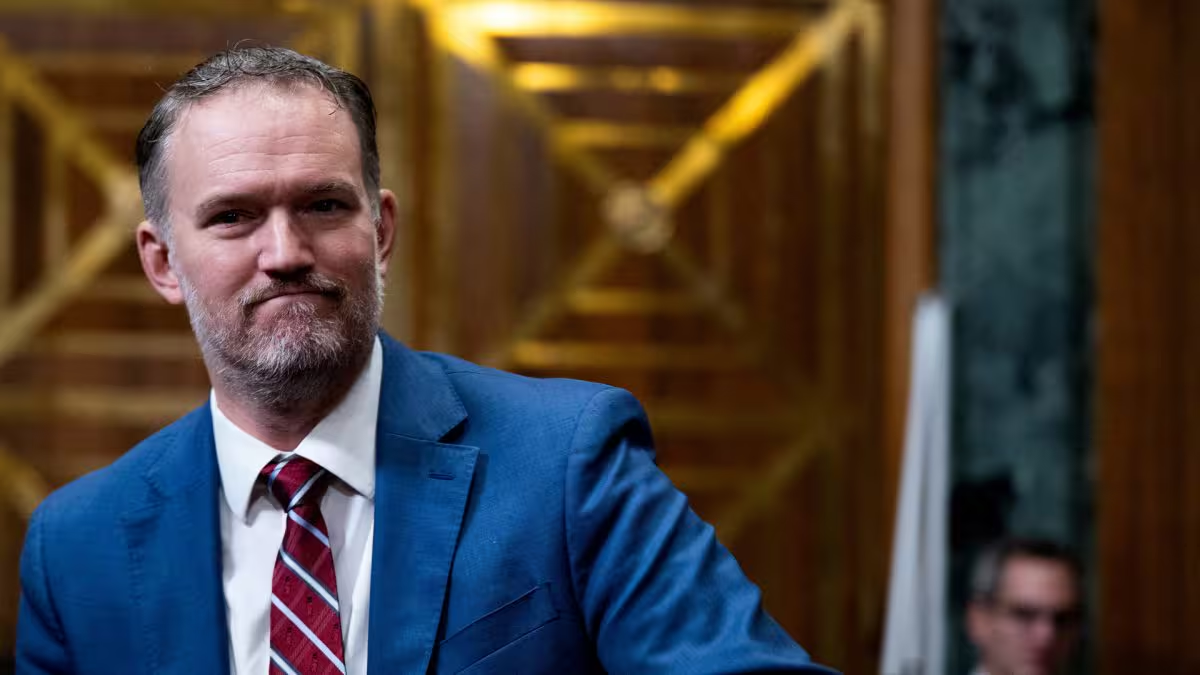
The G20 found common ground on condemning food trade coercion but remained divided over how to tackle excess industrial capacity and forced labour in global supply chains, US Trade Representative Jamieson Greer said.
The differences emerged at the G20 Trade Ministers’ Meeting in Milwaukee, where the US had pushed discussions on four areas of global trade. These included the use of food as an economic tool, structural excess capacity and production, the Most-Favoured-Nation tariff system and forced labour.
Greer said there was broad agreement among G20 members that excess industrial capacity was a problem. But ministers could not agree on a joint response.
“Nearly all countries agree that this is an issue that requires action,” Greer told reporters.
He said existing trade remedies were inadequate to address the problem. The US, he added, had therefore taken unilateral tariff measures to protect its industries.
G20 fails to agree on excess capacity
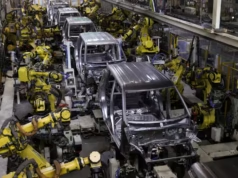
The debate over excess industrial capacity has become a major issue for global manufacturers and trade policymakers.
Greer said production that significantly exceeds domestic demand can spill into international markets and put pressure on producers and workers in other economies.
 More from Business
“Nearly all countries agree that our current system of trade remedies or responses is inadequate to solve this problem,” he said.
Greer did not identify the countries that prevented consensus.
European Trade Commissioner Maros Sefcovic said separately that Europe wanted more coordinated action on the issue. He said excess production had grown into a problem that could threaten important European industries, including automobiles and steel.
Sefcovic warned that a sharp increase in exports could put entire sectors under pressure within weeks or months.
The issue has been particularly contentious in discussions over industrial production in China. Beijing has rejected accusations that its industrial policies have created excess capacity and has argued that Western governments are using the issue to justify protectionist measures.
The Global Forum on Steel Excess Capacity, which met alongside the G20 gathering, separately reached agreement on a framework for cooperation on steel overcapacity.
Food trade coercion
The ministers did reach agreement on condemning the use of food and agricultural trade as a coercive tool.
The G20 was expected to issue a joint statement opposing coercive trade actions involving food, agricultural products and farm inputs.
The issue was one of the four priorities set by the US for its G20 trade presidency. Greer has argued that restrictions involving food and agricultural supplies can have consequences for economies and consumers beyond the immediate trade dispute.
India, however, stressed the need to distinguish between coercive trade measures and legitimate policies aimed at protecting food security.
Commerce and Industry Minister Piyush Goyal said food should remain a source of security, stability and cooperation.
No consensus on forced labour
The G20 ministers also failed to agree on language condemning forced labour in global supply chains.
Greer has argued that products made using forced labour can gain an artificial cost advantage and distort competition in international markets.
The issue has been a major part of the US trade agenda. Washington has linked forced labour concerns to tariffs and other trade measures affecting imports from several economies.
Greer said the US would continue discussions with countries that share its concerns even after the Milwaukee meeting.
The failure to reach consensus on forced labour came alongside the broader disagreement over excess industrial capacity, leaving two of the US priorities without a joint G20 position.
US wants MFN tariff system reviewed
The ministers also discussed a US proposal to reconsider the Most-Favoured-Nation, or MFN, system that has been a central principle of global trade.
Under the MFN principle, WTO members generally provide the same tariff treatment to other members. Greer argued that the unconditional application of the system should be reviewed.
“For us, we think that the principle of unconditional Most Favored Nation tariffs warrants reform,” he said.
Greer said the existing system could fail to promote reciprocity and balance in global trade and could allow some countries to benefit without offering equivalent treatment in return.
The US did not seek a joint G20 statement on MFN reform. Greer described the issue as a longer-term discussion that Washington wanted to begin among major economies.
The proposal reflects the wider US push to reconsider parts of the global trading system established after World War II. Greer had argued at the opening of the meeting that existing trade rules were not designed to deal with challenges such as excess production, economic coercion and forced labour.
India-US trade talks
The G20 meeting also provided an opportunity for India and the US to discuss their bilateral trade negotiations.
Goyal met Greer on the sidelines of the meeting and said the two sides had a “productive discussion” on the early conclusion of an interim agreement under the India-US Bilateral Trade Agreement.
The Milwaukee meeting therefore produced agreement on food trade coercion but left major differences over excess industrial capacity and forced labour unresolved.
Greer said the US would continue working with like-minded trading partners on these issues beyond the G20 meeting.