

In the wake of Purab Anga Gayaki’s revival and consequent popularity in Bengal, it is becoming evident that this rich style is undergoing a gradual transformation. Its rural charm seems to be giving way to a glitzy, urbane showmanship that thrives on khayal’s ornate style. I hear many young vocalists making thumris walk on stilettos of complex taans. The seasonal kajris in thumri (read: khayal) anga are also being treated in the same way. Is this a desirable trend?
To analyse this issue, the Purab Anga Gayaki (PAG) Parivar, with the support of Sree Satyananda Devayatan, recently organised a baithak at Devayatan Hall. It brought together the gurus and scholars associated with the PAG Project, patronised by Vinod Kapur, the inspiring personality behind the VSK Baithak, in New Delhi.
Almost two decades ago a nationwide talent hunt was launched as ‘Purab Anga Gayaki Utsav’ by Vinod Kapur as the first step to bring kajri out of khayal’s shadows and establish it as an independent style. Guided by guru Girija Devi, vidushi Purnima Chaudhuri and other eminent musicians, he identified many talents with desired mizaj for thumri, dadra, kajri, and chaiti that come under the umbrella of Purab Anga Gayaki.
The visionary found Bengal as a treasure trove of this emotive, pada-pradhan (lyric-based) gayaki, because Bengalis took to it like fish to water. Girija Devi’s (Appaji) passing in 2017, preceded by Purnima Chaudhuri’s untimely demise, was a huge setback. Yet, unfazed, Vinod Kapur encouraged the contestants to pursue advanced training and research under gurus such as Manju Sundaram (Benares) and Dalia Rahut (Kolkata). As a result, the PAG Parivar stands out for its authenticity, refusing to lean on the sensibilities of khayal, while maintaining its classicism.
My brief introductory speech explored how our ancestors communicated through pleasing frequencies of sound, drawn from Nature, which formed syllables and resonated within the human body. These sounds evolved into melodic notes, with melody becoming an outpouring of joy and sorrow. Over thousands of years, some melodies were shaped by grammar and evolved into classical music, while those that resisted such formats became folk songs.

The legendary Hindustani vocalist Siddheshwari Devi, whose repertoire encompassed khayals, dhrupads, dadras, tappas, kajris, chaitis, horis, and bhajans.
| Photo Credit:
Special Arrangement
The Purab Anga Gayaki represents a vast repository of women’s emotions, often caged by the social changes of the medieval period when women were confined to their homes, while their lovers or husbands lived in ‘pardes’ to earn a living. These songs portrayed a pining nayika, particularly during the monsoon festivities, for example — ‘Chhayi kari badariya anganawa ho Ram…. morey sainya bidesawa se na aaye ho’.
Sudha Dutta, Appaji’s daughter, was born and brought up in Benares, and had witnessed these rituals as a child. She corroborated that ritualistic songs form a major part of the gayaki. She also described a Rakhi-centric ritual. The demanding refrain, ‘Hamko sawan mein jhulani gadhay de, piya’, speaks volumes about a woman’s status in her husband’s household. ‘Beeran Bhaiya’ becomes the central figure of the festival: sometimes the brother is invited to take her back to her parental home; at other times, she refuses to go with him, declaring, ‘Sawanwa mein na jaibai, nanadi.’ These lively Mizapuri kajris cannot accommodate long, awe-inspiring taans or other aspects of khayal. They are, instead, known for their emotional depth.
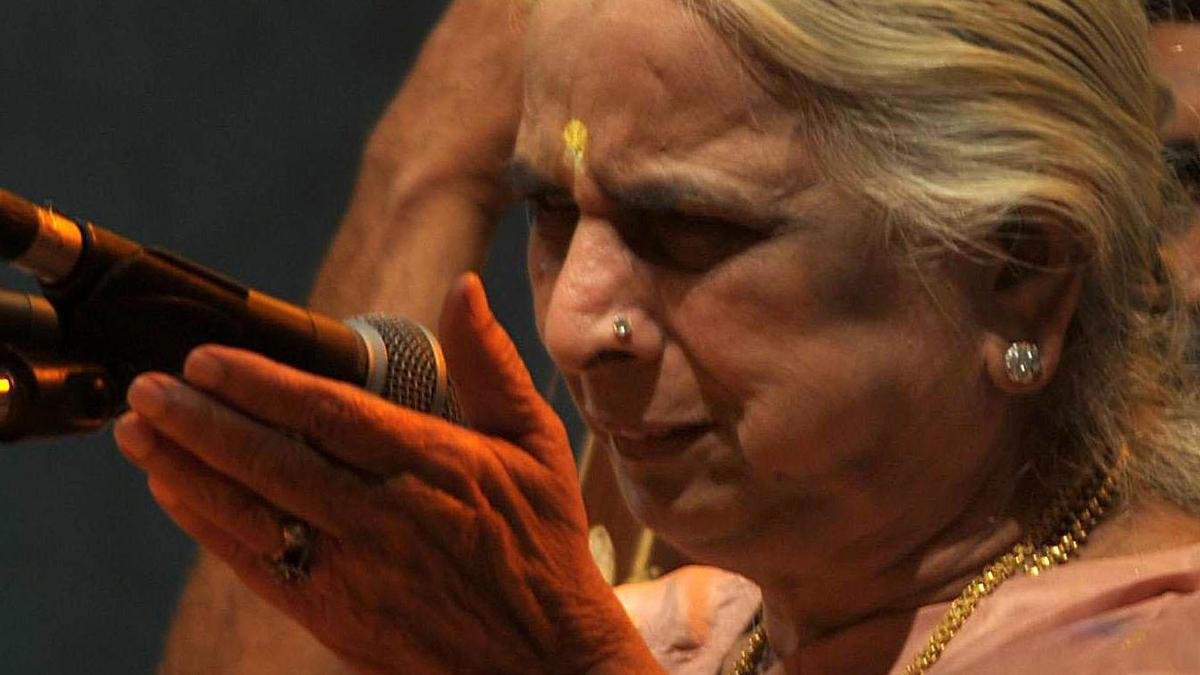
The thumri-anga kajris, as demonstrated by Dalia, can step into the classical arena without surrendering their individuality. Both Girija Devi and Siddheshwari Devi would enjoy singing bol-banav kajris in the thumri anga. They also sang bandishi kajris or kajris in the tappa anga. Appaji would cleverly change some expressions such as Dil Jani to suit the sensibilities of a changing era. It became ‘Kahanwa mano O Radharani’. Sucheta Ganguly, Appaji’s senior disciple, rendered it beautifully without the aid of a microphone.

Purab Anga Gayaki exponents — Sucheta Ganguly, Madhumita Chattopadhyay, Bishnupriya Chakraborty, and Nandini Chakraborty — presented a melodious demonstration.
| Photo Credit:
Special Arrangement
So did a few of Purnima Chaudhuri’s senior disciples, led by Madhumita Chattopadhyay, Nandini Chakraborty and Bishnupriya Chakraborty. Purnima particulary enjoyed singing ‘Hamko sawan me’, where she displayed her command of rhythm. Talfirta (swapping talas in between stanzas) was a striking feature of her rendition. Her lively, rhythmically charged Kajris are, sadly, becoming increasingly rare..
It turned out to be a gathering of long-lost friends, who came away with a clearer understanding of the many varieties of kajris. Bol-banav ki kajri of thumri anga, bandishi kajri of khayal anga and tappa anga ki kajri may accommodate, to some extent, khayal features like taans; but most of the dadra anga kajris and Mirzapuri kajris are too lively and narrative by nature to be tampered with.
They are best left with their rural simplicity and delicacy, along with the age-old tradition of intertwined group dancing as found in Chalti Kajris such as ‘Gheri gheri aayi sawan ki badariya na’.
Most importantly, they must learn to find the anecdotes related to each composition. ‘Radhe bina laage na mora jiya’ drew everyone’s attention when Dalia narrated the incident that led Appaji to compose this popular kajri while experiencing the agony of separation from a companion.
Above all, the Purab Anga Gayaki demands clear and flawless enunciation. Bengal is notoriously known for ‘Bhrashta uccharan’. This needs to change in this era of highly educated musicians.
Published – October 07, 2026 12:35 pm IST