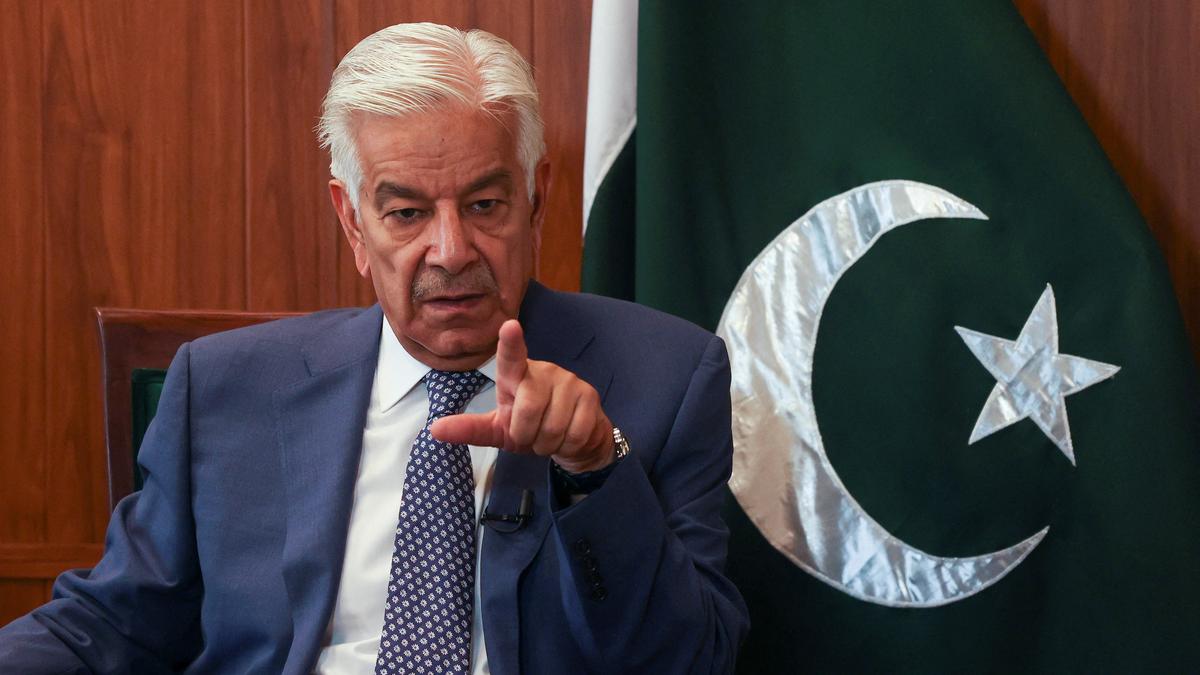

Speaking in Parliament, Khawaja Asif criticised Islamabad’s decision to re-enter the Afghanistan conflict after 1999, saying Pakistan once again aligned itself with Washington in pursuit of US backing, an approach he said ultimately proved disastrous for the country.
In one of his most forceful comments to date, Pakistan’s defense minister Khawaja Asif accused the United States of using Islamabad for its strategic ends before dismissing it as “worse than toilet paper.”
Speaking in Parliament, Asif claimed that Pakistan suffered long-term consequences from its decision to re-align with Washington after 1999, especially with regard to Afghanistan.
He described the pursuit of US backing as a grave miscalculation whose consequences Pakistan continues to bear decades later.
MISUSE OF JIHAD
Asif denied that Pakistan’s engagement in the Afghanistan war was motivated by religious obligation, defying decades of official narrative. He called the framing deceptive and harmful, acknowledging that Pakistanis were organized and sent to fight under the banner of jihad.
Asif claimed that in order to justify these conflicts, even Pakistan’s educational system was altered, and that many of these ideological shifts are still in place today.
He maintained that the conditions never justified a declaration of jihad and contended that American geopolitical objectives, not any true religious necessity, drove the anti-Soviet struggle in Afghanistan throughout the 1980s.
The defense minister claims that Pakistan’s involvement in foreign conflicts caused long-term instability and social harm that has not yet been completely repaired.
USED AND THROWN AWAY
According to Asif, the consequences of realigning with the US after 1999 were disastrous, especially in the wake of the September 11, 2001 attacks. He charged that Pakistan was drawn into foreign conflicts by the late military leaders Zia-ul-Haq and Pervez Musharraf, leaving the nation to bear the consequences long after its allies had moved on.
Asif told lawmakers that Pakistan was treated “worse than toilet paper,” utilized for a purpose and then thrown away, using unusually direct language.
Speaking on the years after 2001, he claimed that Pakistan had turned against the Taliban in order to back the US-led war on terror, but Washington had eventually left the country while it was still embroiled in conflict, radicalization, and economic hardship.
Asif declared, “The losses we suffered can never be compensated,” characterizing those choices as irreparable errors that made Pakistan a pawn in other people’s wars.