

I’ve been looking forward to writing about this one all year. With its first season having come to a close, Jaadugar: A Witch in Mongolia has made a considerably strong case for itself as one of the most meticulous and humane historical anime to grace the screen in recent memory. But it still tickles me that a work this serious, this painstakingly researched and this culturally attentive comes from somebody called Tomato Soup.

In 1213, the city of Tus stood in northeastern Iran at the threshold of a world about to be violently rearranged. A celebrated centre of Persian and Islamic scholarship, Tus was already steeped in the intellectual traffic of the medieval world when Tomato Soup’s young fictional heroine, Sitara, is bought as a slave into the household of Fatima, a woman from a family of scholars. Sitara initially has little use for books, until Fatima’s son Muhammad teaches her that knowledge gives a person some agency over what happens next. Eight years later, the Mongol armies reach Tus, and that lesson acquires an entirely different meaning.
Jaadugar follows Sitara after that catastrophe, when Tolui, Genghis Khan’s fourth son, captures the city and carries her into the expanding Mongol Empire. The historical setting is the period in which the Mongols are transforming from a confederation of steppe peoples into the largest contiguous land empire in history, while their western campaigns are devastating cities across Central and East Asia. Tolui’s campaign through the region was extraordinarily brutal. Tus itself would suffer during the Mongol conquest, and the anime uses that historical violence as the rupture separating Sitara’s intellectual childhood from the political life she is forced to construct afterward.
Jaadugar: A Witch in Mongolia (Japanese)
Director: Abel Góngora, Naoko Yamada
Cast: Akira Sekine, Ami Koshimizu, Hiro Shimono, Ryōta Suzuki, Houko Kuwashima, Jun Saito
Episodes: 12
Runtime: 25 minutes
Storyline: A young Persian slave girl uses her hard-won knowledge to survive the Mongol court and pursue revenge
This premise makes Sitara a uniquely compelling protagonist because her education survives the destruction of almost everything else. After Tus is ransacked, Sitara is taken east as a slave and eventually transported to Mongolia. She assumes Fatima’s name and enters the Mongol court with revenge burning underneath an outward performance of usefulness. Her weapon is literacy. Her ammunition is years of accumulated knowledge. She studies medicine, religion, languages, customs and the habits of powerful people because each piece of information gives her another degree of manoeuvrability. Jaadugar grapples with this humiliation of being intellectually formidable while legally and socially disposable.
The court Sitara enters is populated by people whose private temperaments make the business of empire a curious thing to witness. Ögedei, Genghis Khan’s third son and eventual successor, carries himself with a disarming geniality that’s especially intriguing against the scale of the conquest he inherits. Tolui has a different sort of intensity. His devotion to Ögedei is so sincere that he seems to regard military conquest as an extension of brotherly loyalty. That makes him unpredictable in a way the usual lust-for-power archetype cannot quite explain.
Meanwhile, Töregene, Ögedei’s sixth wife, has developed an impressive talent for turning personal grievances into political leverage. Her own displacement makes Sitara’s fury legible to her, and she quickly sees that the girl’s appetite for revenge can be put to work in the court’s larger contests for power. Their alliance is therefore one of the series’ most combustible relationships, although I would be lying if I said the prospect of these two women plotting the downfall of the Mongolian empire wasn’t also the yuri subplot keeping certain watchers (me) invested.

A still from ‘Jaadugar: A Witch in Mongolia’
| Photo Credit:
Crunchyroll
Elsewhere, Sorghaghtani, Tolui’s wife, has her own ideas about how power works. Her fascination with military technology and foreign cultures gives her another way into the court’s machinery. The women surrounding the Mongol household have been absorbed into the imperial order through marriage and conquest, with patriarchy setting the terms of their existence, yet those same domestic confines place them close to the conversations where decisions are made. The court may belong to the men who rule it, but the women are usually in the room where everyone says something they will later regret.
This is where Jaadugar starts doing something rather mischievous with the historical record. The Mongols descend on Persian memory with an almost bottomless catalogue of devastation, yet the series has little interest in turning them into a convenient cavalry-shaped abstraction of evil. It gives their world its own etiquette and spiritual lives, brimming with people who joke, worship, gossip, fall in love and make perfectly ordinary judgements about their neighbours.

Historically, Mongol rule also accommodated an unusually broad religious plurality, with Muslims, Christians, Buddhists and Taoists all finding space within the imperial order, while elite Mongol women could wield considerable political and religious authority. Jaadugar makes that complexity dramatically useful by preventing conquest from becoming a black and white morality play. The people participating in an atrocious system can still be affectionate husbands, curious rulers, loyal brothers or politically astute women, which leaves us with an Arendtian task of understanding how ordinary human virtues can coexist with brutal acts of violence.
Sitara’s Islamic faith receives the same exactitude. The series opens with the azan (the call to prayer), treats Quranic study as part of Sitara’s intellectual formation, and gives practices such as iddah (the prescribed waiting period observed by a widow or divorcee before remarriage) and halal (dietary observance) a place within ordinary domestic life. There’s something so moving watching Islamic life rendered with this degree of humanity, especially when the depiction sidesteps the Orientalist gaze of reaching for Muslims only when it needs a fanatic or a victim.

A still from ‘Jaadugar: A Witch in Mongolia’
| Photo Credit:
Crunchyroll
Faith belongs to these characters as naturally as family or food, which means their Islam can contain multitudes of tenderness, humour, disagreements and conviction without the story having to either vilify it or pat itself on the back for being “positive” representation. For a Japanese anime to treat Muslim characters with this much cultural intimacy, and rebuking the tendency to flatten the Mongols into an exoticised image of savage Asiatic conquerors, feels quite extraordinary.
Jaadugar also repeatedly returns to books and scientific ideas because its conception of empire includes the movement of knowledge alongside the movement of armies. The series seems fascinated by that perversity of how the Mongols can destroy a civilisation’s physical infrastructure while simultaneously becoming conduits through which ideas travel across enormous distances.

Its most ingenious strokes of writing however, belong to the women who learn to manipulate this environment. Boraqchin is where the series gets properly devious about how power moves through the court. Ögedei’s Great Khatun and Genghis Khan’s former wife first appears as a secluded invalid, summoned by Sitara for a medical consultation, but a late season twist reveals her as a frighteningly methodical political operator capable of intense manipulation. Her schemes eventually draw Töregene, Sorghaghtani and Sitara into her orbit, giving the court a vicious little ecosystem in which women who were once treated as political property have learned to make themselves politically indispensable.
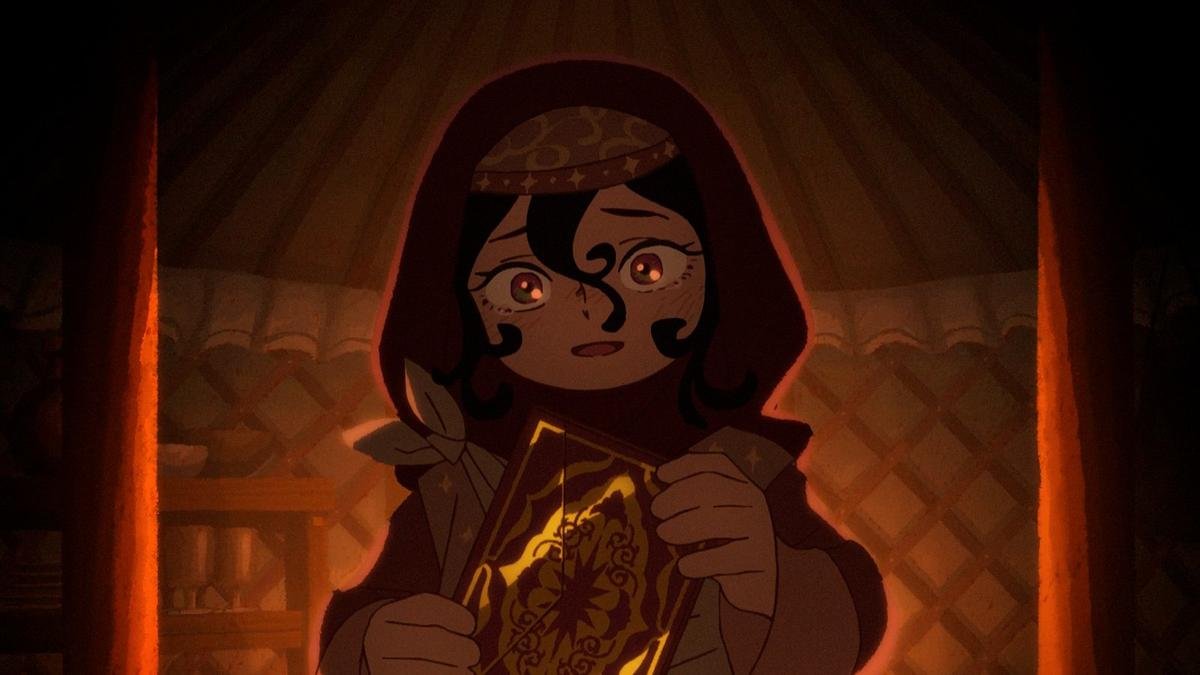
Visually, Science SARU makes an audacious aesthetic choice for a story about slavery and conquest by making almost everyone look ridiculously adorable. The characters have enormous, expressive faces and a wonderfully elastic range of reactions. That softness becomes part of the series’ humanism because every character is allowed to look petulant, amused, frightened or simply silly when the historical material could easily have embalmed them in gravitas. It is a sensibility they seem to have brought over from The Ghost in the Shell, where they likewise knew when to let the serious stuff have a little fun.

A still from ‘Jaadugar: A Witch in Mongolia’
| Photo Credit:
Crunchyroll
Jaadugar is ultimately animated by a remarkably generous faith in learning. From the astronomical and mathematical rigour of Euclid’s Elements to the alchemical investigations of Jābir ibn Hayyān; from Qiu Chuji’s Taoist philosophy to the Mongolian traditions surrounding Alan Gua — scholarship remains the historical connective tissue between cultures that armies have spent centuries attempting to prise apart. You can see why Orb: On the Movements of the Earth, The Apothecary Diaries and Vinland Saga feel like such natural reference points, since it shares the first’s intellectual hunger, the second’s sheer pleasure of putting knowledge to practical use, and the third’s unease of watching conquest deform the people caught inside it.

The anime has a real fondness for the pleasure of learning and in the little miracle of opening a book and finding the world suddenly larger than you had been permitted to imagine. Sitara’s Islamic faith gives her pursuit of knowledge a deeper imperative, since learning is treated as a sacred obligation rather than a luxury reserved for the privileged. In the world around her, structured around the horrors of slavery, patriarchy and imperial bloodlust, learning is one of the few forms of leverage available to the disenfranchised. It’s what makes Jaadugar one of the year’s most affecting pieces of historical and feminist storytelling.
Jaadugar: A Witch in Mongolia is currently streaming on Crunchyroll
Published – September 15, 2026 02:31 pm IST