

The shift comes as India’s economy grew 7.8 per cent in the April-June quarter, beating economists’ expectations for the 12th consecutive quarter
India is showing early signs of a long-awaited revival in private investment, adding a new engine to an economy that has remained heavily dependent on government spending and consumer demand.
The shift comes as India’s economy grew 7.8 per cent in the April-June quarter, beating economists’ expectations for the 12th consecutive quarter. The stronger-than-expected growth is helping the world’s third-largest economy withstand global pressures, including elevated commodity prices, foreign portfolio outflows and a weaker rupee.
The bigger change beneath the headline growth number is the rising contribution of investment.
Investment in the economy rose 11.9 per cent in the April-June quarter. Gross fixed capital formation, a broad measure of investment, increased to 34.3 per cent of GDP from 31.4 per cent a year earlier, according to data from the National Statistics Office.
“Barring COVID-period volatility, this is the strongest real investment print since late-2018 and reaffirms our view of improvement in corporate capex momentum,” Citi analysts said in a note.
The pickup suggests that years of government-led infrastructure spending are beginning to encourage private companies to commit more capital to new projects and capacity.
From government spending to private investment
For much of the past two years, India’s investment cycle was driven largely by public infrastructure spending, while tax cuts and state-level cash transfers supported consumer demand.
 More from Business
The government has continued to maintain high infrastructure spending. Finance Minister Nirmala Sitharaman has proposed Rs 12.2 lakh crore in infrastructure spending for the current financial year, more than twice the level five years ago.
Analysts and bankers say this public investment is increasingly helping bring private capital off the sidelines.
One sign of the shift is bank credit. Credit growth rose more than 19 per cent in the fortnight ended 31 July, its fastest pace in a decade, according to Reserve Bank of India data. Credit to industry grew about 20 per cent.
Axis Bank CEO Amitabh Chaudhry told Reuters that demand for credit was being driven by large companies, non-bank lenders and gold loans.
Even after excluding these segments, credit demand remained strong, suggesting the recovery was becoming broader, he said.
Private investment is also being supported by resilient consumption. Private consumption expenditure grew 7.1 per cent in the April-June quarter, providing companies with stronger demand visibility as they consider fresh investments.
Saurabh Sanyal, secretary-general of industry body ASSOCHAM, said investments in areas such as railways, artificial intelligence and semiconductors were picking up.
He said capital investment, driven largely by the private sector, had increased by more than Rs 5 trillion from a year earlier during the quarter.
Autos, renewables and defence see investment
The improvement in private investment is becoming visible across several sectors.
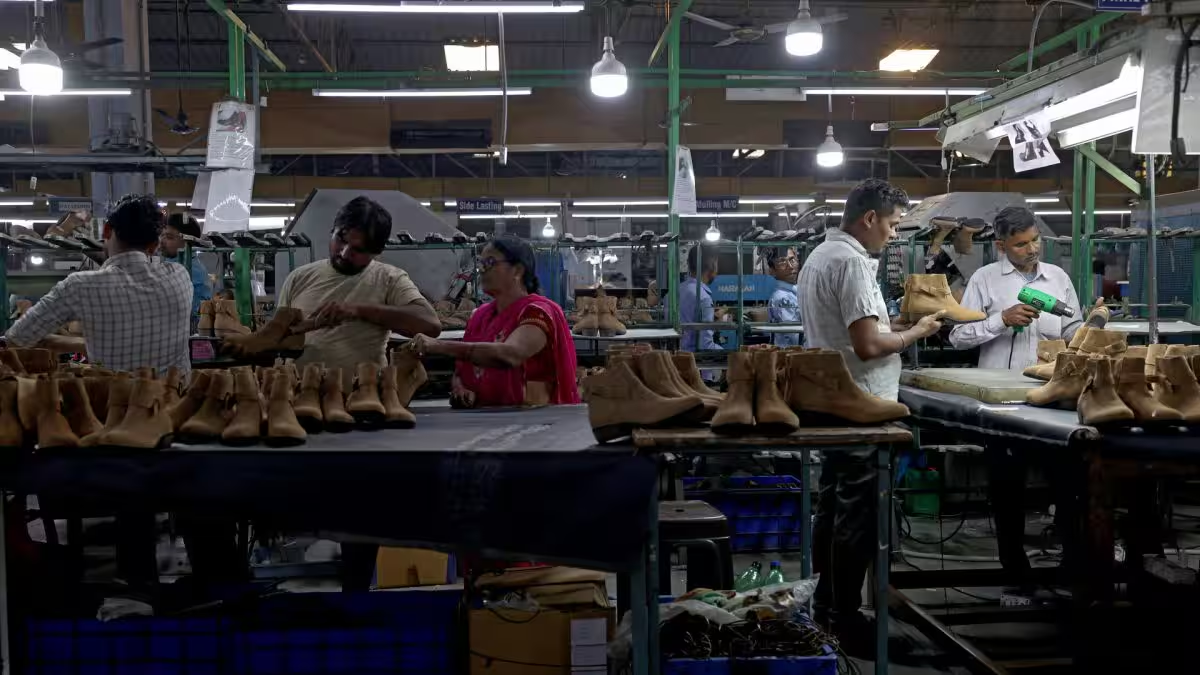
Factory capacity utilisation had approached 77 per cent in the January-March quarter, according to RBI estimates. Analysts said the higher utilisation was encouraging companies to expand capacity in areas including automobiles, renewable energy and defence.
Higher utilisation is important for the investment cycle because companies are more likely to spend on new plants and equipment when existing capacity begins to come under pressure.
Data analysed by Citi showed that capital expenditure by listed Indian companies grew 11 per cent in the financial year ended March 2026, compared with 8 per cent previously.
Citi expects the investment recovery to continue into the 2026-27 financial year, supported by stronger demand visibility, easier availability of funding, lower interest rates, healthier corporate balance sheets and high capacity utilisation.
Technology and manufacturing emerge as new investment drivers
India is also attempting to move beyond traditional infrastructure and attract investment into sectors such as semiconductors, data centres, artificial intelligence and advanced manufacturing.
Global technology companies are increasing their presence in these areas. Google and Amazon have announced plans to invest more than $40 billion in Indian data centres over the next five years.
The government is also seeking to build domestic capabilities in strategic sectors such as aerospace and defence, with Indian companies and state agencies unveiling indigenous rocket and aircraft-engine technologies.
The changing composition of investment could make India’s growth model more diversified, particularly as the economy faces external risks from higher oil prices and global geopolitical tensions.
However, the investment boom is not necessarily translating into a similar increase in employment.
India’s growth is becoming increasingly concentrated in capital-intensive sectors such as automation, semiconductors and data centres. Such projects require large amounts of capital but can generate fewer jobs for every dollar invested compared with more labour-intensive industries.
Weak employment, particularly among young people, remains a challenge for the government despite the strong headline growth.
Risks to growth outlook
The investment recovery also faces several risks. Higher oil prices could increase India’s import bill and raise input costs for companies. Geopolitical tensions and a weaker rupee could add to inflationary pressures, potentially limiting the scope for lower interest rates.
HSBC economists said some moderation in growth could be expected during the rest of the year.
They pointed to slower public-sector capital expenditure, the impact of weak rainfall, fading support from tax cuts and tougher year-on-year comparisons as factors that could weigh on growth.
Still, the emerging shift from government-led investment towards greater private-sector participation could prove important for India’s medium-term growth outlook.
If companies continue to invest as capacity utilisation rises and demand remains resilient, the investment cycle could provide India with a broader base for growth and reduce its dependence on government spending and consumption.
Prime Minister Narendra Modi, responding to the latest GDP data, said in a post on X: “Doomsayers were doomed and India bloomed…yet again!”
The stronger investment numbers suggest that the next phase of India’s growth story may increasingly depend on whether that private-sector momentum can be sustained.
(With inputs from agencies.)