


Japan sees India as a top long-term investment destination, but regulatory hurdles and compliance costs could hold back actual capital flows
Japan sees India as one of its strongest long-term investment opportunities. But for New Delhi, the bigger challenge is turning that interest into actual capital.
The Japan Bank for International Cooperation (JBIC) has ranked India as the top destination for Japanese companies planning overseas expansion for the fourth consecutive year. India led both manufacturing and non-manufacturing sectors in JBIC’s FY2025 survey, released in December last year.
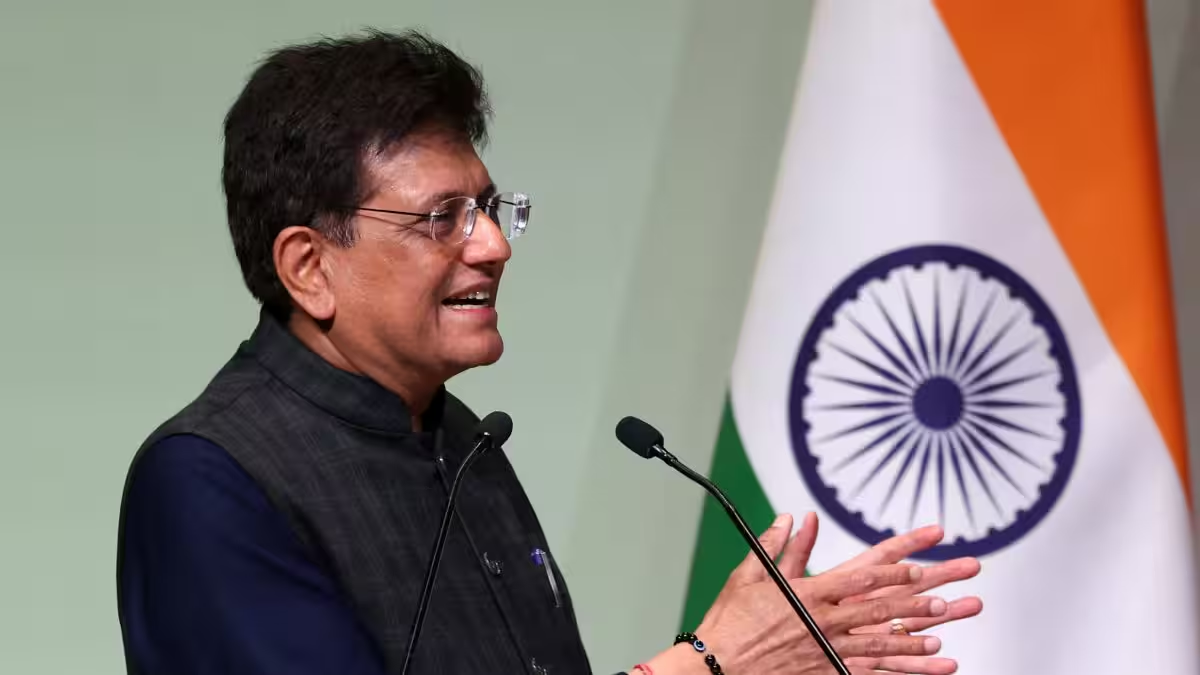
The strong sentiment comes as India seeks to deepen economic ties with Japan. During Commerce and Industry Minister Piyush Goyal’s four-day visit to Japan this week, representatives of MUFG, the Development Bank of Japan, Mizuho, Morgan Stanley, Nomura and Nippon Life discussed ways to increase Japanese institutional investment in India.
The institutions flagged the need to simplify profit repatriation, improve access to Indian capital markets and provide greater regulatory predictability. Currency movements and regulatory and policy changes can also influence short-term investment decisions.
But the concerns are not limited to large financial institutions. Japanese and other foreign businesses operating in India say the bigger issue can often be the complexity of navigating multiple layers of regulation.
Japan wants India. Investors want predictability
Prof Anwesha Basu, Faculty of Economics at FLAME University, told Firstpost that India’s strong position should not be treated as a guarantee of larger capital flows.
 More from Business
“Although the FY2025 JBIC survey report ranks India as the number one most promising future business expansion destination for both manufacturing and non-manufacturing companies, concerns around regulatory changes, capital flows and compliance are key factors for long-term capital flows,” Basu said.
These concerns could weigh more heavily on Japanese small and medium-sized enterprises, which may not have the same resources as larger companies to navigate complex compliance and regulatory requirements.
Steve Bidinger, an American entrepreneur who spent about three decades living and working in Japan before moving to India to build beauty-business platform KANSO, said the issue is less about the lack of opportunity in India and more about the complexity of accessing it.
“I don’t think India has an opportunity problem. Sometimes it has a complexity problem,” Bidinger told Firstpost.
For a Japanese company entering India, he said, there are multiple areas to understand simultaneously, including company law, foreign investment and FEMA regulations, tax and GST, banking, and state and local requirements.
“None of these is necessarily a deal-breaker. The challenge is navigating all of them together, and sometimes getting different interpretations from different people,” he said.
“In India, I’ve learned that the business itself can move incredibly fast while some of the administrative processes move at a very different speed,” Bidinger said. “For Japanese companies, I think clarity and predictability are just as important as simplification.”
Goyal’s Japan pitch
Goyal’s four-day Japan visit, from August 24 to 27, comes as India seeks to strengthen trade and investment ties with one of its key economic partners.
He is leading a delegation of more than 200 Indian business representatives from sectors including manufacturing, semiconductors, clean energy, steel, automobiles, financial services, healthcare and start-ups. The government said the visit is aimed at opening new opportunities in high-technology manufacturing and next-generation industries.
Addressing the Japan Business Federation, or Keidanren, Goyal called for deeper business-to-business ties between India and Japan. He highlighted India’s large market, expanding economy and opportunities in technology, innovation, clean energy and supply-chain resilience.
Hhe met Japanese financial institutions and sought greater institutional investment in India. Discussions covered semiconductors, artificial intelligence, renewable energy, green hydrogen, advanced manufacturing and digital infrastructure, according to the government.
Goyal has also positioned India as a stable and trusted alternative for companies looking to diversify their supply chains beyond China.
During an interaction with Japanese business leaders, he appeared to allude to Alibaba founder Jack Ma while arguing that successful entrepreneurs in India did not have to fear disappearing from public life. He did not name Ma or China.
India’s pitch already has substance
Japan is already one of India’s major foreign investors.
The Commerce Ministry said on August 18 that Japanese investment in India had reached $48.14 billion between April 2000 and March 2026, making Japan the fifth-largest source of foreign direct investment. More than 1,400 Japanese companies operate in India.
Bilateral trade stood at about $27.5 billion in FY2025-26.
The two countries are also targeting 10 trillion yen in Japanese private investment in India over the next decade. The target was set at the India-Japan Annual Summit in July and has since become a central part of New Delhi’s investment pitch.
The question now is whether India can convert Japanese interest into actual investment at the scale being targeted.
A single window does not mean a single process
Basu said India should focus less on announcing new incentives and more on making the existing investment environment predictable.
The National Single Window System (NSWS) is a step in that direction. It brings approvals from multiple departments onto a common digital platform.
But putting approvals on one platform does not necessarily simplify the underlying regulatory process.
“A digital single window is not necessarily a single regulatory process,” Basu said.
India should instead simplify and standardise approvals, documentation and timelines across departments and states, she said.
Faster dispute resolution, more predictable tax rules, changes to distortions in the tariff structure, fewer variations in state-level regulations and better logistics would also improve the investment environment, Basu said.
These issues are particularly important for investments with long payback periods, such as factories, infrastructure and technology projects.
Bidinger’s experience points to a similar issue from the perspective of an entrepreneur actually operating in India.
He said he had not yet reached the stage of repatriating profits and therefore did not want to suggest that his business had personally faced such a problem. But moving money across borders can involve understanding tax treatment, documentation, FEMA requirements and the requirements of banks processing transactions.
“What I would like to see is a simpler and more standardized process,” Bidinger said.
“If a transaction is legitimate, compliant and properly documented, a company should be able to know exactly what documents are required, submit them digitally and have a reasonably predictable processing time.”
For Japanese investors, he said, confidence that capital can be brought into India and legitimate returns can ultimately be taken out without unnecessary uncertainty is important.
Japanese firms are already flagging compliance problems
The concerns over compliance are also visible in JETRO’s survey of Japanese companies operating in Asia and Oceania.
The survey, conducted between August 19 and September 17, 2025, found that expansion intentions among Japanese companies in India continued to strengthen, with growing local demand emerging as a major reason.
A separate JETRO analysis published in 2026 highlighted difficulties with India’s Bureau of Indian Standards (BIS) certification system.
Among Japanese manufacturing companies in India, 71.9 per cent said mandatory BIS certification was affecting, or was expected to affect, their businesses. The figure was 40.8 per cent among non-manufacturing companies involved in imports.
Among affected companies, 73.2 per cent identified approval time as a problem, while 72.6 per cent cited complicated procedures.
For smaller companies, such administrative costs can become a factor in deciding where to invest.
India is competing with ASEAN
India’s growing appeal does not eliminate the competition for Japanese capital.
Basu said it would be premature to suggest that attracting Japanese investment is no longer a challenge. Japanese companies may see India as a major long-term opportunity, but they are also comparing it with other Asian destinations.
ASEAN economies have developed strong logistics and supply-chain ecosystems, making them attractive to Japanese companies that are deeply integrated into regional manufacturing networks.
India has improved its logistics performance. But it has to compete not just on market size, but on the overall cost and ease of setting up and operating a business.
Bidinger said India already has an advantage that many competing markets cannot easily replicate: scale.
“India already has an extraordinary advantage: the size of the opportunity. You have scale, growth, talent, technology and a rapidly developing consumer market all in one country,” he said.
India therefore does not necessarily have to compete by being the cheapest place to do business, Bidinger said. Instead, it needs to make its opportunities easier to access.
“Japanese companies tend to think long term. If they understand the rules and believe those rules will remain reasonably consistent, they are prepared to invest in people, infrastructure, technology and brands over many years,” he said.
He also pointed to a less visible cost: management time.
“A market may be extremely attractive, but if it requires substantially more senior-management time simply to navigate the system, that becomes part of the investment decision,” Bidinger said.
“Japan gives you predictability. India gives you possibility. If India can offer investors a little more of both, I think it becomes an incredibly compelling destination for Japanese companies.”
Basu similarly said India needed to make its business ecosystem easier for Japanese investors.
“India needs to simultaneously work on consistent growth and make the ecosystem easier for Japanese investors so that it translates into actual investment,” she said.
Greater predictability and lower operating costs, she added, would provide a stronger long-term basis for Japanese capital inflows.
India’s speed is an advantage — if regulation can keep pace
Bidinger’s own experience also highlights the contrast between the two business cultures.
He spent around 30 years living and working in Japan, where he said he learned the importance of quality, attention to detail and long-term thinking. India, by contrast, surprised him with its speed and energy.
“Someone can have an idea in the morning and by afternoon people are already trying to make it happen. In Japan, there might be three meetings first,” he said.
That difference can sometimes be frustrating, he said, but it is also one of India’s strengths.
“If I could change one thing, it would be to make the administrative side of doing business more predictable and easier to navigate,” Bidinger said.
“I wouldn’t want India to become Japan. I came here partly because it isn’t. But combining a little more Japanese predictability with Indian speed and ambition would be a very powerful combination.”
CEPA review adds another piece
The investment push is unfolding alongside efforts to reset the India-Japan trade relationship.
On August 25, Goyal held a bilateral meeting with Japan’s Minister of Economy, Trade and Industry Ryosei Akazawa. The two sides agreed to accelerate the review of the India-Japan Comprehensive Economic Partnership Agreement (CEPA), with a view to making the pact more forward-looking.
The agreement has been in force since August 2011. India has been pushing for a review amid concerns over its trade deficit with Japan.