

India and Belgium will work to double bilateral trade over the next five years, Prime Minister Narendra Modi said on Thursday as the two countries sought to expand their economic relationship beyond diamonds into defence, clean energy, critical minerals and semiconductors.
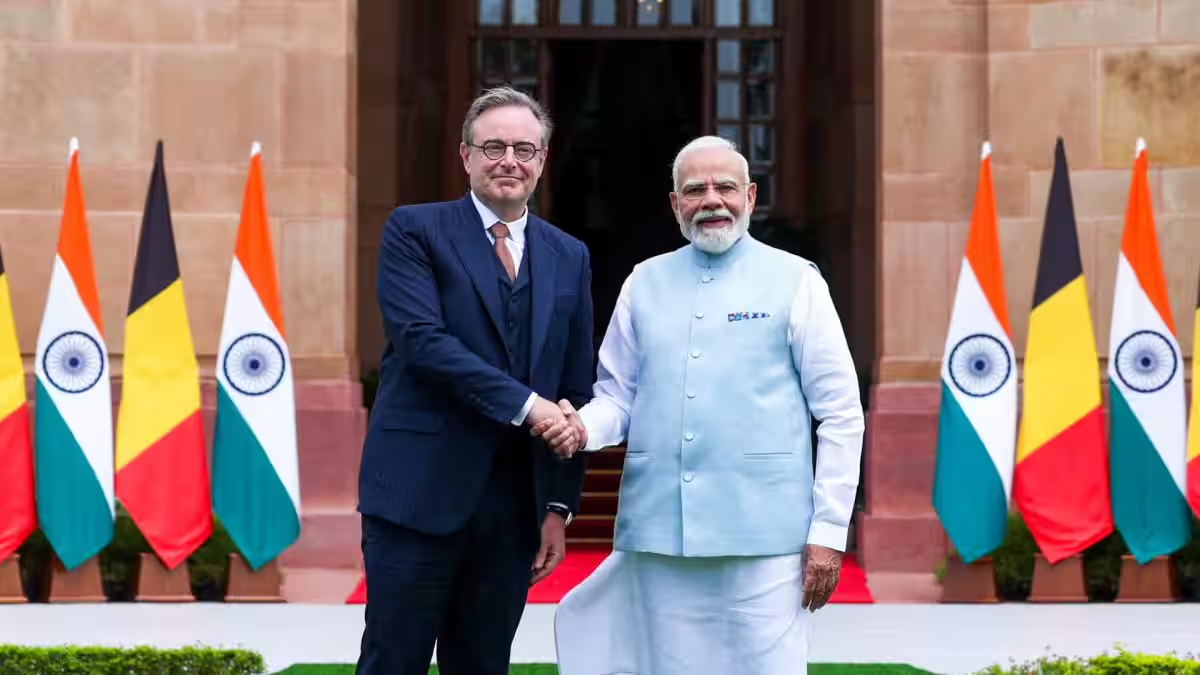
The target was announced after Modi held talks with Belgian Prime Minister Bart De Wever at Hyderabad House in New Delhi. The two sides also agreed to strengthen investment facilitation and business-to-business engagement.
“We have put in place a fast-track mechanism in India for Belgian companies,” Modi said during the joint press interaction. He said the two countries would work towards doubling bilateral trade over the next five years.
India-Belgium bilateral trade stood at about $13.01 billion in 2025-26, while cumulative Belgian investment in India was around $4.2 billion between April 2000 and December 2025, according to Indian government data.
Doubling trade would take annual bilateral commerce beyond $26 billion.
From diamonds to defence, chips and clean energy
Diamonds have traditionally been at the heart of India-Belgium economic ties, with Antwerp serving as one of the world’s major diamond centres and closely linked to India’s diamond-cutting and polishing industry.
But the relationship is increasingly broadening into strategic sectors.
 More from Business
Modi said defence and clean energy have emerged as important areas of cooperation. India and Belgium are also working together on modern defence equipment, including the Zorawar light tank.
Belgian Defence and Foreign Trade Minister Theo Francken, who accompanied De Wever, separately held talks with Defence Minister Rajnath Singh on Thursday, with defence-industrial cooperation among the issues discussed.
The two countries are also looking to deepen cooperation in critical minerals, including their processing and recycling. The minerals are essential for batteries, electric vehicles, electronics, renewable-energy equipment and other advanced technologies.
India seeks Belgian semiconductor expertise
Modi said India and Belgium would work towards connecting Belgium’s Interuniversity Microelectronics Centre, or imec, with India’s semiconductor ecosystem.
The proposed cooperation could support research, innovation, skills development and advanced semiconductor technologies. Belgium brings expertise in semiconductor research and nanoelectronics, while India offers a large market, a growing electronics industry and an expanding domestic semiconductor programme.
Modi said the two countries have complementary strengths, with Belgium’s technological capabilities and India’s scale creating opportunities for deeper cooperation.
Clean energy offers another growth area
Modi highlighted cooperation on renewable energy and pointed to a major green ammonia project in Kakinada, Andhra Pradesh.
Belgian engineering company John Cockerill has been involved in India’s green-hydrogen ecosystem, including electrolyser manufacturing. The Kakinada region is also emerging as a major hub for green ammonia production.
The Asian Development Bank has described the AM Green Kakinada project as one of the world’s largest green-ammonia developments, with planned production capacity of about 1.09 million tonnes a year across two phases.
The two countries also signed a memorandum on renewable energy during the visit, with Modi saying it would provide fresh momentum to cooperation.
Investment push
The two governments are seeking to ensure that the trade target is backed by greater investment.
Modi said India has established an Investment Fast-Track Mechanism for Belgian companies. The India-Belgium Business Forum will also be upgraded into a regular mechanism to strengthen business-to-business engagement.
The countries will additionally work to improve coordination between their financial, fintech and regulatory institutions.
The emphasis on investment is significant because expanding bilateral trade will require greater production, new projects and deeper business linkages rather than relying on existing trade flows.
India-EU trade deal adds to the opportunity
The bilateral push comes against the backdrop of India’s broader economic engagement with the European Union.
Modi said the conclusion of the India-EU trade agreement would create new opportunities for India-Belgium economic relations. The wider European framework could strengthen market access and trade and investment links once it completes the required approval and implementation procedures.
Modi highlights India’s growth
The trade push comes as India seeks to position its economy as a source of stability amid global geopolitical and trade uncertainty.
Modi said the world was going through a period of “great upheaval”, with conflicts and disruptions affecting food, fuel and supply chains.
At the same time, he pointed to 7.8 per cent real GDP growth in the first quarter of 2026-27 as evidence of India’s economic momentum.
“Today, India’s growth story is becoming a source of confidence and new opportunities for the world,” Modi said.
De Wever, meanwhile, said India had changed significantly over the past two decades and underlined the country’s growing importance to Belgium. He is the first Belgian prime minister to visit India in 20 years, according to his remarks at the joint interaction.
His visit follows the first India-Belgium Ministerial-level Strategic Dialogue held in Brussels in July.