
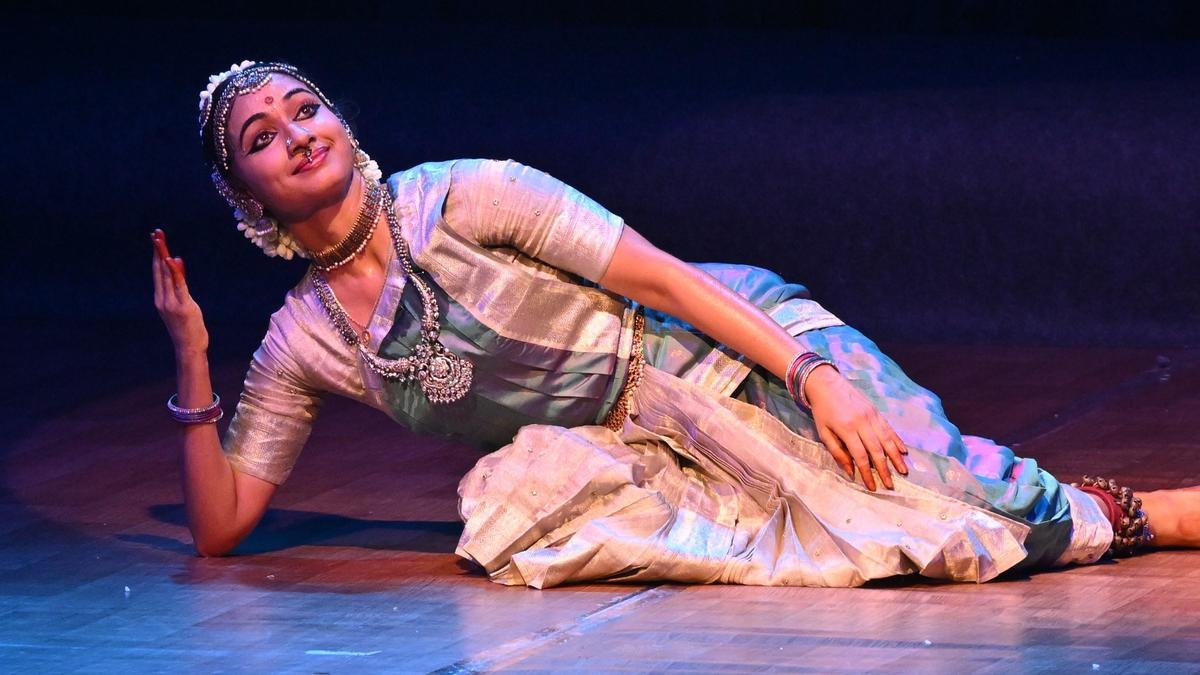


Harinie Jeevitha bridged Taittriya Upanishad’s conception of Akasa as the first manifestation of the Self with Manikkavachagar’s vision of the cosmos in the Thiruvachagam.
| Photo Credit: M. Srinath
Dancer Harinie Jeevitha’s first major independent production, Varadarajam Upasmahe, was creative and deeply researched, with a clearly defined theme that offered several avenues for exploration. This time, she took on a more challenging subject with ‘Akasa’. Unlike the other Pancha Bhootas, Akasha is inherently abstract, associated in Indian philosophy with sound, expansiveness and the inner space of the heart. Translating such an intangible idea into movement calls for a different kind of choreographic thinking.
Harinie bridged the Taittriya Upanishad’s conception of Akasa as the first manifestation of the Self with Manikkavachagar’s vision of the cosmos in the Thiruvachagam. The presentation moved from the emergence of space and the elements to the vastness of the universe, before turning inward to explore the space within and its connection to the world outside. Harinie’s costume reflected the changing colours of the sky.
Even amid such esoteric ideas, Harinie found room to revel in the formless, boundless sky and its ever-changing colours. In ‘Kalai neram’, the sky became something a child might reach out and try to catch, making an abstract idea immediate and playful, before ending on the reassuring thought that the sky was not beyond our reach. The poem’s image of the sky as a loving cloak embracing the entire world made this one of the most inspired and delightful segments of the performance.

Harinie’s ‘Ananda natana prakasham’ was preceded by depictions of Nataraja and Bhikshatana.
| Photo Credit:
M. Srinath
In a thematic presentation, balancing nritta and abhinaya can be challenging, as the nritta must showcase the dancer’s skills without disrupting the flow of ideas. Harinie handled this thoughtfully. For instance, ‘Ananda natana prakasham’ was preceded by depictions of Nataraja and Bhikshatana, with a swara segment building up to its opening, making the nritta feel like a carefully conceived prelude rather than a standalone display of technique.
Clarity is another of Harinie’s strengths. Her padartha abhinaya in ‘Ananda natana prakasham’ was precise and lucid, while the Ghatakasha segment effectively conveyed the Vedantic metaphor of the space within a pot. Harinie consistently translated complex ideas into movement without sacrificing their philosophical depth.

Harinie drew inspiration from Vallalar’s vision in ‘Vanathin meethu’ to highlight the spiritual awakening that transcends caste and religious divisions culminating in the divine light of grace.
| Photo Credit:
M. Srinath
The dancer also drew inspiration from Vallalar’s vision in ‘Vaanathin meethu’, moving from the wonder of the sky towards a spiritual awakening that transcends caste and religious divisions and culminates in the divine Light of Grace. In a striking contemporary counterpoint, images of rockets and satellites eventually becoming debris evoked the consequences of endless desire, offering a quiet critique of capitalism and unchecked technological ambition.
The music was composed and sung by Gayathri Girish, jathis composed by Guru Bharadwaaj, who also played the mridangam. Nattuvangam was by Sudarsini, with violin by T.V. Sukanya, flute by R.S. Adhvaith and percussion by K.S. Ramana. The ensemble created a rich and responsive soundscape through vocals, percussion, chanting, narration, musical effects and nattuvangam. In her first collaboration with a dancer, Gayathri adapted well to the demands of Bharatanatyam, providing strong yet sensitive musical support.
Published – August 26, 2026 03:32 pm IST