

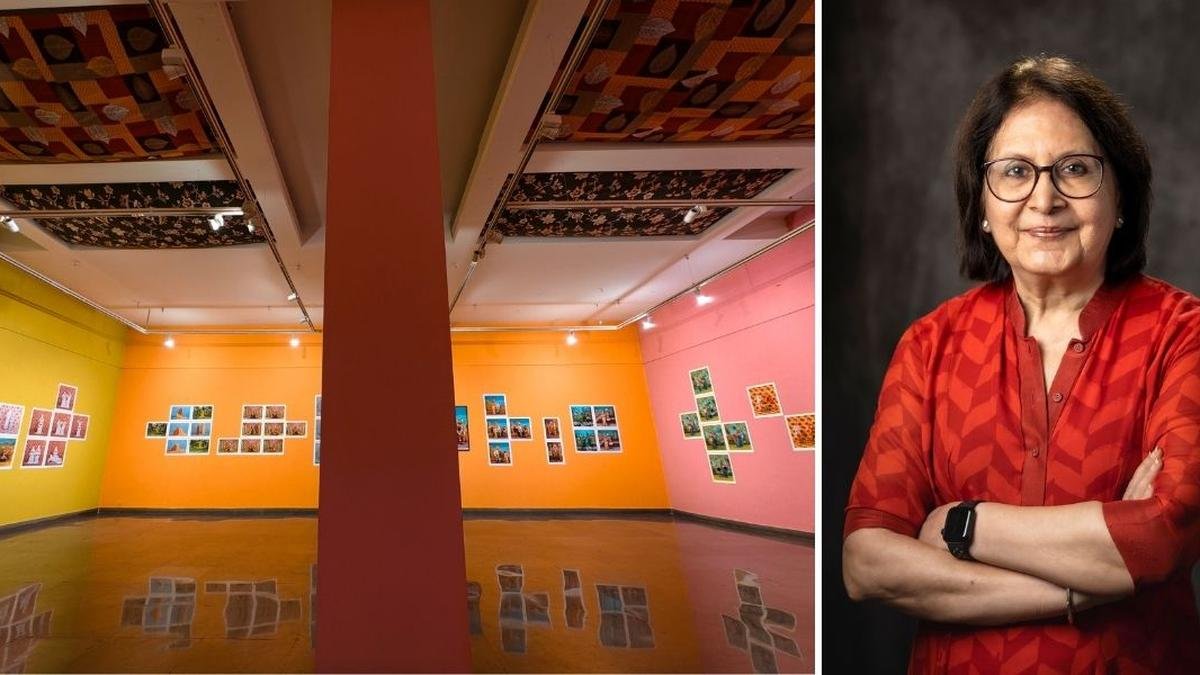

Quite often, patients from the neuro clinic that shares its premises with Gallery Sumukha walk into the gallery’s cavernous front room, filled with paintings and sculptures without knowing what the space is for. Premilla Baid, 73, the founder of the gallery which marks its 30th anniversary this month, finds these serendipitous drop-ins the best way for people to engage with art. The gallery doesn’t seem incongruous in a mixed-use building, with a doctor’s chamber and clinic out front. The doctor has been her generous landlord for decades.
The neighbourhood it’s located in, though close to the city’s central business district, isn’t the typical upmarket area one associates with sumptuous art galleries. And yet, Wilson Garden has been growing into an art and culture hub with such spaces as 1 Shanthiroad, The Courtyard, and the Attakalari Centre for Movement Arts. This defines Bengaluru’s art ecosystem in contrast to its arguably more sophisticated counterparts, Delhi and Mumbai — it is unpretentious, understated and a little scrappy.
Founded in 1996, Gallery Sumukha first started from Baid’s home, then shifted to the Alliance Francaise building before relocating to its current location in 1999. Today, spread over 5,000 sq.ft., Sumukha is housed in the largest private gallery space in South India. Designed by architect Vikram Sardesai, it was built to accommodate large-scale installations, sculptures, and multimedia showcases that smaller commercial galleries of south could not host.
A gallery is born
Moving back to India after six years in Ireland, Baid was deeply inspired by art doyenne Sara Abraham’s Kala Yatra. Self-taught Baid held her first exhibition for a charitable organisation at the Oberoi Hotel. “In those days [1996], we sold paintings worth about ₹5 lakh. That was a lot of money. Then it got into me,” she says. “I don’t know a word of art in the technical sense, I started the gallery out of pure passion alongside my medical practice.”
Baid is careful not to call herself a curator but a gallerist. “Curators usually have technical training and an educational background in art. I just put shows together, relying on my judgment and understanding gained over three decades,” she says. Initially funded by her own savings, the gallery has always been self-sustained. “Whatever money we make goes back into the gallery. Participating in art fairs is expensive. We may make some money here, go to an international art fair, and return without having sold anything, so it’s difficult to turn a profit,” she says. Baid chose sustainability over aggressive commercial growth. The gallery’s entry into Chennai, at her parents’ home, in 2006, lasted around six years.

Schoolchildren visiting the gallery in 2016 for the show ‘Homage to the Rainforest’ by Senaka Senanayake.
| Photo Credit:
Courtesy Gallery Sumukha

Installation view of ‘Painted Weaves’ (2017) by S.G. Vasudev at the gallery.
| Photo Credit:
Courtesy Gallery Sumukha

Installation view of Seattle Art Fair (2023).
| Photo Credit:
Courtesy Gallery Sumukha
The early days
Until the 1970s, Bengaluru didn’t play a prominent role in India’s art world, says artist-sculptor Balan Nambiar, 88. “Karnataka Chitrakala Parishath held annual ‘all-India’ art exhibitions with works by regional artists… displayed at the banquet hall of Vidhana Soudha. In the 70s, Bengaluru had only two freelance artists: Rumale Chennabasavaiah and myself. Most others were employed in government institutions,” he says.

Artist-sculptor Balan Nambiar.
| Photo Credit:
Special arrangement
At the time, Kritika Gallery on St. Marks Road, run by Kausalya Dayaram, was, Nambiar recalls, the city’s only private art gallery, while Kala Yatra made a big impact in its brief existence. “Many galleries (Sakshi Gallery; Gallery SKE) later appeared and disappeared within short spans,” adds the artist who’s been a regular at the gallery since the beginning.
Amid government-owned (Venkatappa Art Gallery) and commercial art spaces (Krithika Art Gallery; Kala Yatra), Sumukha quickly garnered the reputation of being among the first ‘serious’ art galleries in Bengaluru’s then-nascent art world in the 1990s. The 2000s-10s saw the gallery grow into a major commercial contemporary-art space and expand its international art-fair presence.
Kiran Mazumdar-Shaw, chairperson of Biocon and a prominent art collector says, “Gallery Sumukha elevated the level of art galleries in Bengaluru. Before it came along, most galleries would be a bit of everything, from professional to amateur stuff. Premilla paid attention to the market, she organised events around artists and brought in a certain level of professionalism in curation that was missing from the art space in the city.”

‘Beyond Horizons’(2016)by Paresh Maity (centre, in hat); along with Premilla Baid, John Shaw, Kiran Mazumdar Shaw, Jagat Baid and Vikram Sardesai.
| Photo Credit:
Courtesy Gallery Sumukha

(From left) S.G Vasudev, Bose Krishnamachari and Girish Karnad at ‘LaVa: a travelling installation project (Laboratory of Visual Arts)’, 2006.
| Photo Credit:
Courtesy Gallery Sumukha

(From left) Premilla Baid, M.F. Husain, Yusuf Arakkal and Joseph at ‘Watercolours’by Husain at Husain Sankalana in 1997.
| Photo Credit:
Courtesy Gallery Sumukha

(From left) Champa Sharath, Jyoti Bhatt and participants at the printmaking workshop in 2004.
| Photo Credit:
Courtesy Gallery Sumukha

Premilla Baid with artist K. Laxma Goud at the ceramics camp in 2007.
| Photo Credit:
Courtesy Gallery Sumukha

Installation view of 979: An Extravaganza of Art Fashion & Design at The Bombay Brasserie, London, the U.K. in 2007.
| Photo Credit:
Courtesy Gallery Sumukha
Rallying behind artists
Sumukha wasn’t conceived simply as a place to sell paintings; Baid has been using it as a space for workshops (printmaking; sculpture), lectures and experiments. Artist Pushpamala N. says, “Sumukha has been encouraging new and experimental work and has been host to all our works in different media, installations and live performances. It has hosted talks and book releases. And recently, walkthroughs during those exhibitions attended by large groups of school students and art students. This major art space is on the bucket list of every visiting curator and artist.”

Artist Pushpamala N.
| Photo Credit:
Courtesy Gallery Sumukha
Over three decades, Gallery Sumukha has mounted an estimated 230 shows, and worked with 100-plus artists. Its roster has included veteran Bengaluru-based artists such as Yusuf Arakkal and S.G. Vasudev to Vadodara-based Gulammohammed Sheikh, whose book of art prints was recently published by Sumukha, and K. Laxma Goud, as well as major contemporary figures such as Atul Dodiya, Pushpamala N., G. Ravinder Reddy and Paresh Maity. City artist Ravikumar Kashi, whose career has explored the versatility of paper as a medium, has been nurtured by Sumukha since the ‘90s.
Crucial to the gallery’s continued relevance has been its work with artists who have drawn critical and commercial attention globally — veterans like Gulammohammed Sheikh to mid-career artists like Paresh Maity. The association with Maity in the South was crucial to Sumukha’s own success. Baid, who’s taken Maity to many international art shows, calls him the gallery’s biggest “saviour”.

Paresh Maity’s oil and acrylic on canvas.
| Photo Credit:
Courtesy Gallery Sumukha

Book launch of Gulammohammed Sheikh: Hand Prints/ Mind Prints – 70 years of Printmaking in 2026; (from left) Ashish Rajadhyaksha; Sheikh; and Pushpamala N.
| Photo Credit:
Courtesy Gallery Sumukha

Cop Shiva’s archival print on paper.
| Photo Credit:
Courtesy Gallery Sumukha

(From left) Cop Shiva and Gowramma at his ‘NoLonger a Memory’ in 2025.
| Photo Credit:
Courtesy Gallery Sumukha
One of the biggest success stories of the gallery is Shivaraju B.S. aka Cop Shiva, a former policeman turned internationally recognised artist and photographer. “She [Baid] gave me my first solo show in 2012. You can say she found me — I was working as a coordinator at 1 Shanthiroad at the time and a friend asked me to meet her with my work,” says Shiva. The rest, as they say, is history.
The road ahead
Bengaluru today has a much more flourishing art scene than it did when Sumukha was founded. Although the city is one of the three major hubs of the Indian art market, its IT wealth doesn’t convert to art sales, which are a minor proportion of the overall sales in the country, especially when compared to the more mature markets of Mumbai and Delhi. “It is changing, but historically, there are two aspects to this: One, Bengaluru is a much younger city and the wealth is more recent… conspicuous consumption is much more in Delhi and Mumbai compared to Bengaluru, and the proliferation of galleries is less in the South compared to the North. The other factor is the growth of [geography-agnostic] online art sales,” says Abhishek Poddar, Founder-Trustee of Museum of Art & Photography (MAP) and a prominent figure in the city’s cultural space.

Vivek Vilasini’s archival print on canvas.
| Photo Credit:
Courtesy Gallery Sumukha

Ravinder Reddy’s relief sculpture.
| Photo Credit:
Courtesy Gallery Sumukha

K. Laxma Goud’s watercolour on paper.
| Photo Credit:
Courtesy Gallery Sumukha
The gallery is marking its three decades with a rare solo show of Reddy’s sculptures. “We don’t do e-commerce, we don’t think very far ahead in terms of technology, AI art, that sort of thing. I stick to what I know best — finding good artists, young artists. I want to do better shows — that’s it,” says Baid.
The writer is an independent journalist based in Bengaluru.