


The UAE will redraw its tourism map on 30 September when Etihad Rail launches passenger services between Dubai and Abu Dhabi, putting the country’s two biggest visitor destinations just 64 minutes apart by train and, for the first time, offering a genuine alternative to the road that has defined travel between them for decades.
For the travel industry, the significance extends well beyond the arrival of another transport option. Dubai and Abu Dhabi have each developed into formidable global tourism and aviation hubs, but they have largely been sold, booked and experienced as separate destinations; Etihad Rail changes that equation, making it considerably easier for international visitors to include both within a single UAE itinerary.
Services will run between Al Yalayis in Dubai and Mohamed Bin Zayed City in Abu Dhabi, with fares starting at AED39 in Comfort Class and AED109 in Premium Class.
For passengers accustomed to making the journey by car, taxi or bus, there is an obvious attraction in having a guaranteed seat, Wi-Fi, charging facilities and, perhaps most importantly, a predictable journey time that is not dictated by the traffic on Sheikh Zayed Road.
For tourism, however, the more interesting question is what happens when visitors who might previously have spent an entire holiday in Dubai or Abu Dhabi suddenly find it much easier to experience both.
The UAE has become extraordinarily good at getting people here, building one of the world’s great aviation ecosystems around Emirates, flydubai and Etihad Airways, alongside airports serving virtually every major international market. The opportunity now is to make it just as easy for those millions of international arrivals to explore more of the country once they land.
Etihad Rail is an important step towards doing exactly that.
Abu Dhabi to Dubai in just over an hour
Ahead of the 30 September public launch, UAE President His Highness Sheikh Mohamed bin Zayed Al Nahyan travelled aboard Etihad Rail from Abu Dhabi to Dubai, while His Highness Sheikh Hamdan bin Mohammed bin Rashid Al Maktoum, Crown Prince of Dubai, Deputy Prime Minister and Minister of Defence, and His Highness Sheikh Theyab bin Mohamed bin Zayed Al Nahyan, Chairman of Etihad Rail, inaugurated Dubai Station.
The Dubai-Abu Dhabi service runs from Etihad Rail’s Al Yalayis Station, close to Jumeirah Golf Estates, to Mohamed Bin Zayed City Station in Abu Dhabi, but its usefulness for travellers will depend as much on what happens at either end of the journey as it does on the 64 minutes spent aboard the train.
In Dubai, a dedicated pedestrian bridge provides access to Jumeirah Golf Estates Metro Station and the Red Line, while passengers will also be able to use a single QR code for Etihad Rail and public transport journeys through the Nol system.
That may appear a relatively small detail alongside the scale of the railway itself, but from a visitor perspective it is fundamental. The best transport systems are those passengers barely need to think about, and allowing an international traveller to move from an airport or hotel, across Dubai and onwards to another emirate without arranging a car or private transfer makes the UAE considerably easier to navigate.
What passengers can expect
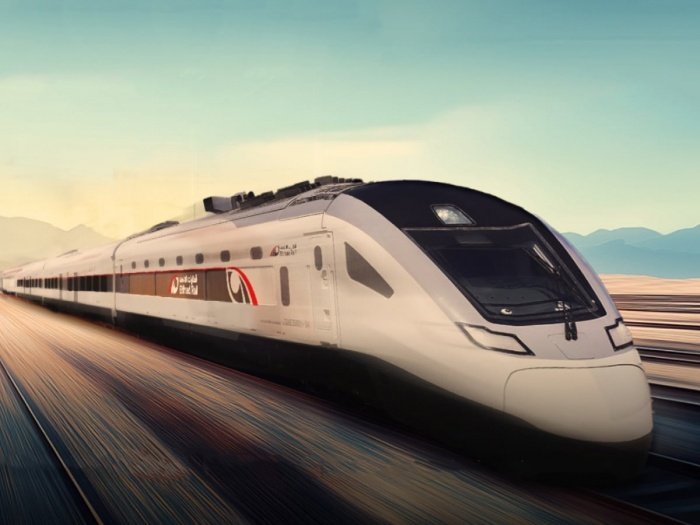
Etihad Rail’s passenger trains have been designed for both leisure and business travel, offering guaranteed seating, Wi-Fi, charging facilities at every seat, luggage space and a choice between Comfort and Premium classes.
The passenger fleet comprises 13 trains, each capable of carrying up to 400 passengers, while stations are being developed with cafés, restaurants, retail and hospitality facilities that should make them part of the wider passenger experience rather than simply places to board a train.
For the Dubai-Abu Dhabi route, initial departures from Al Yalayis include services at 6.14am, 7.14am, 1.14pm, 5.14pm and 6.14pm, according to schedules released ahead of the launch, with tickets available through the Etihad Rail website and mobile app as well as ticket vending machines at stations.
For business travellers, the attraction is immediately apparent. A little over an hour with a guaranteed seat, Wi-Fi and the ability to work presents a very different proposition from spending the same journey behind the wheel or building additional time into the day to accommodate unpredictable traffic.
For leisure travellers, the benefit is equally straightforward: one of the practical barriers to seeing more of the UAE during a single visit has been removed.
A national railway takes shape
Dubai is only one stage in a much more ambitious project, with passenger operations between Abu Dhabi and Fujairah having begun on 30 June and Dubai and Al Dhaid joining from 30 September.
Zayed City and Liwa are scheduled to follow on 30 November, further Al Dhafra stations on 30 December, and Sharjah Station on 30 March 2027, progressively opening up parts of the country that have traditionally been much easier to explore by car.
This is where Etihad Rail becomes particularly interesting for the travel industry.
Dubai and Abu Dhabi already possess enormous international pulling power, but beyond them sits an increasingly diverse tourism proposition. Fujairah combines mountains, beaches and a growing luxury resort sector; Sharjah has established itself as an important cultural destination; Al Dhafra offers an entirely different experience of the Emirates; and Abu Dhabi itself is entering a new phase as Saadiyat Cultural District develops into one of the most significant concentrations of museums and cultural institutions anywhere in the region.
Historically, combining those experiences has largely meant hiring a car, booking a driver or joining an organised tour. Rail changes the calculation, making a day at Louvre Abu Dhabi or Saadiyat considerably more practical for someone staying in Dubai, giving Abu Dhabi visitors an easier route into Dubai and bringing Fujairah within reach of travellers who might otherwise never have considered adding it to their itinerary.
That matters because the next stage of tourism growth in the UAE cannot simply be measured by how many people pass through its airports. It is also about how long they stay, how much of the country they experience and how widely the economic benefits of tourism are distributed across hotels, attractions, restaurants and communities.
Etihad Rail gives the industry another powerful means of achieving that.
More than a train
There is a tendency with infrastructure projects of this scale to focus on the engineering, the trains and the headline journey times, but the more interesting measure of Etihad Rail will be how it changes travel behaviour over the next decade.
The UAE has already demonstrated what happens when world-class infrastructure is combined with long-term ambition. Its airports and airlines did not merely accommodate tourism growth; they helped create it, changing global travel patterns and turning Dubai and Abu Dhabi into destinations at the crossroads of the world.
Passenger rail has the potential to perform a different but complementary role, taking some of those international arrivals beyond the city in which they land and making a broader UAE journey both simpler and more attractive.
Nobody should expect the car to disappear from UAE life, nor does it need to. What Etihad Rail introduces is choice, reliability and a credible new way to travel between destinations that millions of visitors already want to experience.
That is why the 30 September launch matters. Dubai to Abu Dhabi in 64 minutes is the headline, but the bigger opportunity is measured not in minutes saved, but in whether visitors stay longer, travel further and discover more of the UAE.
Justin Cooke, Editor-in-Chief, Breaking Travel News