

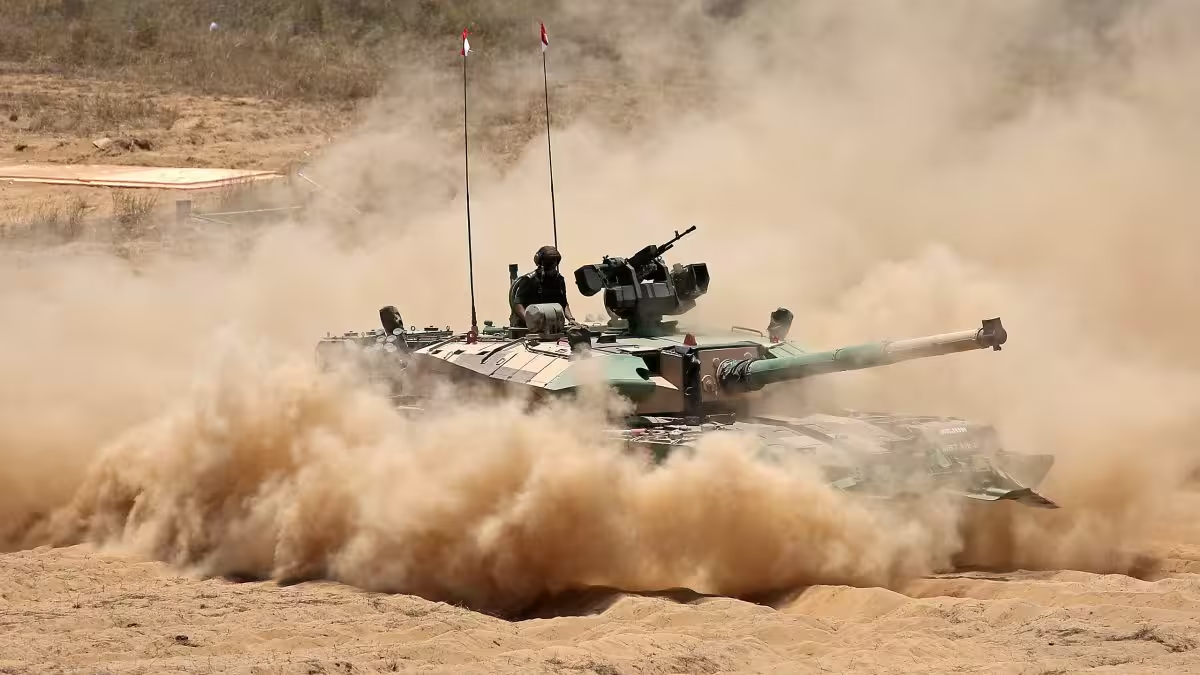

DRDO’s move to involve private firms in missile and guided bomb projects could give fresh momentum to India’s defence indigenisation drive
The Defence Research and Development Organisation (DRDO) is widening the role of Indian private companies in the development and production of advanced weapons, a move industry experts say could accelerate India’s defence indigenisation drive.
DRDO’s Research Centre Imarat (RCI) has invited Indian companies to participate in the development and production of missile and guided bomb systems. It has issued an Expression of Interest (EOI) to identify and shortlist firms as Development Cum Production Partners (DcPPs) for projects under the Directorate General (Missiles and Strategic Systems) cluster.
The shortlisted companies will subsequently be considered for project-specific Requests for Proposal (RFPs), according to the EOI.
The move comes as India seeks to reduce its dependence on imported military equipment and expand domestic capabilities across the defence supply chain.
“This is a forward-looking decision, and exactly the kind of industry participation India’s defence sector needs to accelerate its Atmanirbhar Bharat journey,” said Bodhisattwa Sanghapriya, founder and CEO of IG Defence.
He said the next phase of Indian defence manufacturing cannot be limited to assembling imported technology. Indian companies, he added, need to develop indigenous systems for real operational requirements, including long-range precision strike, autonomous unmanned platforms and advanced guided weapons.
 More from Business
From DRDO development to production
Under the new framework, selected companies will not merely manufacture weapons designed by DRDO. They will be involved in development, assembly and integration of the systems.
The companies will have to create the infrastructure and technical capabilities needed for integration and qualification. Once DRDO completes the development phase and user trials, the selected firms will work with a DRDO-identified supply chain to execute production orders placed by the armed forces.
The private companies could also be responsible for upgrades and integrated logistics support during the weapons’ service life, subject to approval from the concerned DRDO laboratory.
Sanghapriya said this transition from indigenous research and development to testing, procurement and large-scale induction is critical.
“The task now is to strengthen the pathway from indigenous R&D to testing, procurement and large-scale induction,” he said.
According to the EOI, the exact infrastructure and technical requirements will be specified in separate RFPs for individual projects.
The companies will need experience in complex system integration, trained technical personnel and established quality assurance and quality control systems. Depending on the project, firms must also have the ability to undertake bulk production of more than 50 or 100 units.
Who can qualify?
The EOI lays down detailed financial, technical and operational requirements for participating companies.
Applicants must have an annual turnover of at least Rs 100 crore. Their net worth must exceed 5 per cent of the Acceptance of Necessity (AoN) value of the relevant project, with the minimum net worth requirement currently set at Rs 34 crore.
Companies must also have been profitable in at least two of the previous five years and possess a minimum long-term credit rating of BBB (stable) from CRISIL, ICRA or an equivalent agency.
Firms are required to maintain an in-house quality assurance and quality control department and hold internationally recognised certifications such as ISO 9001:2015 or AS9100. DRDO has said AS9100 is preferred.
A valid industrial licence for defence items is also mandatory.
Experience in the integration or manufacture of complex systems, including missiles and guided bombs, is required. Experience in full-system integration, testing and delivery is considered desirable, while experience in the integration and testing of complex sections is mandatory.
Explosives handling requirements
Because the projects involve weapons and potentially hazardous materials, DRDO has also laid down detailed requirements for explosives handling.
Applicants must obtain the required licence from the Petroleum and Explosives Safety Organisation (PESO). The licence has to be secured at least halfway through the DRDO project phase and before transfer of technology.
Some explosive-handling requirements can be met through a licensed joint venture or a memorandum of understanding partner.
Selected firms must have appropriate infrastructure for weapon integration and safe explosives handling. They must either have, or establish, an explosive storage facility capable of holding at least five tonnes of explosives, including TNT and RDX, at any given time.
The storage facility has to be established within one year of a production order being placed.
Companies must also provide a SAMAR Assessment Certificate through DIIQM, DRDO headquarters, by May 1, 2027, or apply for the certificate before submitting their EOI response.
Cyber-security compliance will also be mandatory during the development phase.
How DRDO will select companies
DRDO will assess applicants on their technical capabilities, licences and certifications, management experience and infrastructure.
The evaluation framework carries 100 marks. Companies must score more than 60 per cent overall and at least 50 per cent in each technical compliance category.
A committee of DRDO experts will evaluate the applications. It can also visit the premises of participating companies to verify their infrastructure and capabilities before shortlisting them.
Generally, two DcPP companies will be selected for each project.
However, submitting a response to the EOI does not guarantee that a company will receive a project-specific RFP.
Existing DRDO-identified DcPPs are not required to respond to the EOI. Their continuation or renewal will be assessed separately.
Technology transfer to private industry
An important part of the framework is the transfer of technology developed by DRDO to selected private companies.
Companies chosen as development and production partners will receive the technology free of cost on a non-exclusive basis after successfully completing the DRDO development project phase. The transfer will be subject to DRDO’s policies and procedures.
For technologies involving high-energy materials and systems, transfer will only be made to industries holding the required PESO licences and clearances.
This could allow private companies to take technologies developed through government-funded research into larger-scale production, while keeping sensitive materials and systems under regulatory oversight.
What experts say
Sanghapriya said the move demonstrates that the private sector can increasingly contribute to areas of defence that were once largely seen as the domain of major government establishments.
“This moment proves that the private sector can deliver in domains long seen as the preserve of large defence establishments,” he said.
He argued that closer collaboration between government institutions, the armed forces and Indian defence innovators will be necessary to create an ecosystem in which technologies are designed, developed and manufactured in India.
“DRDO’s move to deepen private-sector participation in the development and production of advanced defence systems is a significant step towards strengthening India’s indigenous defence capabilities,” said Agnishwar Jayaprakash, founder and CEO of Garuda Aerospace.
He said greater collaboration between the government, research institutions and Indian industry could accelerate innovation, build domestic manufacturing capabilities and advance the vision of Atmanirbhar Bharat.
“At Garuda Aerospace, we remain committed to contributing to India’s evolving defence ecosystem through indigenous technology, manufacturing and innovation,” he said.
Why the move matters
The significance of DRDO’s latest initiative goes beyond bringing more private companies into defence production. It seeks to create a clearer path from government-led research to private-sector manufacturing and, ultimately, large-scale induction by the armed forces.
That is important because developing a defence system is only the first step. India also needs companies with the infrastructure, quality systems, technical manpower and production capacity to manufacture those systems at scale and support them throughout their operational life.
The initiative could therefore strengthen the domestic defence industrial base while encouraging Indian companies to invest in advanced technologies.
For the private sector, access to DRDO-developed technology without a technology transfer fee after successful completion of the development phase could also lower some barriers to entering complex defence manufacturing areas.
The larger objective is to move India beyond dependence on imported weapons and towards a defence ecosystem in which critical systems are designed, developed, manufactured and supported within the country.
That is when Atmanirbhar Bharat can move from being a policy objective to becoming an operational capability.