

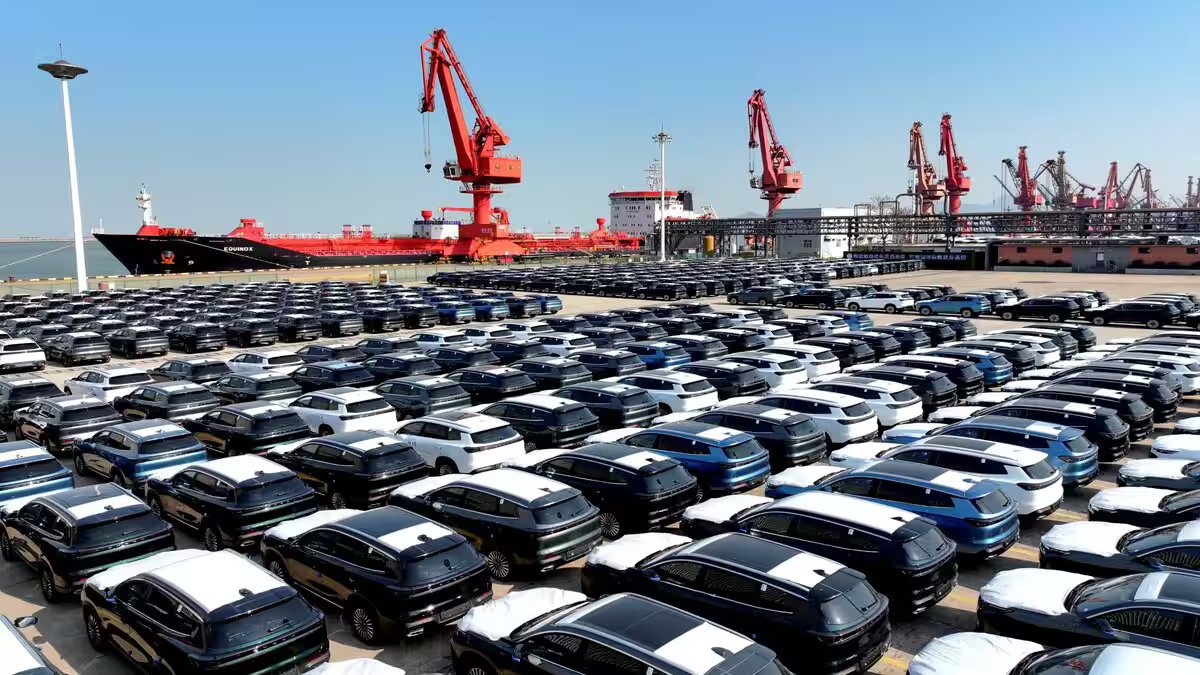

China’s auto market is being squeezed by weak domestic demand and fierce competition, even as automakers turn to booming exports to drive growth.
China’s auto industry is showing two sharply different faces. Automakers are sending a growing number of vehicles overseas, even as demand in the world’s largest car market continues to weaken.
Passenger vehicle exports jumped 77.5 per cent year-on-year to 894,000 units in August, according to the China Passenger Car Association (CPCA). That was slower than the 88.2 per cent growth recorded in July but still represented a powerful expansion in overseas sales.
At home, however, the picture was markedly different. Domestic passenger vehicle sales fell 23.7 per cent year-on-year to 1.55 million units in August, marking an 11th consecutive month of decline and worsening from July’s 21.1 per cent drop.
So, what explains the widening gap between China’s booming car exports and its weakening domestic market?
Why are Chinese car sales falling?
One of the biggest pressures is the intensity of competition inside China’s auto market. Automakers have been fighting for customers in an increasingly crowded market, particularly in electric vehicles, with price competition putting pressure on manufacturers, suppliers and dealers.
The weakness is no longer limited to conventional cars. Electric vehicles and plug-in hybrids accounted for 64.7 per cent of domestic sales in August, yet their sales still fell 10.1 per cent from a year earlier. The decline was significantly steeper than the 3.9 per cent drop recorded in July.
 More from Business
That creates a difficult environment for manufacturers: even as China has become a global leader in EV production and technology, selling more cars at home is becoming increasingly difficult.
Why are exports growing so fast?
The answer lies partly in the strength Chinese automakers have built overseas.
Companies such as BYD and Geely are expanding aggressively outside China, taking advantage of competitively priced vehicles and technology-rich models. Chinese automakers have gained traction in Europe while also expanding into emerging markets.
The contrast is particularly striking in the EV segment. While domestic EV and plug-in hybrid sales declined 10.1 per cent in August, exports of those vehicles surged 154.7 per cent, accelerating from 147.8 per cent growth in July.
For automakers facing weak demand and fierce competition at home, overseas markets are therefore becoming an increasingly important source of growth.
Is China becoming dependent on overseas buyers?
Exports are becoming a much larger part of the industry’s growth story. CPCA Secretary-General Cui Dongshu expects China’s car exports to reach 12 million units this year, with annual exports potentially rising to 18 million-20 million units by 2030.
That shift is also changing the strategies of newer players. Xiaomi, for example, has signed agreements with German auto dealers ahead of its planned European launch next year, as it looks to expand beyond the Chinese market.
For companies that are struggling domestically, establishing an international presence is becoming less of an option and more of a necessity.
But the export boom comes with risks.
China’s overseas push is attracting greater regulatory scrutiny. Authorities are concerned that the intense price competition that has battered the domestic industry could spill into foreign markets.
Chinese regulators recently issued guidelines for automakers’ overseas operations, warning against frequent or steep price cuts and other practices that could harm consumers or damage brands. Major manufacturers, including BYD, Chery and Geely Holding, have pledged to comply.
That means Chinese automakers face a new challenge: they must turn their manufacturing scale and technological advantage into sustainable international businesses without simply exporting the price war that has defined their domestic market.
The bigger picture
China’s auto paradox is therefore not simply that foreigners are buying more Chinese cars while Chinese consumers are buying fewer.
It reflects a deeper transition in the industry. At home, automakers are battling a saturated and fiercely competitive market. Abroad, they are still finding room to grow. The result is an increasingly export-driven Chinese auto industry — one where overseas markets are becoming critical to absorb production, sustain growth and compensate for weakness at home.