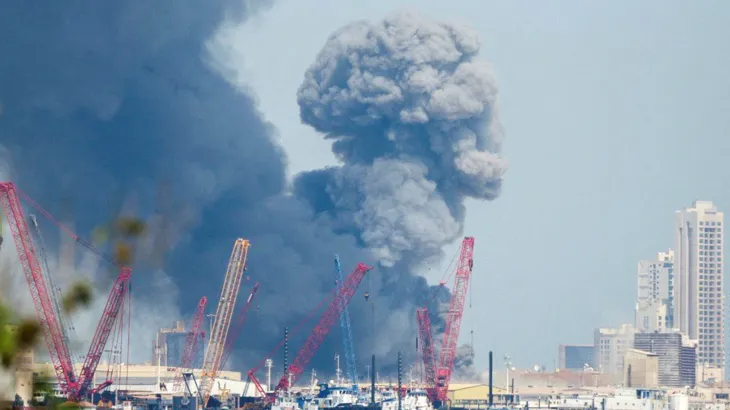

As Kuwait reports that Iranian strikes struck a power and water facility for the second time in two days, starting a fire, regional outrage intensifies.
Following an eighth night in a row of American assaults on Iranian cities, including the partially constructed Darkhovin nuclear complex, Iran launched drones and missiles against Kuwait, Bahrain, and Jordan.
Multiple rounds of Iranian attacks were reported on Sunday in Bahrain, Kuwait, and Jordan. According to Kuwaiti authorities, one attack caused a fire at a water and power station.
The Iranian army claimed to have attacked a US weapons stockpile at Camp al-Adiri and air defence radars at the Ali Al Salem airfield, which is home to US forces, while Iran’s Islamic Revolutionary Guard Corps (IRGC) claimed to have inflicted “heavy blows” to US sites in Jordan and Kuwait.
In addition to reporting damage to a second water and power facility, Kuwait’s military declared that it was battling Iranian strikes. Bahrain and Jordan also sounded alarms. Jordan claimed to have shot down three of four Iranian missiles, while Bahrain subsequently claimed to have stopped Iranian missile and drone strikes.
Since hostilities restarted this month, the three nations that house US military sites have been the targets of Iran’s retaliatory assaults, nearly destroying an interim truce pact that Tehran and Washington struck last month.
The nuclear facility at Darkhovin
The Iranian onslaught came after a series of nocturnal US raids on Iran, which Washington claimed were intended to “punish” IRGC soldiers for previous assaults in Jordan that claimed the lives of two US military men.
The attacks were also intended to “degrade Iran’s ability to threaten commercial shipping in the Strait of Hormuz,” according to the US military.
According to Iranian media sources, the attacks affected Qeshm Island and parts of the provinces of Hormozgan and Khuzestan. According to Tohid Asadi of Al Jazeera in Tehran, they were less severe than the prior US strike nights.
Later, Iran’s nuclear energy agency declared that the US strikes had affected the country’s under-construction Darkhovin nuclear power station in the southwest and denounced them as a violation of international law.
Iran’s deputy foreign minister, Kazem Gharibabadi, described the US strike on the Darkhovin facility in the southwestern province of Khuzestan as a “dangerous assault” on Iran’s civilian infrastructure and pledged to retaliate in order to protect the country’s security.
The plant was still in the early stages of development and did not contain any radioactive material when inspectors last visited, according to the International Atomic Energy Agency (IAEA), which also stated that it was investigating claims of the midnight attack.
Iran is condemned by the Gulf states. Meanwhile, Kuwait accused Iran of attacking “civilian and vital facilities in the country,” claiming Tehran had attacked a power and desalination facility for the second time in as many days. It claimed that part of the station’s infrastructure caught fire as a result of “heinous Iranian aggression.”
The Middle East quickly denounced Iran’s strikes on Kuwait, Bahrain, and Jordan.
Sheikh Mohammed bin Abdulrahman bin Jassim Al Thani, the prime minister of Qatar, expressed his nation’s “strongest condemnation” of the Iranian attacks over the phone with Jordan’s deputy prime minister. He also urged Washington and Tehran to resume diplomatic relations and carry out the June 16 interim ceasefire agreement.
The UAE reaffirmed its support for “all measures” intended to protect the security and safety of the affected nations while denouncing the assaults in “the strongest terms.”
After the strike on its territory, Jordan called Iran’s ambassador and demanded an end to the “unjustified” attacks. Jordan’s Ministry of Foreign and Expatriate Affairs likewise declared its support for the steps its Gulf neighbours take to safeguard their security and sovereignty, pledging Amman’s solidarity with them.
Speaking with his colleagues in Kuwait and Jordan, Lebanese Prime Minister Nawaf Salam denounced the Iranian strikes, stating that they “constitute a blatant violation of the security and territorial integrity of Kuwait and Jordan and a direct threat to the security of the Arab region.”
Hormuz Strait
On Sunday, there were indications of more unrest in the Strait of Hormuz. According to the IRGC, two ships that attempted to utilise a “unsafe route” were prevented. It claimed that both had been a part of an unidentified “accident.”
Since the US and Iran signed a memorandum of understanding last month that committed to the gradual reopening of the waterway and prolonged the April truce, the strait’s status has become a major source of controversy. Tehran has the authority to keep controlling shipping across the strait, according to Iranian officials. The US has reinstated its own embargo on Iranian ports and claims Iran has no control over the waterway.
Iran has the “upper hand” in terms of dedication to the conflict, which it views as existential, according to Paul Musgrave, a professor of government at Georgetown University in Qatar.