

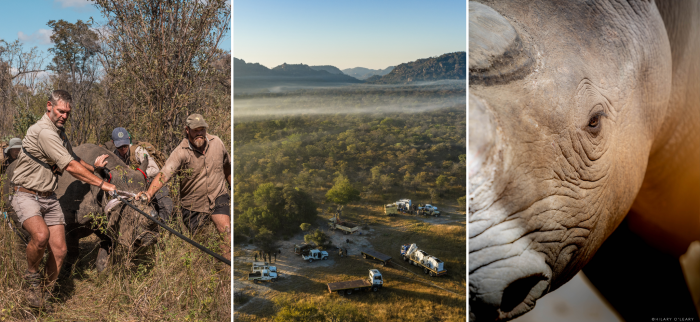


In celebration of World Rhino Day, African Bush Camps announces that guests at Bumi Hills Safari Lodge can now experience Matusadona National Park through three newly launched safari and conservation experiences. The experiences offer an exclusive opportunity to learn about the historic return of critically endangered black rhinos and the ongoing efforts of the park team to conserve the species and landscape.
A Historic Homecoming
For the first time in more than 30 years, black rhinos once again walk the hills of Matusadona National Park. In the late 1980s and early 1990s, organized poaching devastated the Sebungwe landscape, once home to Zimbabwe’s largest contiguous black rhino population. As the threat intensified, the Zimbabwe Parks and Wildlife Management Authority (ZimParks) relocated the surviving rhinos to secure areas across the country.
More than three decades later, their descendants—translocated from Imire Rhino and Wildlife Conservancy, Matobo National Park, and another protected location—have returned home. This homecoming is one of the region’s greatest rewilding stories of this era, made possible through a multi-year management partnership between ZimParks, African Parks, local communities, and dedicated conservation partners. Today, Bumi Hills Safari Lodge is one of the few safari lodges with access to this unfolding story.
“This is not simply the introduction of rhino into a new landscape. It is a homecoming,” said Beks Ndlovu, Founder and CEO of African Bush Camps. “Their return is a powerful reminder of what can happen when people take custodianship of a landscape and conserve it for the future. To be here as African Bush Camps celebrates its 20th anniversary, there is no greater milestone than seeing rewilding efforts bring these animals back to their home.”
Three Ways to Be Part of the Story
Set above Lake Kariba, Bumi Hills Safari Lodge offers a distinctive Zimbabwean safari experience where wildlife, wonder, and water meet, and where guests now have three exclusive ways to connect with Matusadona’s story:
Matusadona Game Drive: Guests board the boat and cross the open water of Lake Kariba into Matusadona National Park. On the far shore, a Matusadona Conservation Trust safari vehicle is waiting to take them deeper into Big Five territory, with their African Bush Camps guide at the wheel. En route, guests can pause for a scenic pitstop with a cooler box stocked with snacks and refreshments.
Guided Walking Safari: Guests board the boat and land wherever the walking is best that day. From there, an African Bush Camps professional guide leads them on foot through Matusadona National Park. They become eye-level with wildlife, reading fresh tracks, discovering the ancient fossils exposed in these hills, and learning which plants have long been used for their medicinal properties. Walking safaris are closely regulated and depart in the morning only, for the best and safest conditions.
The Conservation Experience: This is an experience reserved for very few. Guests cross by boat to the conservation center and step straight into the story: drone technology guarding the rhino, a team on the front line of the wild dog rehabilitation programme, and meeting the people who made this homecoming possible. Guests can ask them anything and watch firsthand as tourism, technology, and community shape the future of conservation in Matusadona National Park.
The return of the black rhino may not mean seeing them from a safari vehicle. It means something more significant: the knowledge that a species once driven from these hills is home again, and a story guests can now be part of.
Conservation Built on Custodianship
For Bumi Hills Safari Lodge, the return of the black rhinos reinforces the connection between an extraordinary safari experience and the long-term conservation of the landscape that makes it possible.
“The most meaningful conservation stories are often the ones that take years to unfold,” said Ian Mills, Chief Conservation Officer at African Bush Camps Foundation. “The return of the black rhino shows what is possible when people are prepared to protect a landscape today so that wildlife can return tomorrow.”
The reintroduced rhinos are protected within a secure 175-square-kilometer Intensive Protection Zone, where they are closely monitored using advanced tracking technology. Their return is part of a broader rewilding effort across Matusadona National Park, which also saw the translocation of 20 African wild dogs in February 2026. Introduced as two established packs, the wild dogs underwent a period of soft release into the park before being released into the wider park. The packs are now monitored using GPS collars, supported by community-based early-warning systems and human-wildlife conflict measures to promote peaceful coexistence.
Because the long-term security of the rhinos within the Intensive Protection Zone takes precedence over high-density wildlife viewing, these activities emphasize hands-on conservation education rather than guaranteed sightings. To learn more about Bumi Hills Safari Lodge and the return of the black rhinos, or to book a stay and incorporate these conservation experiences into your itinerary, visit www.africanbushcamps.com.