
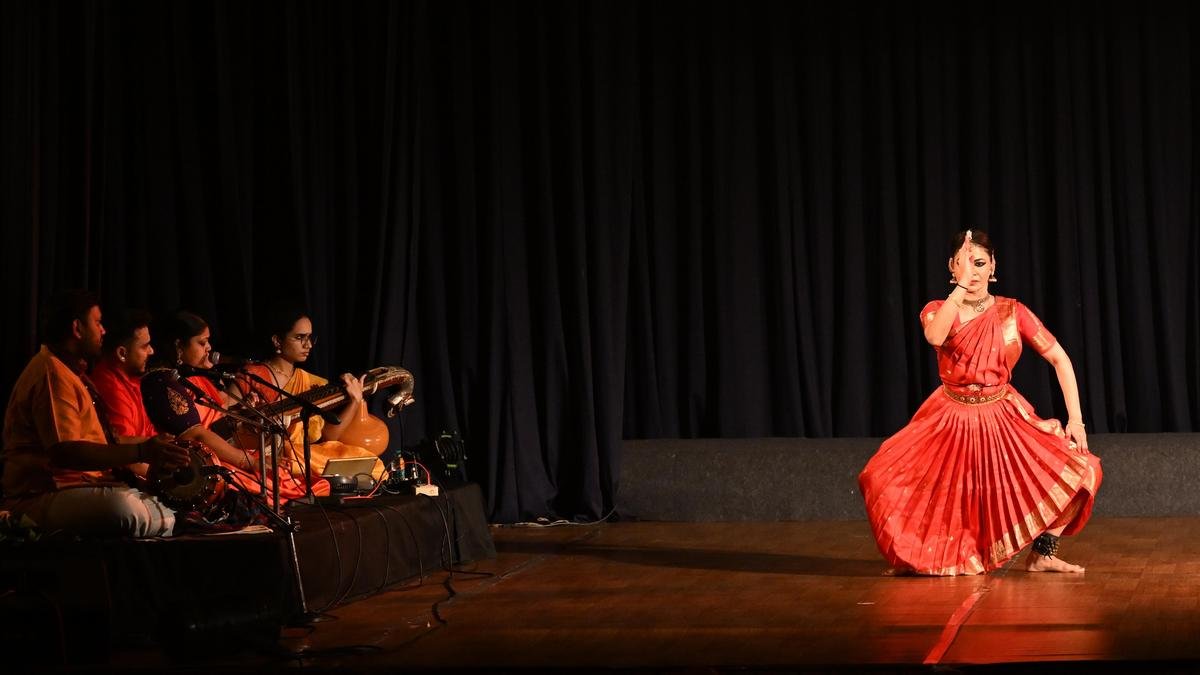


Dancer Navia Natarajan accompanied by Harshita Vidya (vocal), Vinod Shyam Anoor (mridangam and kanjira) and Rakshita Ramesh (veena).
| Photo Credit: B. Jothi Ramalingam
The opening lines of Subramania Bharatiyar’s poem ‘Agni Kunjondru Kanden’ resonated through the auditorium as the dancer walked onto the stage holding a lamp. The glow of the single flame she lit drew the audience into a journey that delved deep into the varied facets of fire, as creator, messenger, destroyer, and purifier. This formed the premise of Navia Natarajan’s ‘Agni’ (Fire), presented as part of Natyarangam’s Pancha Bhootha Bharatham festival at Narada Gana Sabha, Chennai. Even as the sight of the dancer and the lamp, framed by a spotlight, drew one into a moment of quiet stillness, the sudden burst of nritta broke the reverie, setting the tone for a vibrant performance.

Navia Natarajan chose popular stories to highlight different facets of fire.
| Photo Credit:
B. Jothi Ramalingam
Navia then moved on to explore fire through compositions drawn from various literary sources including Kanda Puranam, Thiruvilaiyadal Puranam, Rig Veda and Mundaka Upanishad. Episodes from popular stories were seamlessly woven into the sequence to highlight the different facets of fire. The story of Daksha’s yagna and Dakshayani’s anger and self-immolation, and the episodes of Kovalan and Kannagi evoked fire’s destructive nature; while Sita’s Agni Pravesham, brought forth fire’s association with purification.
“The detailed depiction of the preparation process for Thee Midithal, the intensity of belief, and the total devotion to the goddess that underpin the ritual were particularly engrossing, with the song ‘Ulagathu nayakiye’, tuned by eminent violinist R.K. Shriramkumar, lending a folk flavour to the performance.

The detailed depiction of Thee Midithal, a ritual that showcases the devotion to Shakti, was engaging.
| Photo Credit:
B. Jothi Ramalingam
The high-energy chants of ‘Ram Ram’, the gradual atmospheric gradation of the lone spotlight, framing the dancer’s stillness and slow movement, and its sudden expansion into a burst of rays were a dramatic visualisation of the Hanuman Chalisa. The episodes included Hanuman’s tail being set on fire, which was aesthetically presented by Navia.
Lord Byron’s poem Darkness, which was taken up next, changed the tone of the performance. It was conceived through a literal interpretation of the poem’s ideas and meaning. The mridangam accompaniment, the poetic narration (by P.C. Ramakrishna), and the movement vocabulary did not integrate seamlessly, making the segment less cohesive.

Navia Natarajan chose Dikshitar’s kriti ‘Arunachaleswaram’ to highlight the spiritual dimension of agni.
| Photo Credit:
B. Jothi Ramalingam
The performance concluded with Muthuswami Dikshitar’s ‘Arunachala natham smarami’ in raga Saranga. Here, agni takes on a spiritual dimension, embodied as Arunachaleshwara. Devotion to Arunachala is presented as a path towards realising the ultimate reality, Brahman.
There were many interesting ideas and explorations, some of which often moved into abstraction, while communicating the nature of the element. However, the overall impact of the fiery energy, was a little lukewarm.

Navia Natarajan’s performance included compositions from Kanda Puranam, Thiruvilaiyadal Puranam, Rig Veda and Mundaka Upanishad.
| Photo Credit:
B. Jothi Ramalingam
Harshita Vidya, who replaced vocalist Ashwarya Vidya Raghunath, at the last minute, did a commendable job. However, there were moments when she could have enhanced the impact with a more energetic rendition. Vinod Shyam Anoor played the mridangam and kanjira, and Rakshita Ramesh played the veena. T.S. Sharath conducted the recital. Keerthi Kumar’s lighting design was aesthetic and played a vital role in enhancing the visual appeal of the performance.
Published – August 26, 2026 02:43 pm IST