

When artist Bharti Kher came to India in 1993, it changed the way she saw and perceived art. Born and raised in London, Bharti’s move to India opened up a new way of looking at identity, culture, material and memory – ideas that would go on to shape some of the most significant works in contemporary art in India and abroad.

Bharti has lived in Delhi for close to 30 years now, spending much of her adult life in India, and says the experience of moving between countries has fundamentally shaped her practice. “I am from multiple places, and I think that’s something that comes clearly through my work,” she says. “It’s like your vision is wider in some ways. You’re neither from this place nor from that. You don’t stand with strong identity, ties, allegiances.” For Bharti, that position has eventually become liberating. “I like the expression neither nor,” she says. “I always felt like I’m somewhere sort of in the middle.”

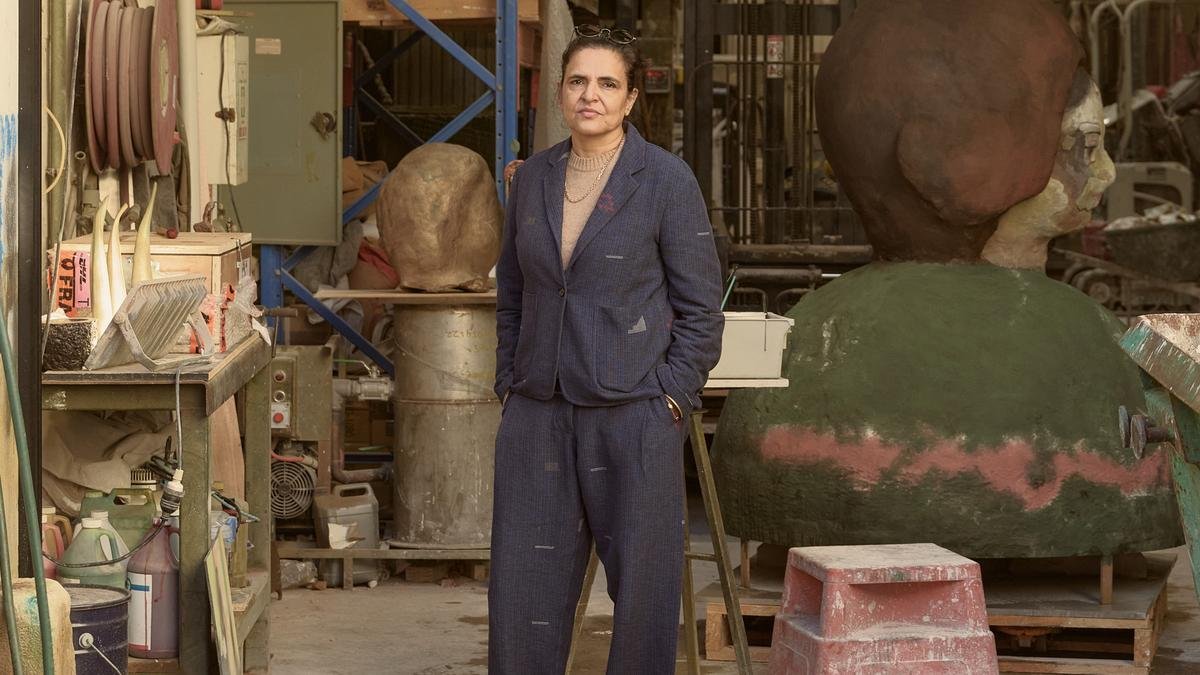
Bharti Kher
| Photo Credit:
Jeetin Sharma
Her experience in India, particularly in Delhi, also taught her to look closely. She describes arriving in a new country as being similar to travelling: you observe, listen and gather clues.
“The way to experience a new country is through empathy, closely watching people, listening, and asking questions,” she says. “When you come to a new country, especially if you don’t speak the language, you listen very carefully,” she adds. That attentiveness, she believes, became almost instinctive — “an extra sensory adaptation” that eventually became a way of looking at the world.
That openness is central to her approach to materials. Her works often bring together everyday objects, found materials, mythology and surreal elements, objects with lived histories that become something else. “Materiality is central to how I make,” she says. “I believe that objects carry energy and memory and historicity and residue from their experiences being here as much as we do,” she adds.
A bindi, a broken object, a fragment of furniture, cloth or even animal forms can enter her studio carrying their own cultural associations. But Bharti is less interested in preserving those meanings than in transforming them. “The transformation is the most important part of my work,” she says.
The divine feminine

Bharti Kher with her sculpture Gaia (2026) at V&A South Kensington
| Photo Credit:
David Levene
The idea of that transformation also runs through her ongoing exhibition at the Victoria and Albert Museum in London. Bringing together four of her works created between 2008 and 2026, the exhibition is primarily installed across the Dorothy and Michael Hintze Sculpture Galleries at V&A South Kensington, with Gaia (2026) placed at the museum’s entrance in the Exhibition Road Courtyard.
Gaia is a four-foot-tall sculpture; the work depicts a female warrior who carries a home on her head. The hybrid Mother Earth goddess embodies ideas of shelter, belonging and home. The house represents the universal symbol of safety. What keeps coming up in most of her sculptures is the divine ‘feminine’, with nostalgia also playing a very significant role.

(Left) Animus Mundi (2018) by Bharti Kher
| Photo Credit:
Peter Kelleher
For instance, in another installation, Animus Mundi, created in 2018, it derives from the ancient philosophical concept of the “world soul”, a universal force connecting all living things and showcasing a female body with a buffalo head adorned with bindis and threaded with a flowing red sari. Bharti’s fascination with saris can be traced to her childhood in London, where her mother owned a textile and sari shop in Streatham, London. Helping to dress mannequins and working in the shop as a young girl, Bharti developed an early awareness of the sari as a cultural signifier.
Yet Bharti insists that her works are not simply attempts to preserve the past. “I think I’m building futures actually, not past,” she says. “You carry pasts with you. And that’s inevitable because that creates the language from which you build it.”
“The goddesses I make have always held this territory for me — the feminine as both nurturing and terrifying. She can be fertile, and she can be destructive. Cosmic and interpersonal, all at once. I’m drawn to this resistance to fixed definitions — more interested in things becoming than in certainty, or reference to past, present, or future,” she says.

The sacred tree

Bharti Kher sculptures Cloak and Shield (2008)
| Photo Credit:
Peter Kelleher
That same philosophy will extend to Australia this year, when she unveils Tree of Life, a seven-metre-tall bronze sculpture commissioned for Powerhouse Parramatta in Sydney that is set to open on November 7. The work will be among the first major commissions for the new museum development and will stand in the entry plaza. Conceived as a spirit work, it draws on the sacred tree, one of the oldest images in Indian mythology, with heads of ancestors layered over one another to form a towering totem.
Bharti says the project has been around three and a half years in the making. The artist traces its presence across Indian and Persian mythology and Sufism. She was also inspired by Aborigine totem structures of Australia. “The idea is of a totem that is steeped in symbolism, which is native to the Australian land, but I also wanted it to be a community structure where people can walk around it,” says Bharti.

“I felt that if I could stack heads of different people from different communities and different places, it almost feels like coming together in a gathering. So you talk about diversity, culture, and people together,” she adds.
For Bharti, making art ultimately means remaining comfortable with uncertainty. She goes to the studio every day, works with her team and deliberately creates problems she can then attempt to solve. “I love solving problems,” she says. “So it’s just something I like making impossible things,” she says.
And perhaps that is where her journey, from London to Delhi, from India to the V&A and now to Powerhouse Parramatta — comes together. “I think it takes great courage to come to work every day as an artist because you’re facing the unknown every day,” she says. “So that’s your inspiration… to meet the unknown every day and be okay with it.”
Her ongoing exhibition can be found at the Dorothy and Michael Hintze Sculpture Galleries at V&A, South Kensington, till Feburary 2027.

Published – August 21, 2026 04:13 pm IST