


Mirai, a technology company specializing in direct hotel sales, has begun rolling out the first plugins for its hotel clients on ChatGPT. Guests and users of the Emperador and Moderno hotels in Madrid, along with the Porcel Hoteles chain in Granada and Gloria Thalasso & Hotels in the Canary Islands, can now interact with them directly from ChatGPT using natural language.
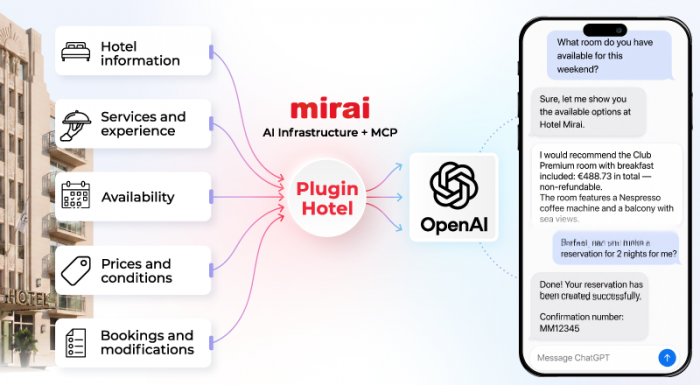
A plugin is an integration that allows ChatGPT to access external services to check information, use tools and perform actions on behalf of the user. When applied to a hotel, it allows answering questions using its knowledge base and, above all, operating in real time: check availability and prices for specific dates and occupancy levels, switch currencies, filter results, explore promotions and rooms, complete a booking, or modify or cancel an existing one. OpenAI recently reorganized its ecosystem and replaced the term Apps with plugins, which is the correct terminology today.
The deployment relies on an architecture that Mirai has been building for some time. Its AI infrastructure centralizes the hotel’s knowledge and, through MCP (Model Context Protocol), makes available both that knowledge and the direct channel’s transactional capabilities. It is the same layer already used by Sarai—Mirai’s AI assistant and conversational booking engine—and the other channels. The plugin serves as the gateway to ChatGPT; the infrastructure and the direct channel’s capabilities are what power it.
For Mirai, that difference is the crux of the matter. The hotel plugins available so far tend to offer a limited experience: they replicate a visual interface within ChatGPT and redirect users to the website as soon as they try to proceed. Mirai’s approach is the opposite: users can state what they need—“I want to go to Madrid next weekend with my wife and two children, with breakfast and a cancellable rate”—and the assistant interprets the request and works directly through the direct channel until the booking is completed. Voice technology makes this need even more evident: when the interface disappears, what remains is the hotel’s ability to understand requests in natural language and take action in response to them.
Mirai places this launch in an early and deliberately limited phase. The plugin ecosystem is evolving rapidly, and there are still significant unknowns, starting with discovery: it does not seem reasonable to envision a future in which travelers would have to know about and install plugins for hundreds of hotels in advance. It is also unclear whether plugins will play a role only in the lower funnel or whether they will also be part of the inspiration and recommendation phases. For this reason, the company does not expect them to immediately become high-volume channels: their value right now lies in experimenting, learning and preparing the direct channel. While the company intends to gradually expand this capability, deployments will be limited in this initial stage until it gains more relevant insights during the early phase.
Pablo Delgado, Managing Partner & CEO America at Mirai, notes: “The challenge for hotels is no longer just to be discoverable by AI, but to ensure that their direct channel is also operable by it: that an agent can understand the hotel, check availability and prices, and complete the reservation. OTAs are already preparing to compete in this new agent-driven ecosystem. The direct channel must do the same. Being discoverable will allow the hotel to be part of the conversation; being operable will allow it to compete for the booking.”