
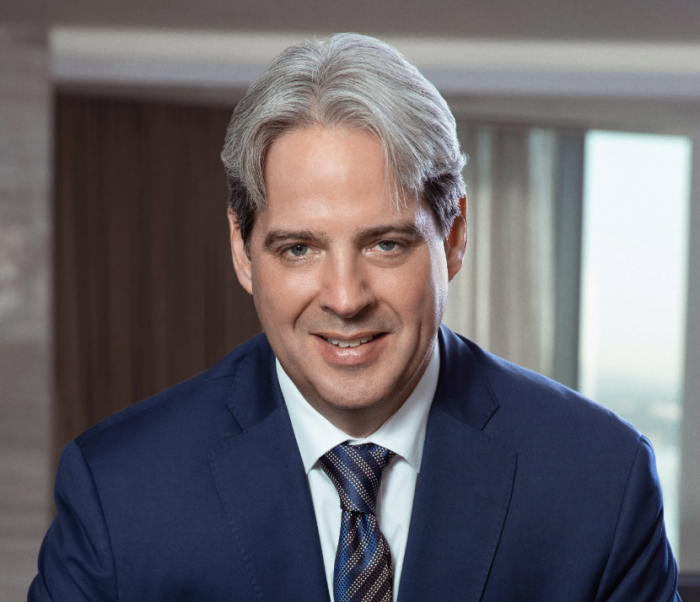


Guy Hutchinson’s appointment as Hilton’s president for the Middle East and Africa was a return as much as a new beginning. Before leading Rotana from 2020 to 2024, he had spent 16 years with Hilton in operational and regional roles across the Middle East, Europe, Japan, China, Australia and India.
That combination gives Hutchinson an uncommon perspective. He understands the systems, brand architecture and loyalty economics of a global hotel company, but he has also run a regional competitor whose strength depended on local relationships and quick decision-making. Hilton’s growth strategy needs both instincts.
Hutchinson began his career with Hilton in Amsterdam and spent roughly 16 years with the group across Europe, the Middle East and Asia Pacific. His assignments included Japan, Australia, China and India, where he served as vice president of operations. He joined Rotana in 2014, first as chief operating officer and later as president and chief executive. During that decade outside Hilton, he helped expand Rotana and introduced a franchise model intended to make the regional brand more flexible for owners.
Returning to Hilton gave him a much larger distribution and loyalty platform, but also a more complex set of brands and approval processes. His advantage is that he understands how regional owners evaluate those systems. They want the reach of a global company without losing access to senior decision-makers. Hutchinson’s credibility will therefore depend on making Hilton feel both powerful and responsive, particularly in fast-moving markets where local competitors can act quickly.
By February 2026, Hilton had more than 400 hotels operating or in development across the Middle East and Africa under 16 brands. The pipeline ranges from focused-service hotels to Waldorf Astoria resorts and branded residences. Each segment has different owners, economics and customer expectations, making portfolio discipline as important as headline growth.
Saudi Arabia is central to the plan. Hilton expects to reach 100 hotels in the kingdom and has associated the programme with up to $8 billion in investment by owners and partners. That expansion supports new business districts, religious tourism, leisure destinations and domestic travel. It also requires a large workforce and a distribution strategy capable of filling hotels outside established international gateways.
In January 2026, Hilton announced Waldorf Astoria Dubai Islands and associated residences, reflecting the continuing depth of luxury investment in the UAE. The company also opened three properties in Oman and two in Saudi Arabia during the period. Across Africa, it signed 29 deals representing more than 100 hotels in 15 countries during 2025.
Hutchinson’s operational experience will be tested most in those growth markets. Some African cities have strong demand but difficult financing and supply chains. Gulf markets can deliver projects quickly but face intense competition for people and customers. Conversions may accelerate expansion, yet they require careful renovation and brand integration.
Hilton’s advantage is scale. Its loyalty programme, sales network and reservation technology can channel international and regional demand to new hotels. But scale only works if owners see results. Hutchinson must make the business case for each brand, support pre-opening teams and ensure that rapid portfolio growth does not weaken the guest experience.
His return also coincides with a broader shift in global hospitality. The Middle East and Africa are no longer peripheral development regions. They are sources of investment, outbound travellers and new brands as well as places to operate hotels. Hutchinson’s career on both sides of the global-regional divide gives him insight into how that balance is changing.
The significance of his work is therefore not just the number of Hilton signs appearing across the map. It is the creation of an operating network that can translate economic and tourism growth into sustainable hotel performance. Hutchinson has spent much of his career learning the region property by property. Hilton is now asking him to apply that knowledge at unprecedented scale.