

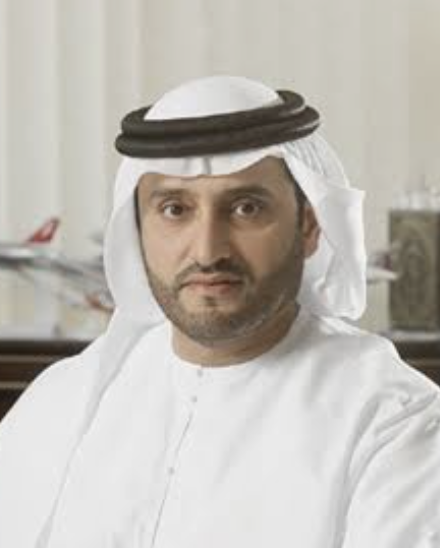


Sharjah International Airport sits inside one of the region’s most distinctive aviation models. It supports a large low-cost network, serves a dense resident population and connects tourism, trade and cargo across the UAE’s northern emirates. Ali Salim Al Midfa has been responsible for developing that platform as chairman of Sharjah Airport Authority since 2014.
Al Midfa has almost three decades of airport management experience. He holds a bachelor’s degree in business administration from the Higher Colleges of Technology in Dubai and has combined aviation leadership with roles across the Sharjah Executive Council and industry organisations.
His career predates the authority’s current structure and has tracked the airport’s transformation from a relatively small regional gateway into the base of a major low-cost airline. That institutional memory is valuable when infrastructure decisions have consequences lasting several decades. Al Midfa has seen how route growth changes terminal flows, ground handling, cargo demand and the commercial businesses around an airport.
He chairs Sharjah Aviation Services, Sharjah Airport Travel Agency and the local duty-free company, and has served on the regional board of Airports Council International. These roles give him responsibility for several parts of the passenger and airline relationship that are often managed separately. Ground services affect punctuality, retail affects revenue and experience, while the travel agency connects the airport with customers before they reach the terminal.
In 2025, Sharjah Airport handled 19.48 million passengers, an increase of 13.9 per cent. Flight movements rose by 8.3 per cent to 116,657. Air cargo reached 204,323 tonnes, while sea freight added 16,770 tonnes. The figures reflect an airport that is growing across passenger and logistics markets at the same time.
Air Arabia is central to that success. Its base at Sharjah has opened routes across the Middle East, South Asia, Central Asia, Africa and Europe, creating affordable access for residents, visiting friends and relatives, business travellers and tourists. The airline and airport have grown together, but Al Midfa must also maintain an environment that works for other carriers and cargo operators.
Capacity is the immediate challenge. The airport’s expansion programme is intended to raise annual capacity to 25 million passengers. Construction must proceed while operations continue, making phasing, passenger flow and disruption management as important as the completed terminal design.
Al Midfa’s wider responsibilities demonstrate the commercial ecosystem around an airport. He chairs Sharjah Aviation Services, Sharjah Airport Travel Agency and the emirate’s airport duty-free company. These businesses influence ground handling, travel distribution and non-aeronautical revenue, all of which affect the airport’s service and financial resilience.
His involvement with Airports Council International Asia-Pacific and Middle East gives Sharjah a voice in regional discussions on safety, sustainability, technology and passenger experience. It also provides benchmarks against airports operating at very different scales.
The tourism opportunity is to connect airport growth more directly with the emirate’s cultural and leisure offer. Many passengers using Sharjah may be travelling elsewhere in the UAE. Better information, transport and stopover products can encourage a larger share to explore Sharjah itself.
Cargo is equally strategic. The airport’s location, road connections and operating flexibility support time-sensitive goods and regional distribution. A balanced passenger and freight business can provide resilience when one market softens.
Digital systems and sustainability now sit alongside physical expansion. Passenger processing can increase effective capacity before a building is enlarged, while better operational data can reduce delays and improve aircraft turnaround. Energy, waste and ground access affect the airport’s environmental performance. Al Midfa must ensure the new capacity is more efficient as well as larger, because a 25-million-passenger airport will magnify every weakness in the existing system.
Al Midfa’s leadership is ultimately about making growth usable. Passenger records attract attention, but the airport’s long-term value depends on reliable processes, appropriate capacity and strong connections to the economy around it. His experience across the airport’s operating companies positions him to manage Sharjah’s gateway as one integrated system.