

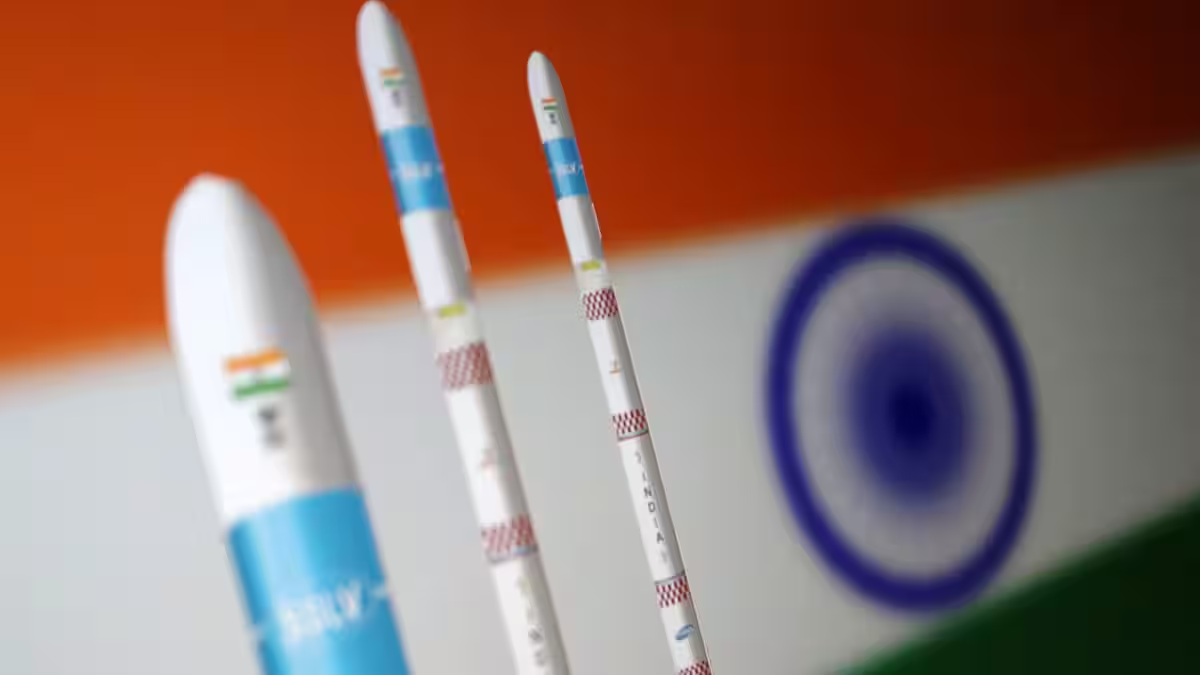

India’s space economy is projected to reach $40–45 billion over the next decade, with private investment and the number of space startups rising sharply
India’s biggest gap in its growing space ecosystem is launch capacity, according to Neeraj Khandelwal, CEO and co-founder of Astrobase Space Technologies.
As India builds more satellites and space applications, the country will also need the ability to put significantly more payload into orbit, Khandelwal told Firstpost.
“The biggest gap today is launch capacity. As India builds more satellites and space applications, we also need the ability to put significantly more payload into orbit,” he said.
The comments come as India’s private space industry expands rapidly. The number of registered space technology startups in India has risen to around 440 as of August 2026, from just one in 2014, according to the government. India’s space economy was valued at around $9 billion as of August and is projected to reach $40–45 billion over the next decade.
Private investment in the sector has also increased sharply. Cumulative investment in Indian space startups reached $618.5 million by March 31, 2026, up from $100.5 million in 2021–22. The government said $187 million was invested during 2026 alone.
Khandelwal sees opportunities across the wider space infrastructure value chain over the next decade.
“Over the next decade, I see a large opportunity across propulsion, launch vehicles, manufacturing and testing infrastructure,” he said.
India expands launch infrastructure
India’s launch ecosystem is already expanding, even as private companies seek to build additional capacity.
 More from Business
The country currently has two operational launch pads at Sriharikota, with a third being established for next-generation launch vehicles. Kulasekarapattinam in Tamil Nadu is also being developed as a second rocket launch site, with the government saying it will support Small Satellite Launch Vehicles and private-sector launches.
India has also seen rising demand from international customers. The government said the number of foreign satellites launched by India increased from 35 before 2014 to 399 as of January 2026.
The private launch sector recorded a major milestone in July when Skyroot Aerospace’s Vikram-1 became India’s first privately developed orbital launch vehicle to successfully reach orbit. The mission carried customer payloads as well as technology demonstrations from Indian and international partners.
Astrobase targets first orbital launch by December 2028
Astrobase is developing EVEREST, an 800 kN-class LOX-methane staged-combustion engine, as part of its planned launch vehicle programme.
Khandelwal said the company’s immediate focus is completing EVEREST’s development and validation, followed by full-scale hot-fire testing, establishing repeatability and reliability, and then progressing towards vehicle integration and qualification.
“We are currently targeting our first orbital launch by December 2028,” he said.
A significant part of Astrobase’s propulsion, manufacturing and testing capability is being developed in India, according to Khandelwal.
“The challenge is not just making an engine work once. It is making it work reliably and repeatedly, and then building the manufacturing capability to produce it at scale,” he said.
The government is also working on higher-capacity and reusable launch technologies. ISRO is developing a 200-tonne thrust semi-cryogenic engine and a semi-cryogenic booster for LVM3, while also demonstrating vertical take-off and vertical landing technology for booster recovery. It is developing a partially reusable Next Generation Launch Vehicle using LOX-methane propulsion.
Reusability could support higher launch frequency
Astrobase sees reusability as central to its launch strategy. But Khandelwal said the commercial value of reusable systems goes beyond reducing the cost of putting payloads into orbit.
“For customers, ultimately all four matter: cost, reliability, availability and the ability to launch repeatedly,” he said.
The company is still in the development phase and does not want to specify launch-cost or turnaround targets before validating its system, Khandelwal said.
The emphasis on launch frequency comes as India seeks to build capacity for both domestic missions and international customers. The government has said the expansion of launch infrastructure is intended to increase launch frequency and operational flexibility.
Funding and manufacturing remain key challenges
Moving from a rocket prototype to a commercial launch business requires substantially more infrastructure and capital than engine development alone, Khandelwal said.
“Building launch capability is capital intensive because it requires much more than developing a prototype,” he said.
This includes manufacturing, testing infrastructure, supply chains, vehicle integration and the ability to produce and launch vehicles repeatedly.
The broader industry is also receiving government-backed funding support. The government has introduced schemes including the IN-SPACe Seed Fund, a Rs 1,000 crore Venture Capital Fund and a Rs 500 crore Technology Adoption Fund. A Satellite Bus as a Service scheme has also been allocated Rs 75 crore.
As of mid-2026, IN-SPACe had granted 113 authorisations to 52 non-government entities, including 18 startups, for activities including satellite operations, payload establishment and launch services.
Private sector seen as key to India’s space ambitions
India opened its space sector to private participation in 2020 and subsequently introduced the Indian Space Policy 2023 and other measures aimed at expanding private participation across the space value chain.
The government has also been transferring ISRO-developed technologies to industry. NewSpace India Limited has signed 118 technology transfer agreements covering 83 technologies, while IN-SPACe had facilitated 71 ISRO technology transfers to industry and startups as of January 2026.
Khandelwal said private companies can help build the additional capacity required as India moves towards more ambitious human spaceflight, exploration and commercial missions.
“India’s long-term space ambitions will require significantly greater launch, manufacturing and testing capacity,” he said.
India’s government has set out plans for the Bharatiya Antariksh Station, with the first module targeted for launch by 2028 and the station targeted for operationalisation by 2035. The Gaganyaan programme is also targeting a crewed mission by 2027.
“We have the engineering and manufacturing base to build advanced propulsion, launch systems and space hardware in India,” he said.