
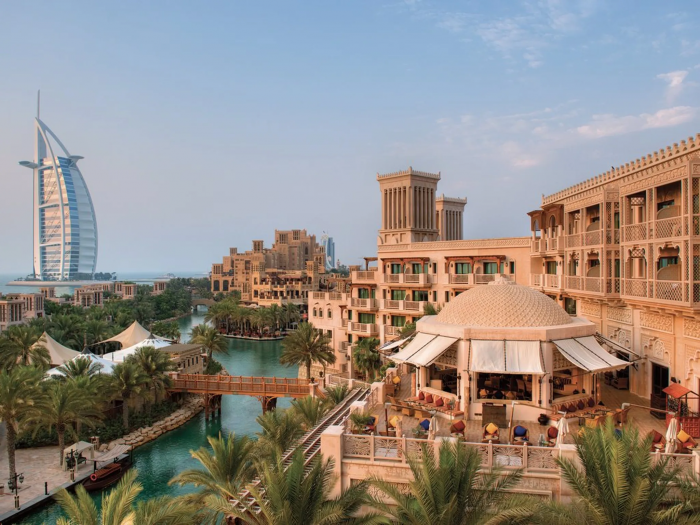


As Dubai wakes up this morning, FHS World opens its doors at Madinat Jumeirah at a fascinating moment for global hospitality, and perhaps the most revealing thing about the thousands of investors, owners, operators, developers and government leaders gathering here is that, after one of the more challenging years the industry has faced since the pandemic, nobody appears to have lost their appetite for what comes next.
There is no point pretending 2026 has been easy. Regional geopolitical disruption has affected airspace, international arrivals and hotel performance, while higher development and operating costs and a more demanding investment environment have forced owners and developers to look much harder at where they deploy capital and what returns they expect from it.
The numbers illustrate just how real that pressure has been. UAE hotel RevPAR was down 31.8 per cent year-to-date through June as regional tensions compounded the traditional summer slowdown and affected international arrivals, while the World Travel & Tourism Council expects Middle East Travel & Tourism GDP to contract sharply this year before returning to long-term growth.
Yet look in the other direction and an apparently contradictory picture emerges.
The Middle East hotel development pipeline reached a record 717 projects and 177,110 rooms during the first quarter of 2026, up 13 per cent and 12 per cent respectively year-on-year. More tellingly, almost 40,000 rooms were sitting in early planning, an increase of 48 per cent in a year.
In other words, the short-term environment has become considerably harder while the long-term ambition has continued to accelerate.
That, to me, is the real story as FHS World begins.
Reinvest in our Future
The theme of this year’s summit is Reinvest in our Future, and it is difficult to imagine a more appropriate moment for that conversation.
More than 200 investors representing some US$5 trillion in assets under management are expected at FHS World, alongside over 1,000 hospitality leaders, with almost half of those investors travelling from outside the GCC and half attending for the first time.
These are significant numbers, but what matters more is what those investors are here to discuss.
Look at today’s programme and you get a remarkably accurate snapshot of the questions facing hospitality.
Following the opening of FHS World, UAE Minister of Economy and Tourism H.E. Abdulla bin Touq Al Marri will sit down for a conversation entitled The UAE Growth Engine: Tourism, Investment and the New Economy.
That is immediately followed by Beyond the Headlines: Investing in a Changing Middle East, before the programme moves through regional capital flows, deal flow and capital markets and concludes its main-stage discussions with the Global Presidents Forum.
This is not an industry gathering to congratulate itself on how many hotels it is building.
It is asking harder questions about where capital should go, what owners now expect from brands, which destinations have the fundamentals to support the extraordinary pipelines being announced and how hospitality responds when geopolitical events can change trading conditions almost overnight.
Those are exactly the conversations the industry should be having.
Challenging year, extraordinary fundamentals
There is an important distinction between acknowledging a difficult year and losing sight of the structural forces reshaping travel.
Globally, hotel investment is already recovering. Direct hotel investment in 2025 was 22 per cent higher than at the market trough in 2023, hotels reclaimed around eight per cent of global commercial real estate investment and international tourism surpassed pre-pandemic levels, while global air passenger volumes are forecast to grow another 4.9 per cent this year.
Capital is available, but it is becoming more selective.
That distinction matters enormously for the Middle East.
The region does not simply have a large pipeline; it has one increasingly concentrated towards the top of the market. Luxury alone accounted for 207 Middle East pipeline projects and 45,780 rooms at the end of last year, both record levels.
At the same time, the fundamentals underneath the UAE tourism story remain formidable. Before this year’s disruption, UAE hotels generated more than AED26 billion in revenues during the first half of 2025, with occupancy running at 80.5 per cent, while Dubai entered 2026 welcoming two million international overnight visitors in January alone.
Even after the immediate pressures of this year, the long-term forecasts remain striking. WTTC expects the Middle East to become the world’s fastest-growing Travel & Tourism region between 2026 and 2036, with sector GDP growing at an average 6.3 per cent annually to reach US$605 billion.
Saudi Arabia, the UAE, Oman and Qatar alone generated US$272 billion in Travel & Tourism GDP last year and are projected to reach US$435 billion by 2036.
That is the context in which FHS World is taking place.
The industry is changing with the region
The programme over the next three days also tells us something else: hospitality itself is becoming a much broader asset class.
Tomorrow, owners and brands will debate From Pipeline to Partnership: What Owners Really Need from Brands, alongside conversations about food security, leadership, sustainability and regenerative tourism. By Thursday, an entire FHS Living programme turns the spotlight onto branded residences and asks what will define the sector’s next big bet.
There is good reason for that focus.
Dubai is already the world’s largest branded residences market, with 64 completed schemes and another 87 in the pipeline, while Ras Al Khaimah, remarkably, has 24 schemes in the pipeline despite having none completed at the point of the latest global analysis.
That is not a peripheral extension of hospitality anymore. It is becoming one of its major growth engines, bringing together hotels, luxury brands, real estate, investment and lifestyle in ways that would have looked distinctly unconventional a decade ago.
The same can be said of wellness, longevity, restaurants, technology and AI, all of which feature prominently across the FHS programme because they increasingly sit at the centre rather than the edges of the hospitality investment proposition.
For much of my career, many of the trends shaping hospitality in the Middle East originated somewhere else and were subsequently imported into the region.
That relationship is changing.
The Middle East is increasingly one of the places where the future of hospitality is being conceived, financed and tested first.
Optimism with discipline
None of this means every hotel in the pipeline should be built, every branded residence will succeed or every destination can sustain the extraordinary growth currently being projected.
Indeed, the events of this year should make the industry more disciplined, not less ambitious.
Capital is asking harder questions. Owners expect brands to demonstrate what they actually contribute to performance. Developers are having to think much more carefully about cost, positioning and demand. Investors are increasingly differentiating between trophy assets, strong destinations and projects whose economics depend too heavily on optimism.
That is healthy.
There is an important difference between momentum and exuberance, and the next phase of Middle East hospitality will require more of the former and less of the latter.
But there is little evidence that investors are turning away from hospitality as an asset class. Globally, the availability of capital is improving, hotel transaction volumes are recovering and investors continue to seek high-quality assets, while here in the region the scale of development continues to grow despite everything that 2026 has thrown at it.
Which brings us back to Dubai this morning.
A moment to reflect, adapt and connect
FHS World provides a moment to reflect on a year that has reminded everyone in travel and hospitality that growth is never guaranteed.
It is a moment to adapt, because technology, capital, traveller expectations and the economics of hotel development are all changing simultaneously.
And it is a moment to connect, because despite AI, automation and everything else transforming our industry, hospitality remains fundamentally a people business, and gatherings such as FHS continue to be where capital meets ideas, relationships become partnerships and projects begin.
But there is something else flowing through this industry and this region which no spreadsheet or pipeline report quite captures.
Energy.
You feel it in Dubai. You feel it in Abu Dhabi, Ras Al Khaimah and across Saudi Arabia. You see it in the hotels being built, the destinations emerging, the global brands competing for opportunities, the capital arriving from around the world and the entrepreneurs who still believe there is another experience to create and another convention to challenge.
This has been a challenging year, but it has not been a year in which the Middle East stopped thinking about the future.
Quite the opposite.
The industry has been reminded of risk while simultaneously doubling down on opportunity, and perhaps that is why FHS World feels particularly relevant this morning. Hospitality does not progress because conditions are always perfect; it progresses because people continue to invest, innovate and build through the cycles.
Over the next three days, Breaking Travel News will be here at Madinat Jumeirah, capturing those moments as they happen, speaking to the people deploying the capital and shaping the projects, and breaking the news as the next chapter of this extraordinary industry unfolds.
There will be plenty of time this week to discuss what has been difficult.
But as FHS World opens in Dubai this morning, what is impossible to ignore is the unstoppable momentum, energy and ambition of an industry, and a region, that is already looking towards what comes next.
Justin Cooke, Editor-in-Chief, Breaking Travel News