
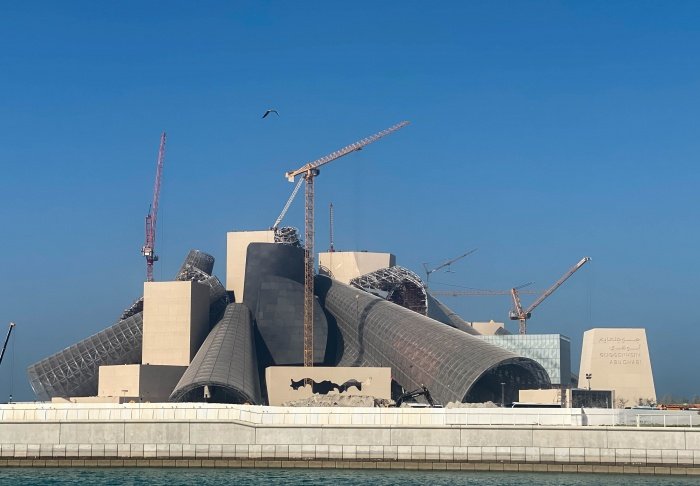


Guggenheim Abu Dhabi under construction in February 2026
BTN explores how Abu Dhabi is building a global cultural destination from desert heritage, deep history and contemporary art.
When BTN visited Abu Dhabi during Ramadan in February, its cultural strategy was already clear: across museums, heritage sites, hospitality and a rapidly expanding calendar of attractions. Six months later, conversations with Abu Dhabi’s tourism leadership at Arabian Travel Market offered a timely opportunity to revisit that strategy as the emirate’s tourism recovery gathers momentum. What emerged was a destination being built around a surprisingly coherent idea: culture as a way of connecting everything.
Art leads into history. History leads into landscape. Landscape leads into natural history. Islamic traditions lead into contemporary hospitality. Global entertainment is being introduced with an Emirati dimension. Even the physical geography of Abu Dhabi, an archipelago of islands, is being connected through a growing network of attractions, infrastructure and experiences. The result is increasingly a curated cultural ecosystem.
A location built on deep time
The story begins long before the UAE itself. At Al Ain Oasis, the 1,200-hectare landscape contains 147,000 date palms alongside an ancient irrigation system known as a falaj.
UNESCO identifies one of the Al Ain systems at Hili as an Iron Age falaj, dating back around 3,000 years. The wider Al Aflaj tradition incorporates underground channels, surface waterways and inherited knowledge about finding, maintaining and equitably distributing water in an arid environment.
It is an extraordinary piece of infrastructure to encounter as part of a modern tourism itinerary. The same landscape that depends on sophisticated contemporary infrastructure is still carrying evidence of an ancient relationship between people, water and the desert. That relationship has become part of Abu Dhabi’s cultural storytelling.
Falaj irrigation systems Abu Dhabi
The itinerary moved between Al Ain’s oasis heritage and the museums of Saadiyat, where the timescale expands dramatically.
The Natural History Museum Abu Dhabi takes visitors through 13.8 billion years of Earth’s history, from the origins of the universe and formation of the planet to the evolution of life and the ancient ecosystems of the Arabian Peninsula.
The effect is surprisingly emotional. Adults become children again, drawn into questions about fossils, meteorites, extinction, evolution and the extraordinary scale of deep time.
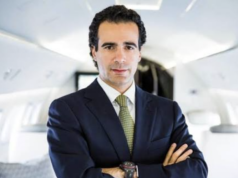
That sense of curiosity is part of the point. Yousuf told Breaking Travel News that visitors to Abu Dhabi should begin by understanding the natural history of the place before moving into the history of the country. “You need to know the history of the nature of the area itself,” he said.
The Zayed National Museum then extends that story into the history of the UAE and its people. Its galleries explore more than 300,000 years of history, linking archaeological evidence, landscapes, Sheikh Zayed’s legacy and the formation of the modern nation.
Yousuf described the wider ambition in similarly expansive terms. “Many people who come to Abu Dhabi, they want to experience UAE, but they also want to know the story of the rest of the region.”
From local to global
The Louvre Abu Dhabi provides another layer to that story. Its architecture and collection deliberately create connections across cultures, with Jean Nouvel’s dome producing the famous “rain of light” effect as water and sunlight move through its geometric structure. DCT describes the museum as a bridge between Eastern and Western cultures.
Walking through the building, those connections are physical as much as intellectual: light, water, geometry, architecture and objects from different civilisations come together as one experience.
The forthcoming Guggenheim Abu Dhabi pushes that international dialogue further. Yousuf said its collection will have a strong focus on a much broader geographical perspective than the traditional Western museum narrative.
“It will be focused on the East,” he said, describing a collection spanning more than 100 countries and more than 1,100 acquired works.
That gives the Saadiyat Cultural District an interesting position within global culture. Abu Dhabi is importing some of the world’s best-known cultural institutions while also trying to shift the cultural conversation towards the histories and perspectives of the wider region.
DCT’s own description of Saadiyat is revealing: it calls the district a global forum for creativity and exchange, designed as a place for dialogue, debate and exploration of the ideas and histories that shape how we understand the world.
Iftar celebrations being set up in the desert
Culture beyond the museum door
This cultural strategy extends well beyond museums. Ramadan provided a particularly effective framework.
The city moves into a gentler daily rhythm during the holy month, with activity shifting towards the evening. Iftar brings together dates, Arabic coffee, food, family and guests; suhoor creates a quieter late-night tradition.
Experiencing that rhythm in person gave the architectural and historical elements of the destination another dimension.
At Sheikh Zayed Grand Mosque, the scale is spectacular, but the details tell a more intimate story: white marble, lapis-coloured mosaics, mother-of-pearl, reflected light and intricate patterns.
The mosque itself was conceived as an open cultural space, and its construction involved artisans from around the world, including 1,300 female artisans who hand-knotted its enormous main prayer-hall carpet.
An iftar at Emirates Palace offered a different form of cultural encounter. Food, coffee rituals, architecture, hospitality and the rhythms of Ramadan became part of the visitor experience.
This is where Abu Dhabi’s approach to culture becomes especially interesting. There is a deliberate movement between the monumental and the everyday: the mosque and the coffee ritual, the museum and the farm, deep time and the evening meal.
Global entertainment with a local accent
The strategy extends even to the giant international brands now joining Abu Dhabi’s tourism landscape.
On Disney’s forthcoming Abu Dhabi project, Yousuf said the Emirati experience would be incorporated into the design from the outset.
“We want to welcome the world to come and experience our Emirati hospitality,” he said.
The same principle applies to the wider entertainment ecosystem around Yas Island.
Warner Bros. World and SeaWorld sit alongside major cultural institutions, while further developments including Disney and new theme parks are expanding the family proposition.
SeaWorld’s “One Ocean” concept is particularly interesting in this context, using marine life and the interconnectedness of the world’s oceans as the central narrative.
The result is a destination where culture increasingly means many things at once: fine art, archaeology, religion, science, natural history, food, entertainment and hospitality. That may be the most significant element of Abu Dhabi’s approach.
Teamlab teamLab Phenomena Abu Dhabi
Curating the archipelago
Yousuf described the cultural landscape as becoming a complete destination in its own right, with the museums and attractions designed to complement one another and encourage visitors to stay longer.
“One out of three” visitors is now choosing Abu Dhabi because of its cultural offer, according to figures presented by DCT during its ATM briefing.
The destination is also deliberately connecting its different visitor segments. DCT’s February itinerary moved between Abu Dhabi and Al Ain, heritage and contemporary art, nature and entertainment, with Ramadan providing another thread through the programme.
The department’s Tourism Strategy 2030 sets an ambition to grow visitor numbers from nearly 24 million in 2023 to 39.3 million by 2030, while increasing the tourism sector’s annual GDP contribution to approximately AED 90 billion.
At ATM, Yousuf said the emirate’s year-to-date hotel occupancy was around 70%, with domestic demand proving particularly resilient. He also said the broader strategy had been designed to account for different forms of risk and changing market conditions.
This makes the cultural investment more than an exercise in placemaking. It is part of a long-term destination strategy: create enough depth that Abu Dhabi becomes somewhere to explore rather than somewhere simply to pass through.
A different kind of global destination
There is an elegant logic to the way Abu Dhabi is assembling this. Start with the land itself. Move into its water systems, oasis agriculture and archaeological history. From there, explore the UAE’s national story, Islamic culture and hospitality. Then move outward through universal museums, contemporary art, science and natural history. Finally, bring in global entertainment and technology, while continuing to place Emirati identity within the experience.
The destination keeps returning to the same underlying question: how do you tell the story of a place while inviting the rest of the world into it? Yousuf’s answer was simple.
“We want to welcome the world to come and experience our Emirati hospitality.”
After spending several days moving through the emirate, from the ancient falaj of Al Ain to the museums of Saadiyat and the rituals of Ramadan, that seemed to be the thread holding the location together.
Abu Dhabi is building a cultural destination at considerable scale. Its most interesting ambition is that the story should remain larger than any one building: a story of landscape, civilisation, hospitality, art, science and a place finding its position within global culture.
Words and images by Sapphire Goss