
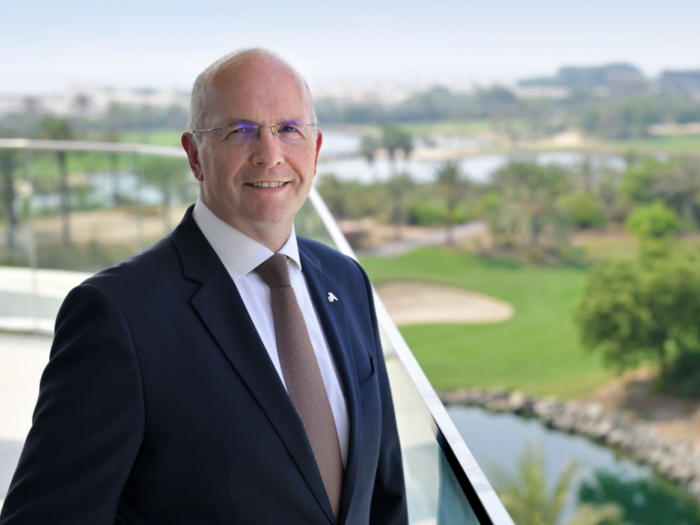


Ralph Porciani became chief executive of JA Resorts & Hotels in 2024 with more than 40 years in luxury hospitality behind him. Roughly a third of that career was spent in leading central London hotels, followed by two decades at Scotland’s Turnberry resort. There he helped guide the property to Forbes Five-Star status, mastering the complexities of a destination combining hotel, golf, food, heritage and international reputation.
That experience is well suited to JA, a home-grown Dubai company founded in 1981. The portfolio now comprises nine properties and 1,879 keys across the UAE, Maldives and United Kingdom. It includes the three hotels at JA The Resort in Jebel Ali, JA Ocean View Hotel, JA Hatta Fort Hotel and Indian Ocean assets. Porciani inherited a brand with history, land, loyal guests and considerable unrealized international potential.
His first strategic task is to sharpen what JA stands for. The group spans beach resorts, city hotels, a mountain retreat, islands and golf. That diversity can be an advantage if unified by warm service and experience-led leisure, but it can also make the brand difficult to summarize. Porciani’s career in iconic individual properties gives him an instinct for distinctiveness, while his chief executive role requires a common commercial platform.
The 2025 entry into Scotland through Mar Hall Golf & Spa Resort near Glasgow and The Bruntsfield in Edinburgh marked JA’s European debut. For Porciani, the move connects familiar territory with a new corporate chapter. The two assets also broaden the portfolio from resort-led sun destinations into country and city hospitality. Execution will show whether JA can transfer its culture across borders without losing local character.
In Dubai, the launch of JA Sports & Shooting Club expanded the group’s experience ecosystem at Jebel Ali. The wider resort occupies about one million square metres, giving Porciani the ability to package accommodation, golf, sport, dining and family leisure at unusual scale. His challenge is to make that abundance navigable and personalized rather than overwhelming.
Porciani often describes his philosophy through craft and care, influenced by early exposure to his family’s restaurant. That service instinct now meets asset strategy. Legacy properties need continual reinvestment, and international growth must be selective. The chief executive must decide where capital and management attention will strengthen the brand most.
JA does not need to mimic a global mega-chain. Its opportunity is to become a confident independent collection with Dubai roots and genuine destination expertise. Porciani has spent his career stewarding hotels whose identity mattered. If he can combine that custodianship with disciplined expansion, JA’s next era could be its most internationally significant.
Scotland also allows him to connect source market and destination. British guests are important to Dubai and Maldives tourism, while JA’s new UK presence creates year-round brand visibility and potential cross-selling. Porciani can use that relationship intelligently without making Scottish hotels feel like sales outposts for warmer resorts. Each property must succeed locally before network benefits become credible.
His Turnberry experience provides another lesson: great resorts are renewed continuously. Golf courses, spas, kitchens, rooms and landscapes all need capital and specialist stewardship. At Jebel Ali, the same principle applies across a far larger activity ecosystem. Porciani must establish a long-term plan that protects the resort’s established affection while updating it for new generations. The work is less dramatic than acquisition, but it is where an enduring brand is made.