
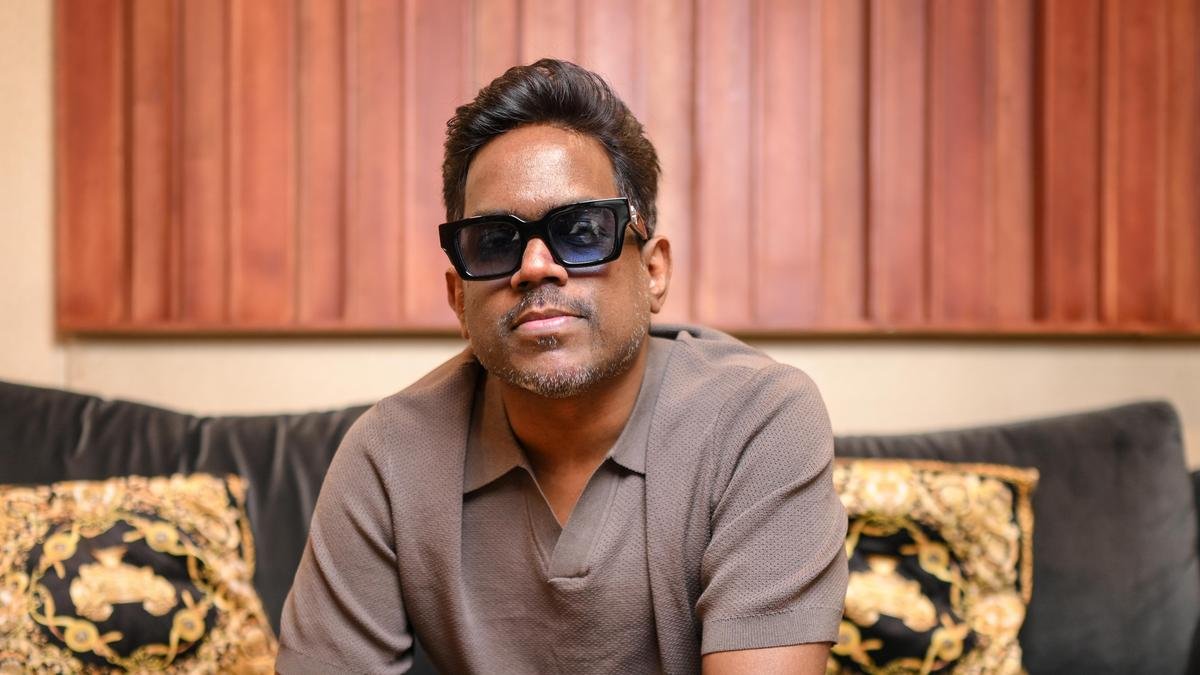

“Drugs are legal here,” says a comment on a jukebox featuring his superhit tracks.
For a generation of Tamil film audiences who grew up in the 2000s, heartbreak and happiness came accompanied by a song tuned by Yuvan Shankar Raja. For them, his voice oozes intoxication – it’s no wonder that there are multiple playlists that are titled ‘U1 Drugs’.
But his voice alone will not be in the forefront of ‘Walking through the Rainbow’, a concert by the man this weekend in Chennai. A symphonic experience, it seeks to present a full-length orchestral experience of his iconic background scores that have been celebrated by Tamil cinema fans across the globe. Excerpts from an interview with the musician:
When did you conceptualise the idea of a symphonic presentation of your work, and why is this special?
I like to break regular formats. I went to Hans Zimmer’s concert in Abu Dhabi, and wished to do something on those lines. That took us to ‘Walking Through the Rainbow’, which is the first-ever concert built entirely around scores. We rehearsed the tracks with a symphony orchestra at Bangkok – some of them were very easy for them, but when it came to the music of 7G Rainbow Colony, they had to practise for almost half a day… which gave me the satisfaction that I had written a good score for that particular film. For me, be it the score or the songs, when I listen to my past work, I go back to the journey associated with it, and hence it is special. I believe audiences will experience the same feeling.
Your background music has become popular in its own right. When you score this, what are you trying to achieve that is different from what you do with a song?
Everything that we do is to elevate the film’s sequences. Take the ‘Bat Theme’ in Chennai 600028, for instance. Venkat (director Venkat Prabhu) already had a tune from my father’s work [Ilaiyaraaja’s ‘Apoorva Sagodargal’ emotional theme] for that situation, but I created a trap version around it. Before I embarked on Paruthiveeran’s background score, I heard as much as possible of my father’s and AR Rahman’s folk work and decided to go the opposite way. I kept it as raw as possible. If you hear the score even today, the nadaswaram player had made some mistakes. But I left it as such – because I wanted it to be like a thiruvizha, where such missteps occur.
A song has lyrics and singers to steer audience emotion. With background music, there are no words. How do you find that emotional language?
My scores and themes are usually not based on the songs in the film. I prefer taking the hard way, and do a score that has a connection with the songs of the film. Sometimes, the visual inspires me – Mankatha’s chase sequence is one example. Sometimes, we take English scores and paste them on for a sequence – not as a rip off, but to understand the sound spectrum. Simbu’s Manmadhan was done like that.
You’re known for both romance and mass music. Which is tougher to crack?
Truth be told, both are not tough. Your mind has to be like a clean slate when you start works. Creativity is about flow. If there’s something amiss in the office, I cannot work. If my mind is clutter free, music flows. My mind goes back to ‘Naane Varuven’, a score that Selvaraghavan and I worked for almost seven days. Dhanush heard it, and scrapped everything. But I managed to complete the entire score within 24 hours, because my mind was free. As a composer, I am like clay. I can mould myself according to what the makers seek in a project. This is a quality that I picked from my father.

Music composer Ilaiyaraaja
| Photo Credit:
Thamodharan B
Your father recently presented ‘Valiant’, a classical symphony. How inspiring was that achievement for you as a musician to devise your own symphonic presentation?
I started composing music when I was 16, much before I had the life experiences to score for the subjects I was taking on. My father and his music were the biggest foundation for my inclination towards background score. Even when I have a tough sequence in front of me, I take it as a challenge.
What happens when you’re composing music and hit a roadblock?
Nothing. I just have some dessert (laughs).
Did you grow up listening to your father’s work and wanting to become like him?
When I was in school, my only exposure to my dad’s songs was through Oliyum Oliyum on TV. They would play the programme loudly at home and I would happen to listen to the songs in the background even as I was playing. As time went by, I kept listening to hip-hop and RnB. I was in a zone where I thought, ‘We need to bring this kind of music here.’ I decided to do a private album, for which I listened to RD Burman and MS Viswanathan’s work extensively. When I came to appa’s work, the vehicle stopped (laughs).
After becoming an established composer yourself, how much did your relationship with your father’s music change?
I had gone to Melbourne to mix Sarvam (2009), and on the flight, I happened to hear ‘Netru Indrum Neram’ and another song in Tik Tik Tik (1981)on loop. I was taken aback by how he had managed to pull off those sounds, back in the Eighties. The minute I came back, I rushed to him to understand how that was done. Then, I started noticing more of his background scores and realised that he is an encyclopaedia when it comes to music.
Today social media is filled with a debate pitting Ilaiyaraaja versus AR Rahman. As a music fan, how do you view this debate?
I don’t see it as a debate. I know ARR very well; his son, AR Ameen, hangs out with me all the time. There are no walls between composers. We all speak to each other. I’m unable to understand this from a fan’s point of view.

Actor Ajith’s Dheena (2001) was a turning point in your career. You share a warm camaraderie with him; last year, we saw you bonding with him in Dubai when he was practising for the Le Mans race. As a film industry colleague, how inspiring is it to see him pursue motor racing?
It is vera level to watch him. It’s very easy for us to speak about car racing from a distance, but I have witnessed his struggles up close. He showed me recorded footage from his previous races. It is extremely inspiring to watch his passion and intensity.
People close to you tell me that you are deeply spiritual. You converted to Islam. Has your spiritual pursuit influenced your musical journey too?
It has helped handle the stress around me. Be it losing someone or winning a big award, spirituality has helped me handle both these ends of the spectrum of life. It has helped me be more at peace.
Yuvan’s ‘Walking Through the Rainbow’ will be held at Nehru Indoor Stadium on September 19. Tickets on District
Yuvan’s line-up
City of Gold
Raja’s Playlist
7G Rainbow Colony – 2
Bang Bang
Paripadi (Malayalam)
Published – September 16, 2026 04:47 pm IST