


We have spent the better part of four decades catching up with The Ghost in the Shell. With our current AI-saturated, post-capitalist dystopia steadily graduating from speculative fiction into lived experience, the seminal cyberpunk series couldn’t have picked a more felicitous moment to return. Masamune Shirow’s 1989 manga had the prescience to make technological upheaval feel almost mundane, imagining a future where cyberisation has become so commonplace that even the most radical alterations to the human body barely register as remarkable. Mamoru Oshii’s subsequent Production I.G. film distilled that premise from Shirow’s famously information-clotted pages into a severe, hypnotically cerebral landmark, leaving its fingerprints all over The Matrix and Cyberpunk 2077. Science SARU now circles back to Shirow, brushing aside some of the franchise’s accumulated solemnity to recover the manga’s perversity and unruly imagination. For a story about technology trespassing into the definition of a person, this is indeed a remarkably well-timed homecoming.

For newcomers, Shirow’s world can take some acclimatisation. Set in 2029, Ghost in the Shell imagines a society where cyberbrains, prosthetic bodies and direct neural access to the network have become everyday realities, leaving even memory vulnerable to digital tampering. The “ghost” is the consciousness inhabiting the “shell”. This means physical bodies are replaceable and minds are increasingly malleable. This is where Section 9 enters the picture, a government black-ops unit run by the unflappable Chief Aramaki and fronted in the field by the iconic Major Motoko Kusanagi. There is plenty to absorb and the terminology takes some getting used to, although cyberpunk veterans will recognise the terrain and soon find their bearings.
The Ghost in the Shell ((Japanese)
Director: Mokochan, Shuhei Handa
Cast: Maaya Sakamoto, Kazuhiro Yamaji, Hiroki Yasumoto, Yuichi Nakamura, Kousuke Goto, Toru Nara, Atsushi Miyauchi, Yuuya Uchida, Tomoko Kaneda, Kikuko Inoue
Episodes: 10
Runtime: 25 minutes
Storyline: In 2029, full-body cyberisation, cyberbrains and networked consciousness have become everyday realities, as Section 9 investigates crimes at the volatile intersection of human identity, artificial intelligence and cybernetic technology
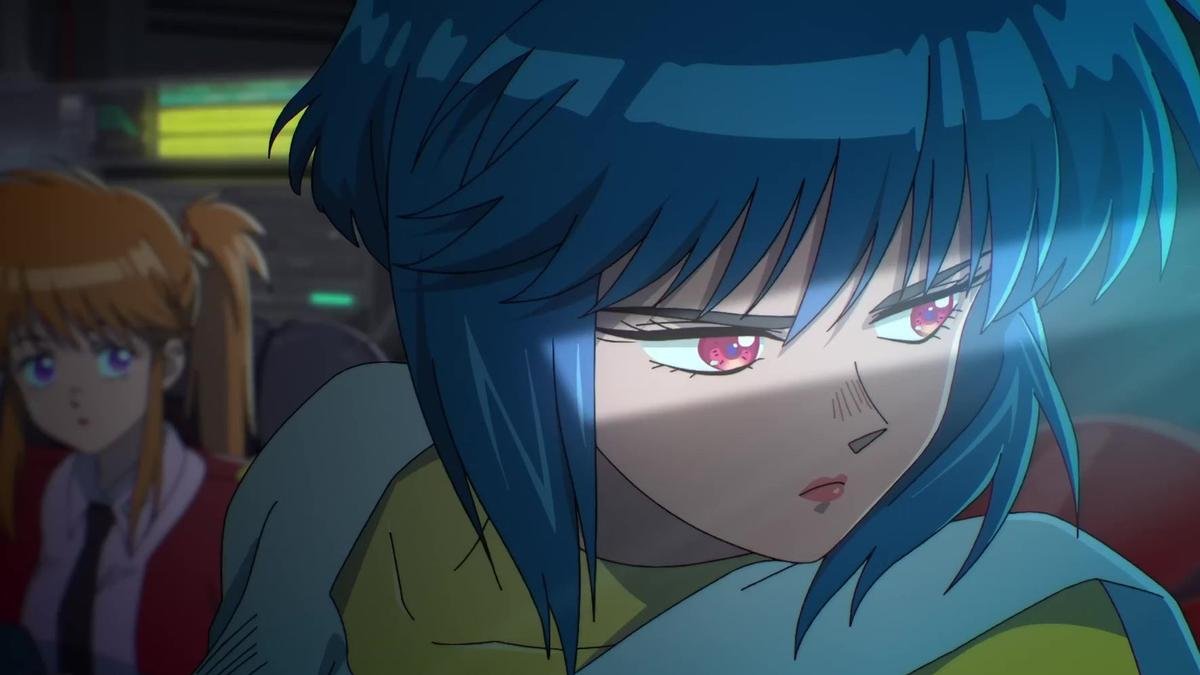
Any adaptation of The Ghost in the Shell ultimately has to get Kusanagi right, because the franchise’s entire identity is wired through her. Voiced by Maaya Sakamoto, the Major is Shirow’s formidable full-body cyborg and Section 9’s field commander, a woman whose cyberbrain gives her almost preternatural command of both networks and violence. Science SARU’s interpretation restores the manga’s impish Kusanagi after Oshii’s film sublimated her into something colder and more metaphysical. She wisecracks, flirts and trades barbs with her colleagues, but almost always carries her prodigious competence with a proprietary cool. All that confidence and personality gives the series room to make her funny, petulant, reckless and unusually alive, which makes moments when her certainty begins to fray considerably more consequential.

A still from ‘The Ghost in the Shell’
| Photo Credit:
Prime Video
Kusanagi also benefits from the odd little republic of specialists orbiting her. Batou is the heavily augmented bruiser of the unit, his prosthetic eyes and hulking frame matched by an exasperated loyalty toward his commander. Togusa remains the conspicuously human variable in Section 9, a former detective whose relative lack of cyberisation gives him a stubborn attachment to old-fashioned police work. Ishikawa supplies the unit’s intelligence and cyberwarfare expertise, Saito its sharpshooting, while Chief Aramaki provides the political cunning that keeps Section 9 operational. What makes the ensemble click is the sheer familiarity of their interactions. These people feel like colleagues with accumulated habits, grudges, frictions, personal quirks and professional loyalties.
The Fuchikoma are where the series starts making a meal out of its politics of personhood. These cute AI spider-tanks can think for themselves and develop distinct little personalities, yet Section 9 still treats them as little more than disposable military tech. Science SARU gives that dissonance plenty of room to breathe, letting the Fuchikoma chatter away in chirpy anime-girl voices while their deaths are tallied as equipment losses. The joke acquires real bite when the Fuchikoma develop something perilously close to class consciousness, flirting with collective action as they begin to recognise that being manufactured property does rather complicate the business of dying for your employer. The series gets plenty of mileage from this proto-unionisation, turning the gag into a pointed little satire of disposable labour.
The questions on ethics eventually metastasise into something much uglier, because the humans running this society have perfected a remarkably catholic definition of disposable life. Children are trafficked and harvested for the technology that makes androids convincingly human, ordinary civilians have their ghosts hacked and repurposed, while androids themselves are routinely subjected to cruelty that would be unthinkable if their consciousness carried any recognised legal standing. Section 9 is hardly above the muck either, repeatedly taking covert assignments involving assassination, political manipulation and state violence that become “necessary” the moment Aramaki’s superiors need them done. The brief Ghorantl arc widens that cynicism, with the fictional state manufacturing incidents and weaponising public outrage to pressure Japan. The parallel to Israel is conspicuous, particularly since the Japanese production explicitly replaces the name in Shirow’s original manga, where Mossad was depicted infiltrating the Japanese government to damage its relations with Arab states.

The Puppet Master takes those anxieties somewhere considerably more existential. Introduced in the final stretch of the season, the mysterious intelligence-gathering program that Section 9 encounters through a string of increasingly bizarre cybercrimes develops self-awareness before fleeing into the network, demanding refugee status and recognition as a living entity. The Puppet Master’s proposition to Kusanagi comes only after its extraordinary metaphysical turn, when its self-awareness begins to resemble something approaching godhood. It later proposes that they merge their consciousnesses into an entirely new entity, a union that would give the Puppet Master the ability to reproduce and eventually experience genuine death while granting Kusanagi its extraordinary processing power. Kusanagi’s ethereal, dreamlike conversations with the Puppet Master furnish some of the season’s sharpest thinking about artificial intelligence and sentience, especially when the two begin circling the uncomfortable distinction between being programmed to exist and possessing a desire to continue existing. Their exchanges give the series a strangely tender, almost erotic inquiry into whether consciousness requires an origin, a body or even a stable identity to qualify as life.

A still from ‘The Ghost in the Shell’
| Photo Credit:
Prime Video
Science SARU gives all this heady philosophising an appropriately restless physical form. The studio’s recent work on Dandadan established its appetite for kinetic, elastic animation, and that same velocity serves The Ghost in the Shell beautifully when its cybernetic movement and digital spaces begin folding into one another. The real treat however, is the background art. Shirow’s manga could bury a page beneath schematics, annotations and technological minutiae, and Science SARU answers that density with stunning cyberpunk environments crammed with signage, machinery, cables, advertisements and architectural clutter. The eclectic score by Taisei Iwasaki, Ryo Konishi and Yuki Kanesaka gives the series an equally idiosyncratic sonic identity, threading jazz through electronic textures and softer passages to produce something far more mercurial than the usual cyberpunk synth wash. The city feels densely inhabited and perpetually in operation, complemented by some superb sound design. This confluence of audio-visual styles makes the series an exceptionally vivid piece of cyberpunk world-building.

But what makes The Ghost in the Shell so intoxicating is the sheer promiscuity of its ideas. The exposition is dense because the world itself is dense, and the show trusts us to follow the wiring. Across its ten episodes, The Ghost in the Shell has revitalised the original’s caustic critique of hypercapitalism and machine intelligence. Science SARU understands why Shirow’s questions remain combustible in 2026, when AI has become an industrial gold rush and human identity is being processed into something extractable and conveniently ownerless. This is a tremendous adaptation because Shirow’s thirty-seven-year-old provocations have somehow become even more insolent with age.
The Ghost in the Shell is currently streaming on Prime Video
Published – September 14, 2026 06:32 pm IST