



For years, Ajman has been the UAE emirate travellers drove through on their way somewhere else. Now, increasingly, it is becoming the somewhere else.
Last night, at the World Travel Awards Middle East Gala Ceremony in Dubai, Ajman UAE Tourism was named Middle East’s Leading Emerging Tourism Destination 2026, an accolade that signals a remarkable shift in the emirate’s fortunes and recognises its growing appeal to an international audience.
The award feels especially appropriate because Ajman’s attraction lies not in trying to replicate the spectacle of Dubai or the cultural grandeur of Abu Dhabi, but in offering something rather different: a slower, more intimate vision of the Emirates.
The smallest of the UAE’s seven emirates, Ajman has long possessed an understated charm. Its coastline stretches along the Arabian Gulf, its history is deeply connected to fishing, pearling and dhow building, while its landscapes range from sandy beaches and mangroves to the rugged foothills of the Hajar Mountains.
Now, that quieter character is becoming its greatest asset.
Just a short drive from Dubai, Ajman offers an intriguing counterpoint to the high-energy pace of its famous neighbour. There are stretches of soft sand, turquoise Gulf waters, a relaxed Corniche and a growing collection of hotels and resorts, creating the kind of destination where a weekend can unfold without an itinerary dictating every hour.
The transformation is particularly evident at Al Zorah, where nature and contemporary luxury meet. The developing coastal community combines beaches, resorts, residences, restaurants and an 18-hole championship golf course, while its extraordinary nature reserve has become one of Ajman’s most distinctive attractions.
Spread across around one million square metres of mangrove forest, Al Zorah Nature Reserve is a sanctuary of lagoons, tidal channels and sandy beaches, home to almost 58 species of birds, including flamingos, herons and egrets. Kayaking through the calm mangrove waterways offers a remarkably tranquil experience — and a world away from the skyscrapers and traffic of nearby Dubai.
It is this juxtaposition that makes Ajman so compelling.
One moment, visitors can be wandering along a contemporary waterfront; the next, they can be drifting silently through mangroves, watching birds move across the water. There are golf courses and luxury resorts, but also historic neighbourhoods and traditional markets. There is the beach, but beyond the city lies Masfout, a mountain enclave where the landscape changes dramatically and the air feels cooler.
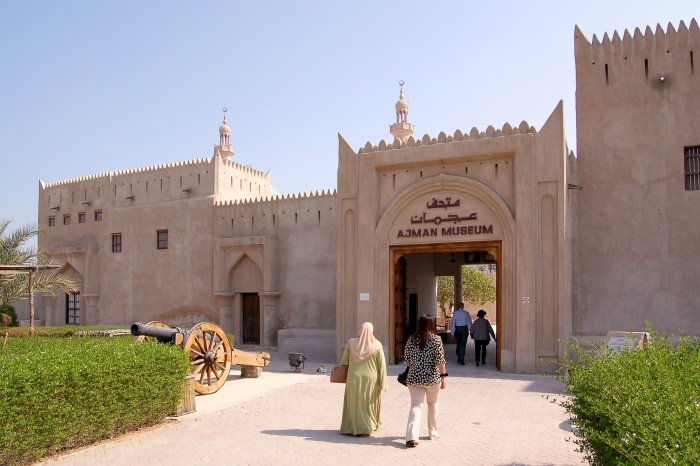
For those seeking a sense of the emirate’s past, Ajman Museum provides an essential introduction. Housed inside an 18th-century fort that served as the ruler’s residence until 1970, the museum traces the story of Ajman through archaeological finds, manuscripts, traditional weapons and objects reflecting the emirate’s maritime heritage.
It is a reminder that Ajman’s story did not begin with tourism.
Long before luxury hotels arrived, life here revolved around the sea. Fishing, pearling and dhow building shaped the local economy and culture, creating traditions of hospitality and community that remain central to the emirate’s identity.
Today, Ajman is building on that heritage rather than leaving it behind. Recent investment has brought new hotels, upgraded beaches, leisure facilities and attractions, while a growing calendar of cultural festivals and sporting events is giving visitors more reasons to come — and, importantly, to return.
The result is a destination with an increasingly appealing rhythm.
Morning might begin beside the Gulf, followed by a leisurely breakfast and an afternoon exploring the old city. Another day could mean kayaking through Al Zorah’s mangroves, a round of golf among the coastal landscape or a drive towards the mountains. By evening, the emirate’s waterfront becomes a place to linger over dinner as the temperature falls and the lights begin to shimmer across the coast.
This is not tourism designed around spectacle. It is tourism built around experience.
And that may explain why Ajman is emerging at precisely the right moment. Travellers are increasingly looking beyond the obvious landmarks in search of destinations that feel more personal, less crowded and more connected to their surroundings. Ajman offers all of this while retaining the convenience and infrastructure for which the UAE is renowned.
The World Travel Awards recognition is therefore more than a trophy. It is an acknowledgement that the international perception of Ajman is changing.
The emirate no longer needs to compete by being louder, bigger or more extravagant. Its appeal lies in its contrasts: heritage alongside contemporary hospitality, beaches beside mountains, mangroves within easy reach of the city, and a distinctly relaxed atmosphere just beyond one of the world’s most frenetic urban destinations.
For travellers who have already experienced Dubai and Abu Dhabi, Ajman offers another side of the UAE — one that feels softer, more intimate and perhaps unexpectedly authentic.
And for those yet to discover it, the message from last night’s World Travel Awards ceremony is clear.
Ajman has arrived.
Not as the next Dubai, but as something considerably more interesting: a destination finally being appreciated on its own terms.