

Goyal says India will finalise the US trade deal once Washington offers Indian exporters better tariff terms than their competitors
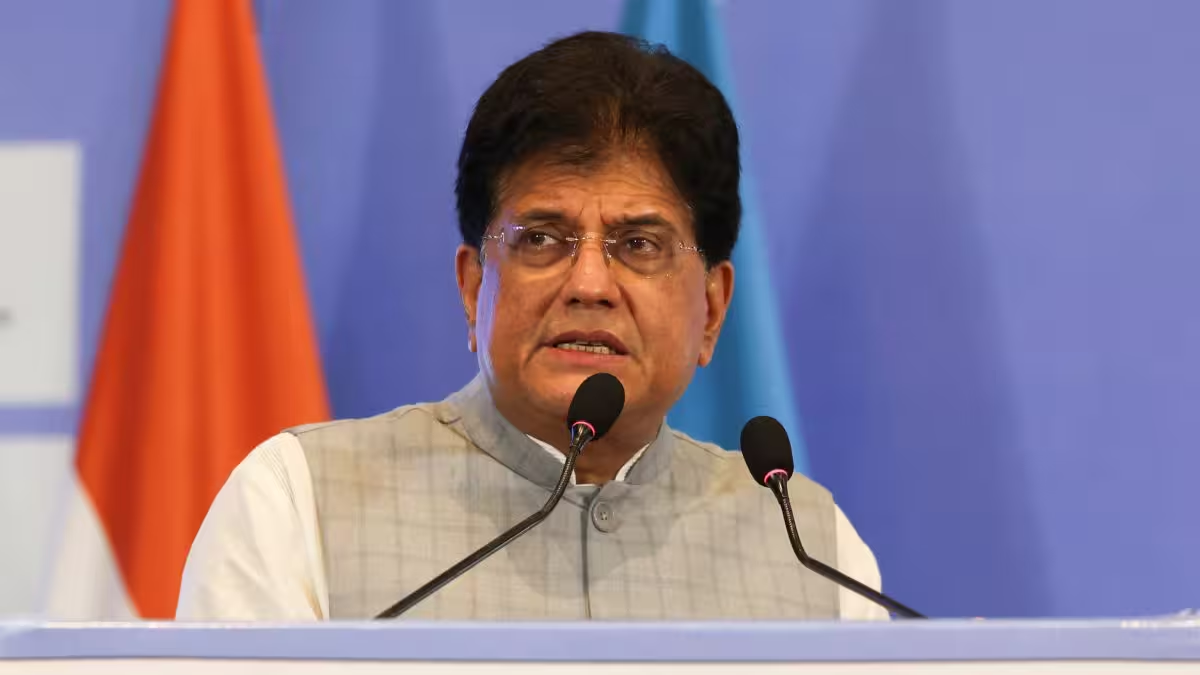
India is holding back the finalisation of its trade deal with the United States until Washington offers Indian exporters tariff terms that are better than those available to their competitors, Commerce and Industry Minister Piyush Goyal said on Thursday.
“As soon as the US is able to give us the preferential rate in comparison to our competition, we will finalise the BTA and announce the final details,” Goyal said at a national workshop on leveraging free trade agreements in New Delhi.
India and the US have been negotiating a Bilateral Trade Agreement (BTA) covering a wide range of issues, including market access, digital trade, non-tariff barriers and supply-chain cooperation.
US Trade Representative Jamieson Greer and Goyal reviewed the negotiations during Greer’s June 22-24 visit to New Delhi. The two sides had then said that their teams had made substantial progress and remained committed to a balanced and commercially meaningful agreement.
The talks followed an understanding reached in February on an interim agreement on reciprocal and mutually beneficial trade.
Why tariff advantage matters
Goyal said the real test of a trade agreement was not simply whether tariffs came down, but whether Indian companies could compete on better terms than businesses from rival countries.
 More from Business
This has been a longstanding concern for Indian exporters in sectors such as textiles, where competitors including Bangladesh and Vietnam have benefited from preferential access to major markets.
Goyal said Indian exporters must now use the market access secured through trade agreements to expand their scale, improve quality and deliver on time. “The ball is now entirely in our court,” he said.
The minister’s comments come as India steps up efforts to use its growing network of trade agreements to push exports.
India wants FTAs to reach every district
Goyal called for a nationwide campaign to make sure the benefits of India’s FTAs reach businesses well beyond established export centres.
India currently has nine FTAs covering economies with a combined GDP of around $60 trillion, he said. These agreements provide preferential access to nearly two-thirds of global trade.
With more agreements in the pipeline, India could potentially secure access to markets accounting for about 75 per cent of global trade at tariff rates lower than those faced by competitors, Goyal said.
He called for the FTA outreach programme to cover all 780 districts and reach MSMEs, traders, start-ups, entrepreneurs, women entrepreneurs and first-time exporters.
The focus, he said, should now shift from signing agreements to getting Indian businesses to use them.
Industry bodies and Export Promotion Councils have been asked to take information about FTA benefits to the grassroots, including through local-language material and simpler guidance.
India targets $1 trillion in exports
Goyal said India is targeting $1 trillion in exports in the current year, which would require growth of around 16 per cent.
Exports during April-July were about $317 billion, up from roughly $280 billion in the same period last year, an increase of around $36-37 billion, he said.
He pointed to India’s 7.8 per cent GDP growth in the first quarter as evidence of continued economic strength despite uncertainty in the global economy.
The government, he said, wants to broaden India’s export basket, bring more businesses into international trade and help smaller exporters grow.
The longer-term target is even more ambitious. India aims to take exports to $2 trillion by 2030.
More trade deals in the pipeline
India already has operational trade agreements with Mauritius, Oman, the UAE, Australia and the UK, while other agreements are expected to take effect progressively.
New Delhi is also pursuing trade arrangements with Canada, Mexico, Chile, Mercosur, SACU, the GCC and Israel.
India is separately reviewing its trade arrangements with ASEAN, South Korea and Japan.
Goyal said these agreements should translate into actual orders for Indian companies rather than remain limited to improved access on paper.
E-commerce could play an important role, particularly for MSMEs and first-time exporters looking to reach customers overseas without building a large physical presence abroad.