
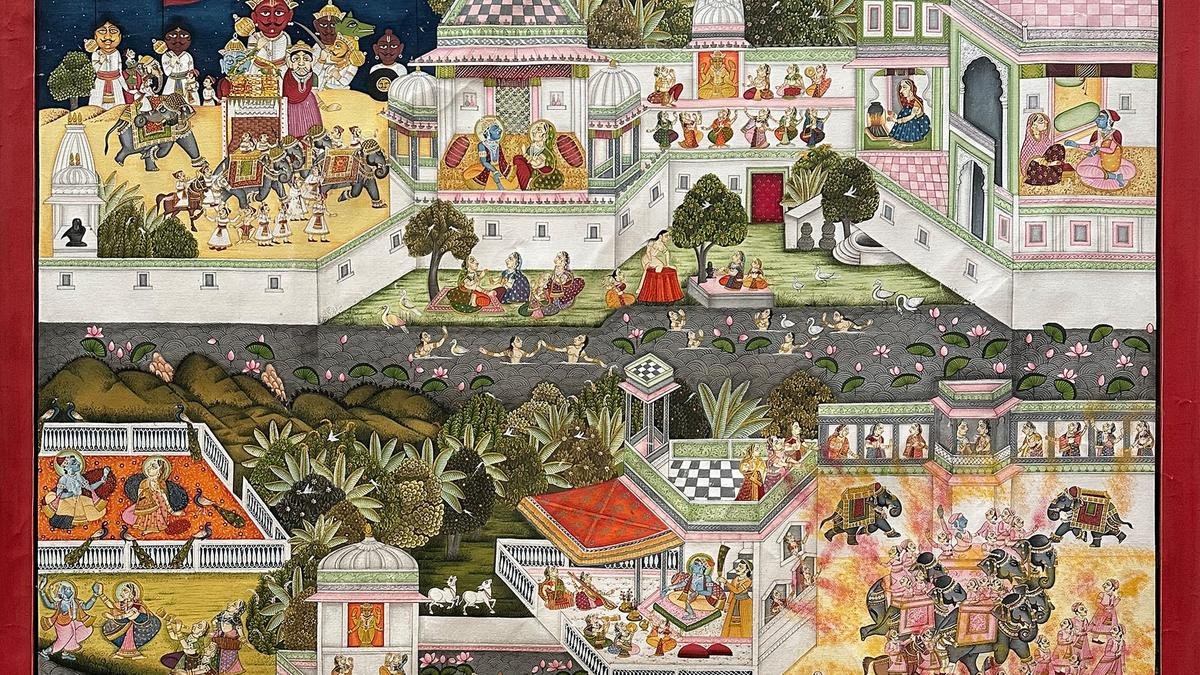

Almost 400 years ago, in the small temple town of Nathdwara in Rajasthan, an art form emerged in which painters began covering cloth backdrops with images of Shrinathji — the seven-year-old form of Krishna worshipped there, characterised by almond-shaped eyes, a stocky build, and a sharp nose. These hangings, called pichwais (from pichh, meaning ‘behind’, and wai, meaning ‘hanging’), were draped behind the idol, changing with the seasons and festivals.
At Forum Art Gallery, artist Yugdeepak Soni brings that same tradition through his Sri Pichwai exhibit. The paintings are a part of the pichwai legacy rooted in the Pushtimarg tradition of the 16th Century. Yugdeepak, who hails from Udaipur, has been associated with pichwai artworks for more than two decades now. He is the student of his nanaji (grandfather), Badri Lal Chitrakar from Bhilwara, Rajasthan.

“I was a good observer in my school days. My teachers and my uncle used to say that a good observer is more important than a good painter. Pichwai was in my blood, so nobody had to push me into it. I felt like I needed to hold the brush too. I was privileged that my gurus were within my own house. With so many artists under one roof, it became easy for me to adopt their approach to art,” he says.
Talking about the tradition, Yugdeepak says, “In the Nathdwara temple, lord Krishna is revered as a seven-year-old child who was not permitted to step outside. To ensure the young deity could still experience and celebrate every auspicious occasion, artisans painted these backdrops to bring the daily and seasonal festivalsinside the temple.”

Pichwai artwork titled Baramasa
| Photo Credit:
SPECIAL ARRANGEMENT
Traditionally painted on cotton cloth and now on handmade paper, most of these paintings chronicle the celebratory life of Shrinathji, focussing on key seasonal festivals like Janmashtami (his birth), Sharad Purnima (the autumn full moon raas leela dance), and Govardhan puja, narrating the mythological scene where Krishna lifted Mount Govardhan on his little finger to shield the villagers of Braj from the storms sent by lord Indra.

Like traditional pichwai paintings, Yugdeepak’s works feature elaborate scenes, with the cow emerging as a recurring motif — a companion of Shrinathji. The lotus, peacock, and monsoon clouds also appear as symbols, allowing the artist to place himself in the presence of the traditional divine image.

Pichwai artwork titled Vishwaroopam
| Photo Credit:
SPECIAL ARRANGEMENT
The artist explainshow colour plays an important role in these paintings and how, traditionally, most of these colours come from . “Traditional artists use natural pigments and semi-precious stones. These pigments come in powder, semi-powder, or stone forms. For instance, a specific red is derived from a stone called hinglu, which must be crushed, ground and put through a purification process where only two grams of red colour are derived from 10 grams of stone,” he says.
In old times, the artist says that the red used to be a “very specific red”, but now, with modernisation and commercialisation, the definition of this colour has changed. “Nowadays you can also do crimson red or a vermilion red,” he adds.
When he is asked about the future of pichwai paintings, Yugdeepak does not seem very hopeful. “I don’t think the coming generation will have that same level of patience, because everything they want is at their fingertips. They will encourage pichwai; they will buy the end product, but they won’t encourage the process of traditional art. That’s the difference,” he says.
Sri Pichwai is on till October 30, at Forum Art Gallery, Padmanabha Nagar, Adyar, from Monday to Saturday, 10.30am to 6.30pm.
Published – September 24, 2026 04:50 pm IST