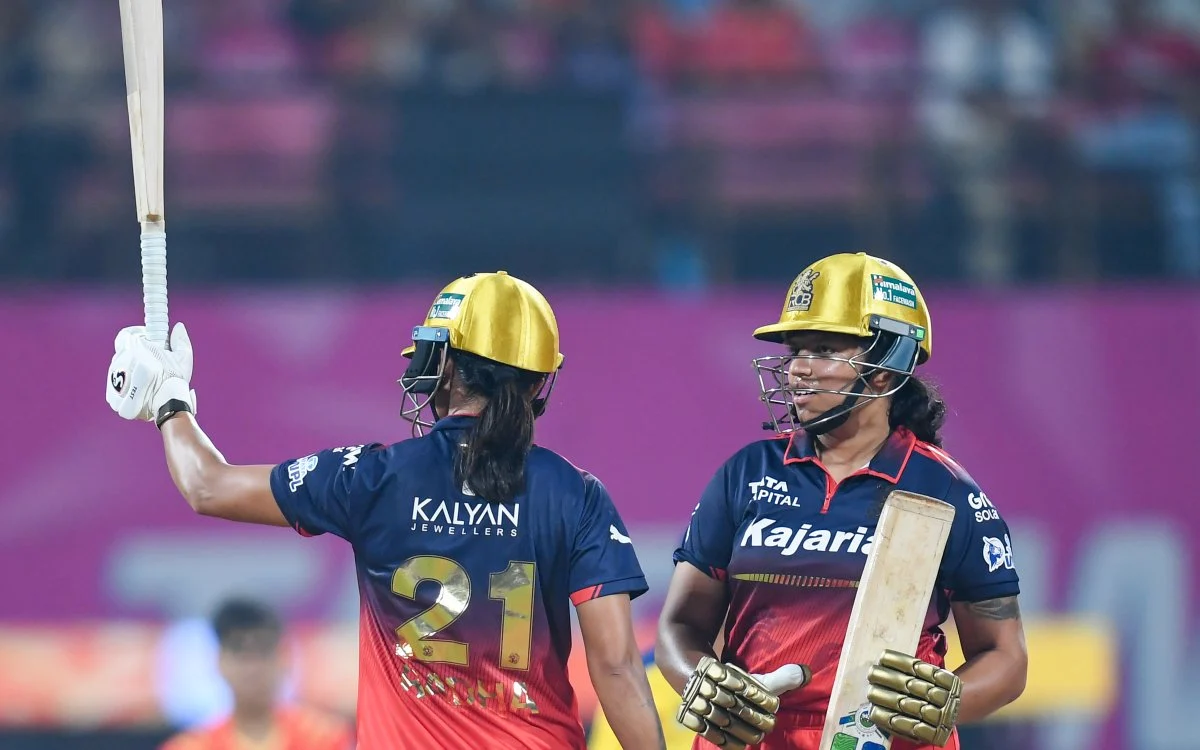

RCB’s top four were back in the dugout even before the Powerplay was over. Later in the innings, an attempt was made to contain Richa Ghosh’s powerful hitting, but it was short-lived. Eventually, with three balls of field limits still in place, she had to walk in at No. 6. At last, RCB’s bold bat experiment was put to the test. Richa will have company from Radha Yadav at No. 5.
In the first game, RCB was spared the humiliation of losing a 155-run chase thanks to a Nadine de Klerk special. In the second, their middle order experiment didn’t need a trial since Grace Harris attacked up front. There was no way out on Friday. It was time to reveal what only the RCB team management knew—that Radha Yadav was a worthy No. 5 on a stage as prestigious as the Women’s Premier League—when the squad was down to 43/4.
Radha had large boots to cover for the injured Pooja Vastrakar at No. 5 because he had batted at No. 8 or lower in 39 of the 50 international and WPL games prior to the event. Radha had long appreciated her batting prowess, having spent almost ten years as a middle order player for Baroda. It was time for her to put it to the test in an open-match situation this season and prove the club management’s confidence in her backup ability.
Renuka Singh boldly drove the first full-length delivery she received to mid-off. The following one was smacked around mid-on. One punched to covers after that. Despite the fact that none of the three shots resulted in a run, she had to regain equilibrium and control her aggressive tendencies because wickets were falling swiftly on a regular basis. She flicked some off the pads, pulled, and felt at ease using the drives.
She only managed three runs after holding back for ten balls. She then sent a loopy shot straight down the track for a six after carving one through point against Georgia Wareham.
Radha began to move on, while Richa tried to wait it out. She wasn’t experimenting with risk, even when boundaries started to flow. In order to release her long arms and play through the offside, pacers and spinners continued to offer width.
Michael Klinger, the head coach of the Gujarat Giants, acknowledged that the method was flawed regardless of if it was a well-thought-out strategy. Even Renuka Singh used a similar strategy, long after the movement with the older ball had become insignificant.
Furthermore, Gardner only deployed five bowlers to break the partnership, none of whom caused any trouble, despite having a few extra alternatives in the left-arm spin combo of Rajeshwari Gayakwad and Tanuja Kanwar. Radha didn’t need to overhit in order to continue scoring effortlessly. She was content to keep her drives and flicks on the ground and rely on finding gaps for a significant portion of her early inning.
She was able to rotate strike without chewing up dot delivery, even in short bursts when boundaries dried up. Even Richa began to accelerate from the other end as the alliance grew, and Radha started playing with the field.Klinger said, “We knew she was a good player.” “I believe you were exactly right there. We simply didn’t get our lines with the ball exactly correct outside of the power play. We simply couldn’t keep stumps in play once the ball stopped swinging, and we made a bunch of wide free fours. Therefore, we definitely need to address that.”
They tried bowling wide outside off, but it didn’t work, so they tried cramming her on the legside. Radha responded by leaving herself space and shaping the ball toward the empty areas on the offside. She even hit the ball past the ‘keeper after shuffling across.
Radha skillfully changed gears as her innings went on, and on her way to becoming just the third Indian batter to score a half-century this season, she demonstrated the full range of tempo: rotating the strike and picking regular boundaries through the middle overs, providing the surge once she crossed 35, and cautiously protecting the wicket when necessary. She made good use of the crease’s width to undercut the bowlers’ strategies by countering the field arrangement.
Here’s a breakdown of her innings progression:
Balls 1-10 – 3 runs
Balls 11-20 -19 runs
Balls 21-30 – 13 runs
Balls 31-40 – 25 runs
Balls 41-47 – 6 runs
With the effortless comfort of a No. 5 hitter, she drove, cut, pulled, and even went down the ground. Ash Gardner and Bharti Fulmali, two of the park’s top fielders, took her down twice, so she did have her fair share of luck. However, that didn’t really detract from the excellent display of her batting.
“I middled the first ball I faced,” Radha said. “I then realized that I had previously done this for both India A and the state. I was therefore confident. However, it makes me very happy to perform it here on this stage for the first time. Richa told me to “be calm, see what the opposition were doing, dot balls will come, don’t worry” as we were batting. Since we have the shots, we can profit later.
“I had a very important chat with Richa. We had lost four wickets, so it was not an easy scenario to bat in. I’ll give Richa full credit for the way she addressed me. I am aware that I possess the strokes, the game, the temperament, and everything else, but Richa’s ability to instill confidence was crucial.”
Nadine de Klerk’s brief blitz shortly followed Radha and Richa’s game-changing partnership of 105 runs in just 66 balls, which set the stage for RCB’s 32-run victory.
“She’s always played that role for the state team, and she’s always done well, even when India A toured Australia,” said captain Smriti Mandhana, explaining why Radha was placed so high in the RCB batting order. We always view her as a finisher because we know that she consistently bats at that number.Radha was the most straightforward replacement when we lost out on Pooja for the first four-five games when we considered her pre-auction because she had done it for the state squad. You should support someone who has batted at that order in state cricket since the WPL is an Indian competition.
Given how Radha batted on Friday, the trial may no longer feel like a true “experiment,” but the side’s uneven balance is still startling. It’s still unclear why RCB chose to keep using Linsey Smith’s left-arm spin to bowl the powerplay at the expense of some top-order muscle (when only six of eight bowling options are used per game).
Smith hasn’t yet been able to make much of an impression. However, similar to Radha’s batting, it’s possible that the RCB team management has faith in the English spinner. For the time being, three wins in three games and a spot at the top of the table are sufficient to legitimize their preparation and execution, regardless of whether it works out or not.
After all, Radha Yadav was prepared to declare herself the capable No. 5 for RCB when the limelight, opportunity, and pressure came together.